
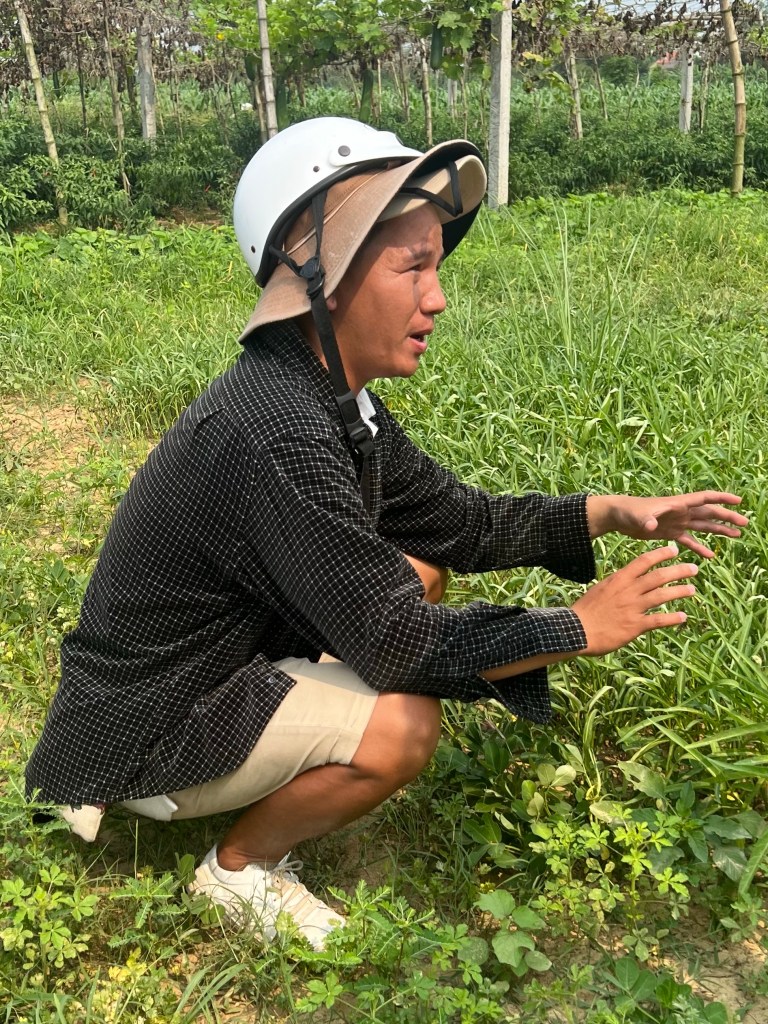
We have had such a great day today seeing the more rural side of Vietnam…. on bicycles. Starting early, Ha introduced us to our guide for the morning, ‘Man’ who had come to our hotel to pick us up. We drove to his ‘HQ’, where he assigned us all a bike. Unlike the ones in Costa Rica, these had brakes, but no gears for our five hour bike ride! However, we were assured it is all very flat which indeed it was. It is a little cooler here, and Ha and Man were in their winter woolies – Man in a thick cord shirt over his t-shirt and Ha in several layers. Meanwhile we were all sweating in our sleeveless linen shirts and cotton shorts! Like India, covering up seems rather more about not getting darker. There is also a fetching fashion for wearing as many hats as possible under your bicycle helmet!
We headed off, a little wobbly, into the busy streets of Hoi An doing our best to stay on the right side of the the road and before long we were in the much more peaceful back streets of Hoi An, passing people’s pretty but humble homes fronted by the most amazing selection of different tropical flowers which seem to grow so happily here.
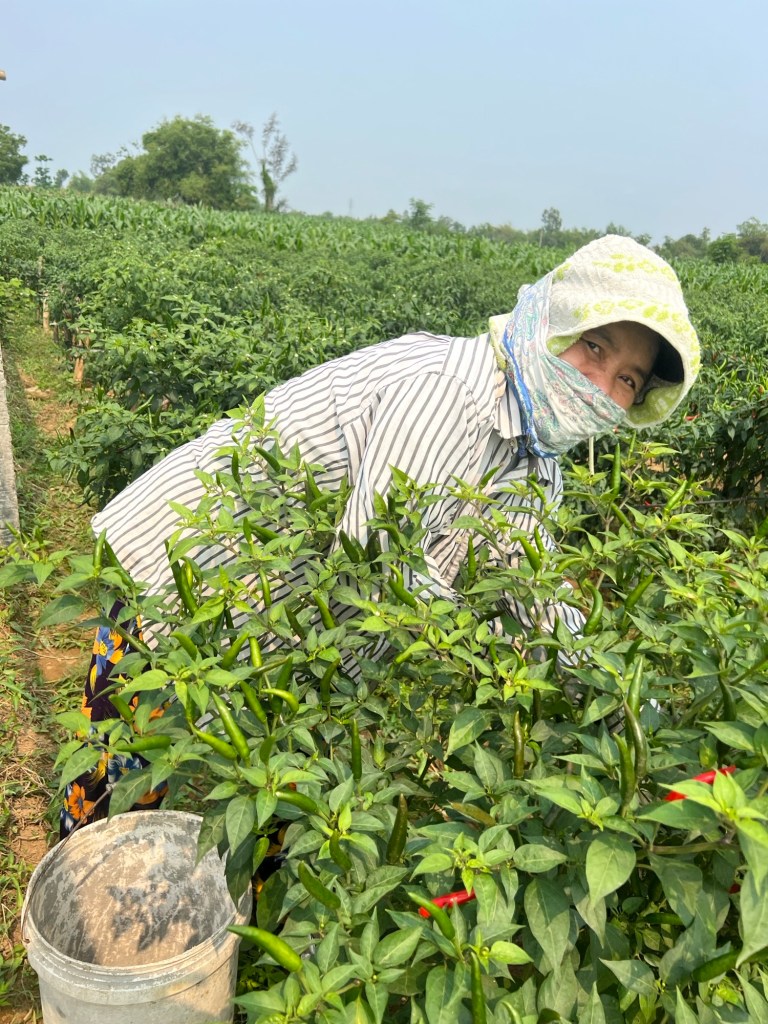
We then crossed a wonderful steel bridge, over the Thu Bon river, to the neighbouring island of Cam Kim. The connecting bridge, only for bikes and motorbikes, was built in 2016, before which the only way to the mainland was by boat. A second bridge for cars was built in 2021.As you reach the other side, you are transported into a calm, rural scene of rice paddies and other crops: corn, melon, chillis, sweet potatoes, gourds and peanuts.
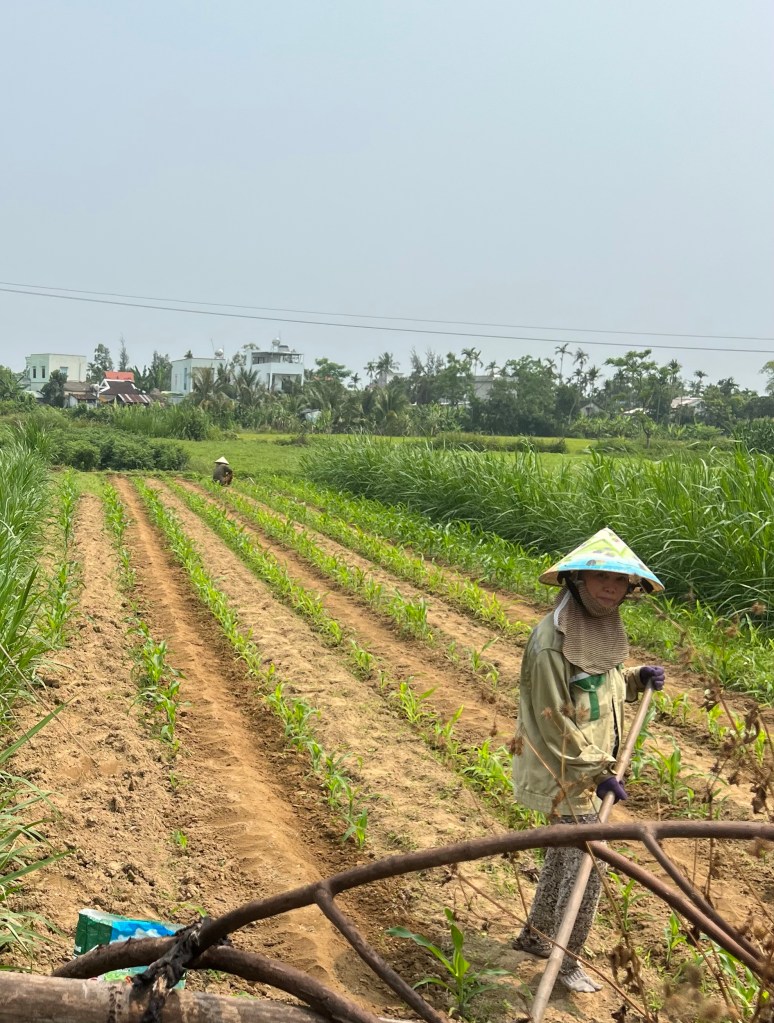
Man explained that the land, divided up into small plots, all belonged to different families who would just be growing enough to keep themselves going, possibly selling a little. The families work very much as a cooperative, everyone helping one another and often pooling and sharing the harvest. The rice was behind that in the south, and still two or three weeks from harvest, so looking its best.
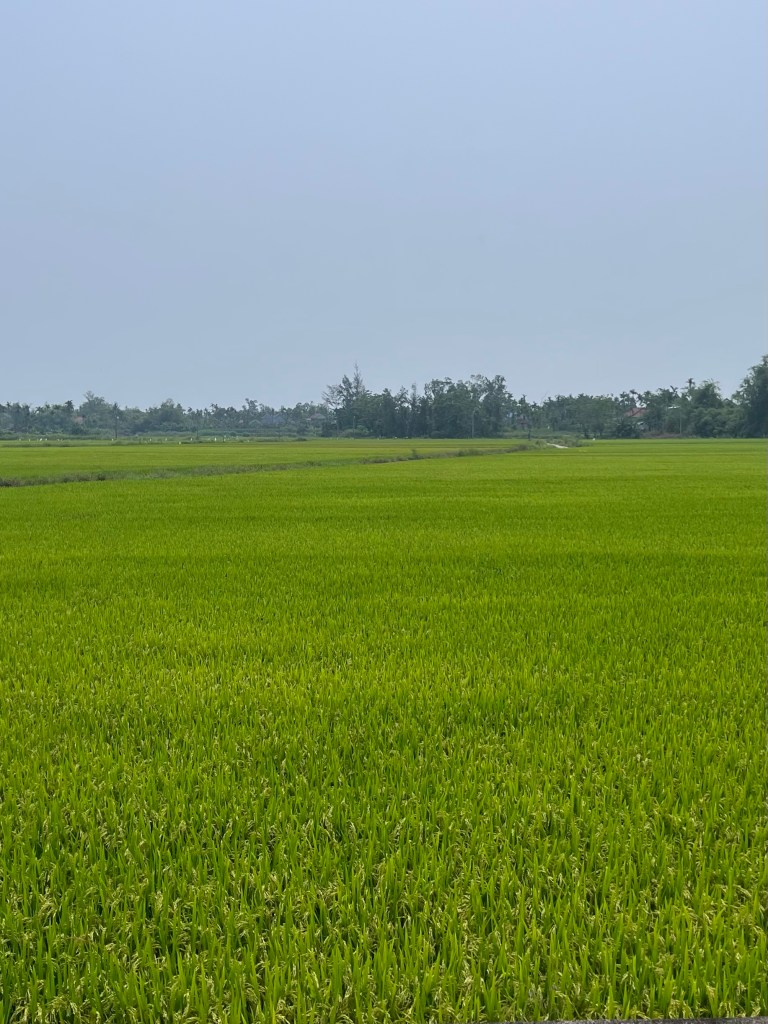
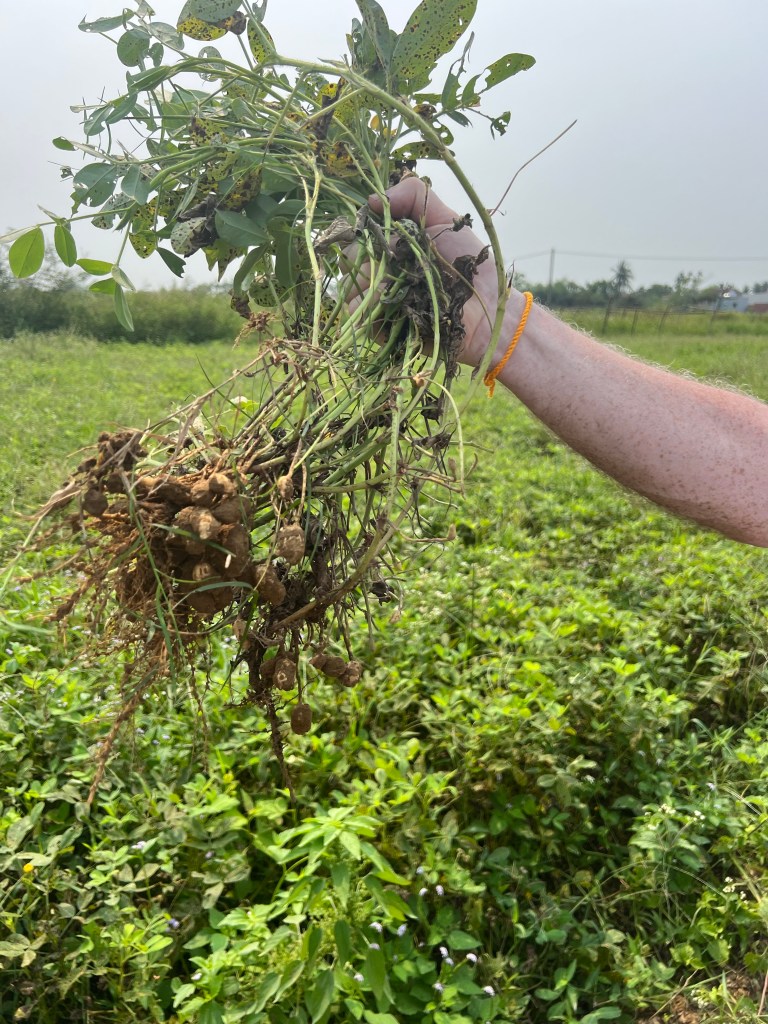
The rice farming is all done by hand here and at this time of year, the farmers are out at first light to collect all the snails which might be munching their crop, which needless to say they also eat! They had a simple but effective irrigation system of concrete channels from the river with covered holes into the fields. The hundreds of doors, covering the holes, have to be removed one by one, by hand twice a day. A field of peanuts was ready to harvest, indicated by their yellow flower. Again harvested by hand, literally pulling up the route where the peanuts lies – confession …. I thought they grew on trees!
Once again there were large graves dotted around these fields, but even with this precaution to prevent the sale of the land, few of the new generation are wishing to go into farming, as it is such hard work with so little income. To add to the hardship of farming here, it regularly floods, so most houses are on two storeys. Those in single storey houses will go and live with a neighbour until floods die down.
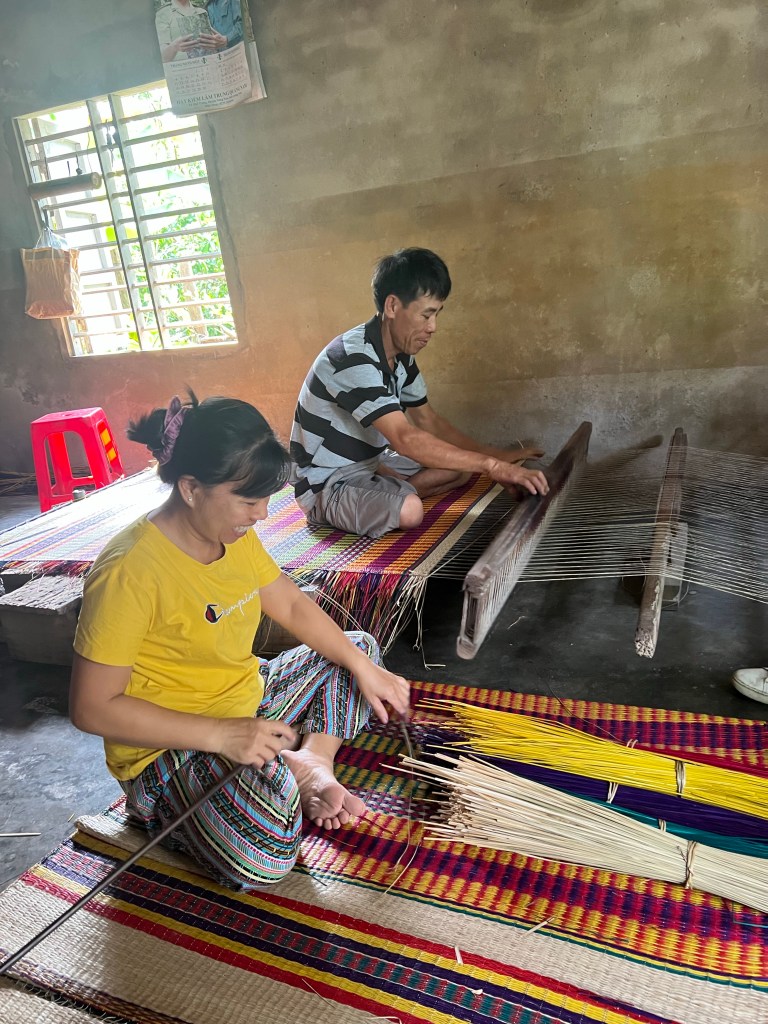
Our first visit was to a weaver making colourful sleeping mats from local reeds. We met a wonderful couple who had been sitting on the floor together weaving mats for 45 years – it was much harder than it looked and back breaking work which they were doing at incredible speed. They could create a sleeping mat in just four hours, but only sell it for $4 – that is 50 cents an hour each. This couple grew their own reeds and dyed them in huge vats, leaving them out on the road in the sunshine to dry. They had recently built a second storey on their house, but still had their little coconut basket boat tucked above the beams for emergencies. Man explained that most rural people would still sleep on a mat, and indeed he did himself. They are very personal and prized items, which you can fold or roll and carry anywhere, lasting twenty or thirty years.
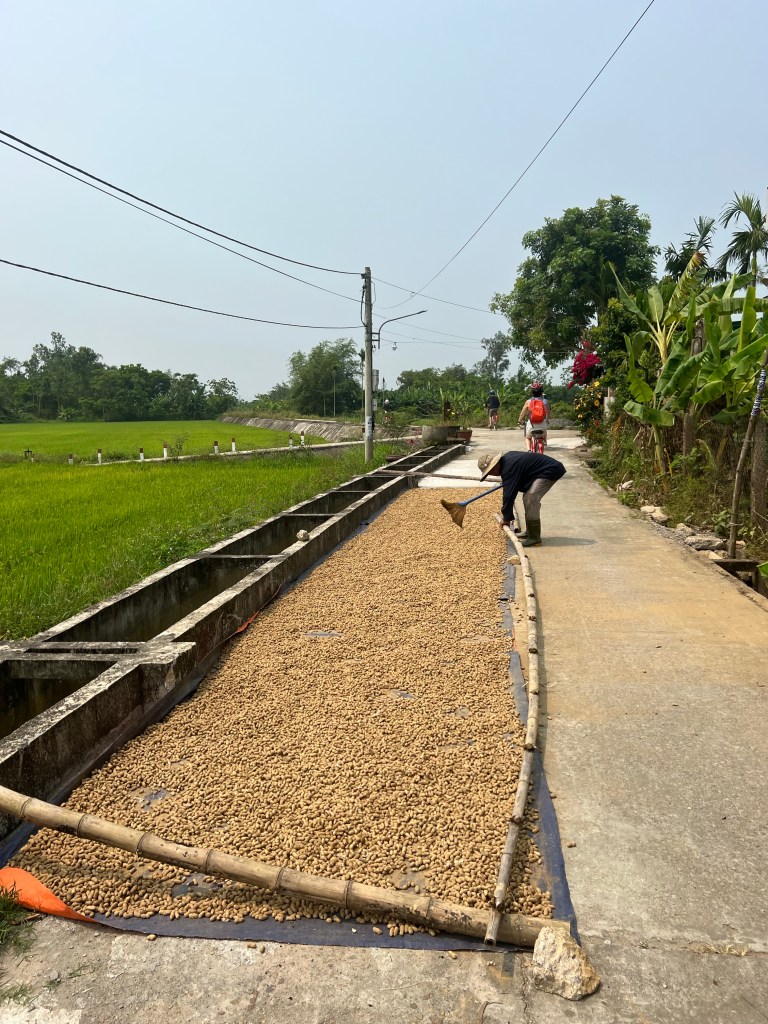
As we cycled on, we had to avoid many houses with reeds drying in front of them on the side of the road, so competition must be high. There were also masses of peanuts drying in the sun, on the side of the road, which is not wide anyway!
We cycled on passing a young boy with a poor unfortunate sparrow attached to a long arial type stick, used as a decoy to attract other birds which he then nets and either sells to eat or for tourists to release… truly horrid. Man did however point out another bird industry which was less abusive and in fact, rather ingenious. The harvesting of swift nests for highly valued birds-nest soup and other products particularly loved by the Chinese. Above a tall building we saw many swifts buzzing around. Again there was an antenna, giving out ‘swift noises’, to attract other swifts to come and nest in the building. Swifts make their nest using saliva which is the highly valued component. In theory the nests are not allowed to be removed until the young have fledged. They are then processed under high temperatures to remove impurities and bottled up. A kilogram of top quality bird’s nests (about 120) would fetch about $4,000. Apparently the industry has been going for over 500 years and in China dates back to the Tang Dynasty, 1,500 year ago. The Chinese are still the main market, believing that birds-nest has all sorts of medicinal benefits and will maintain beauty and wellness.
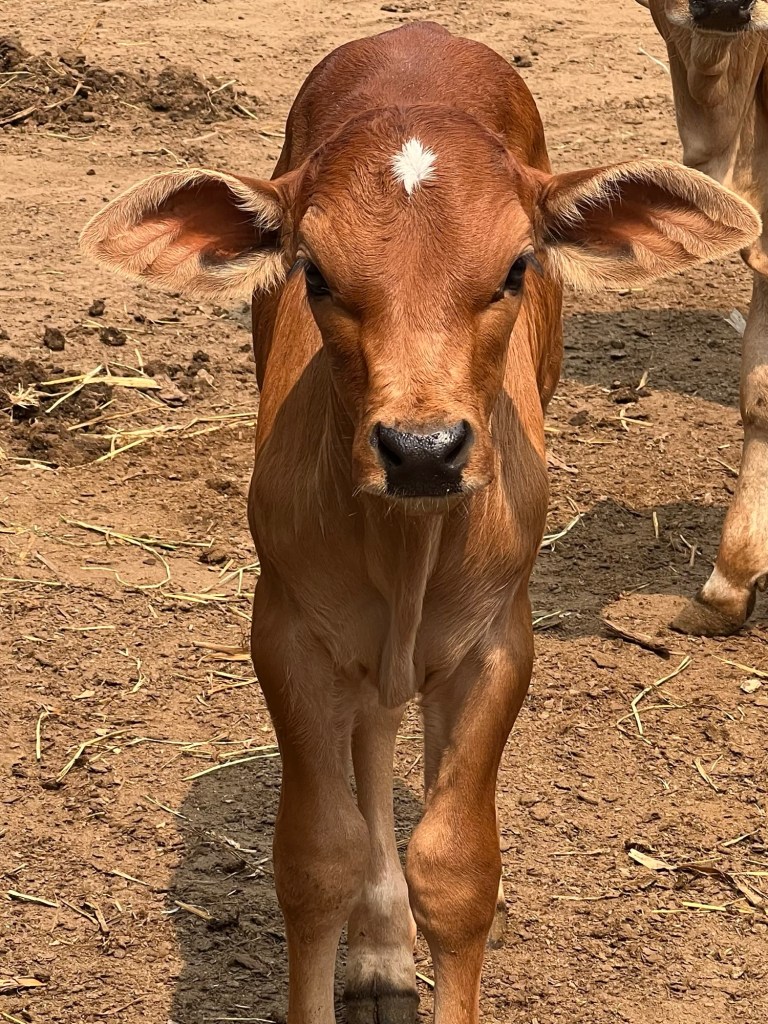
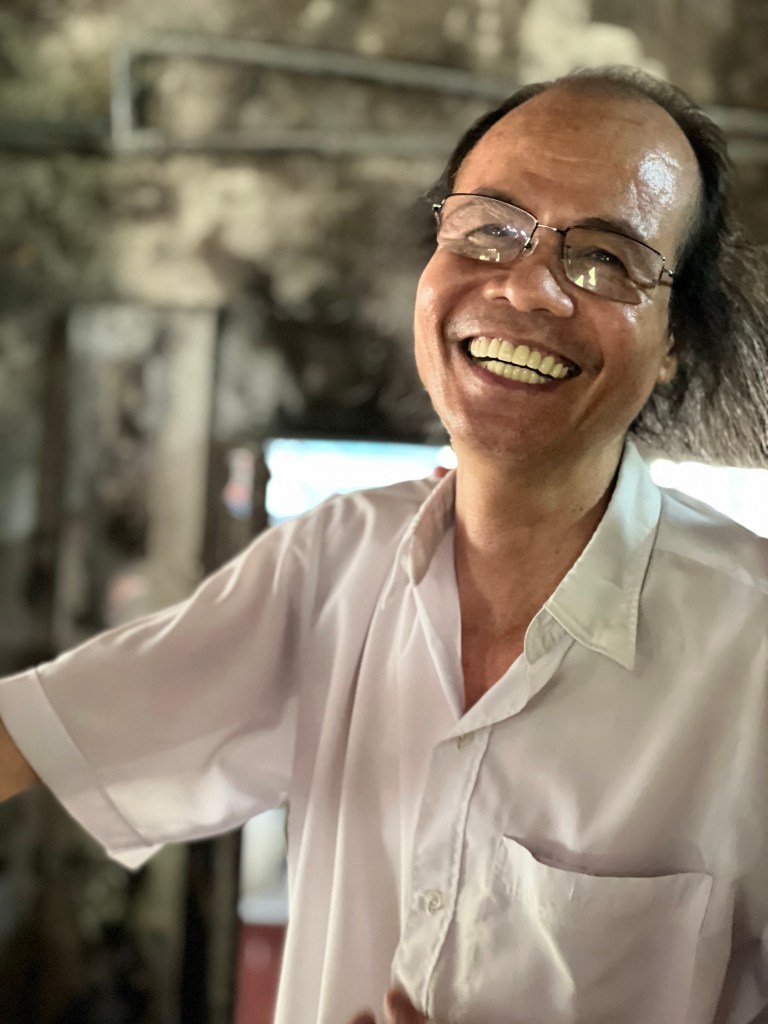
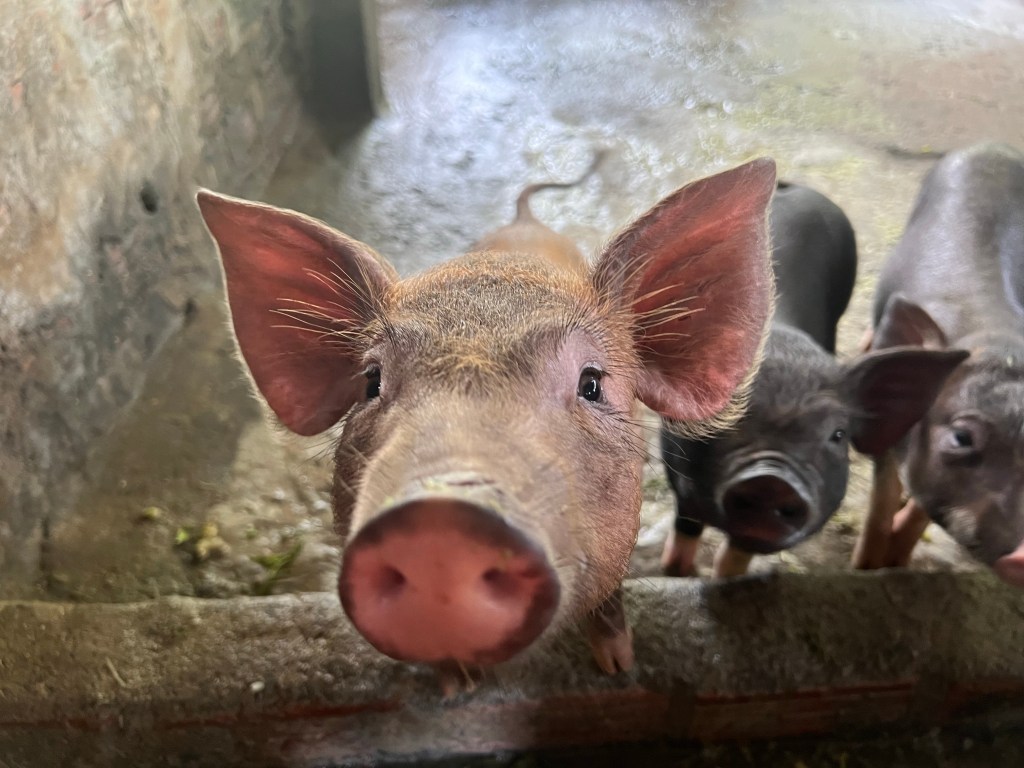
Next stop was the rice wine distillery. This used a similar process to the distillery we saw in Laos, but took place in our host’s house who boasted a sustainable process even producing his own methane from the most adorable group of inquisitive pigs, at the back of his house. The rice is again cooked and then laid out on a tray of palm leaves to cool. He sprinkled this with yeast and mixed it by hand. It is then put into a large plastic bucket where it ferments for three days. Water is then added and it is then boiled, using the piggy methane and the condensation cooled over a tank of cold water and collected. Depending on the process, 5kg of fermented rice can produce up to a litre of 50-60% alcohol. Again snakes can be added or our friend was also keen on centipedes.
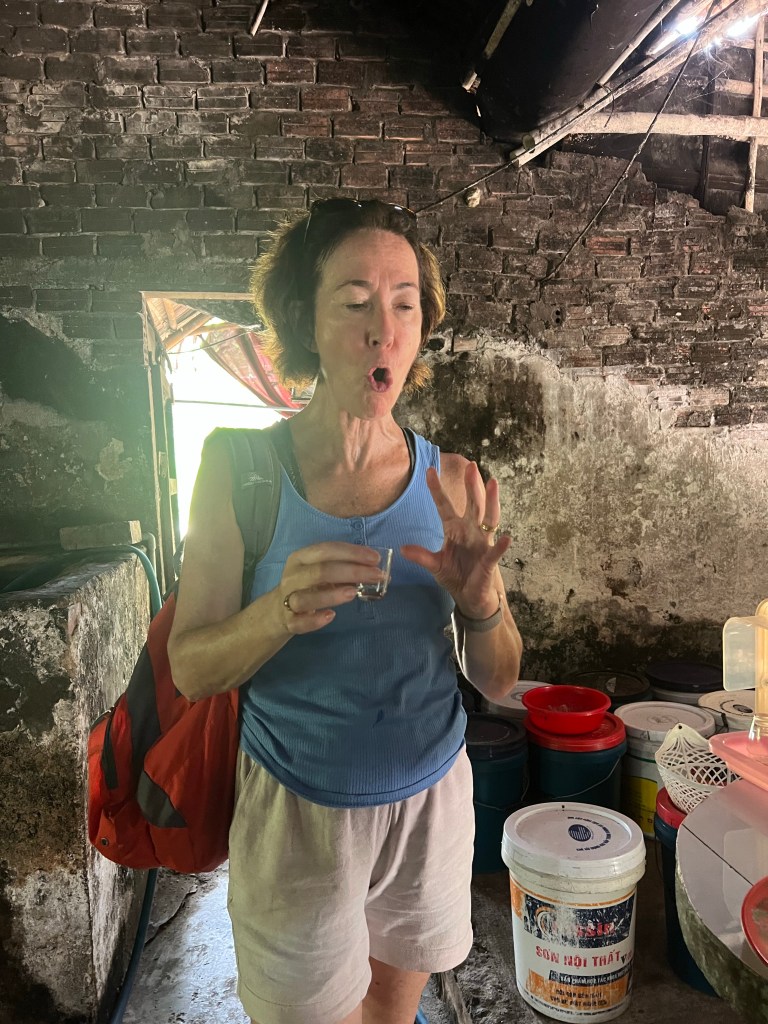
We of course tried them all …. it was pretty fiery stuff! There was indeed almost zero waste, with the husks of the rice being used as fuel, lit by the methane from the pigs, and the residue from the boiled fermented rice, given to the pigs – no wonder they were looking so content.
We peddled on, somewhat wobbly after our rice wine, to our last lesson of the day …. noodle-making. Another group was in front of us, so we started off by having a rather tasty pork noodle soup with the most delicious sweet chilli jam (would have been TEC’s best!), and then we tried our hand at making them. Once again noodle-making is a true labour of love, and would be made fresh every day. Our hostess, An, is up at 4am to make her 70kg of noodles, before all the tourists arrive.
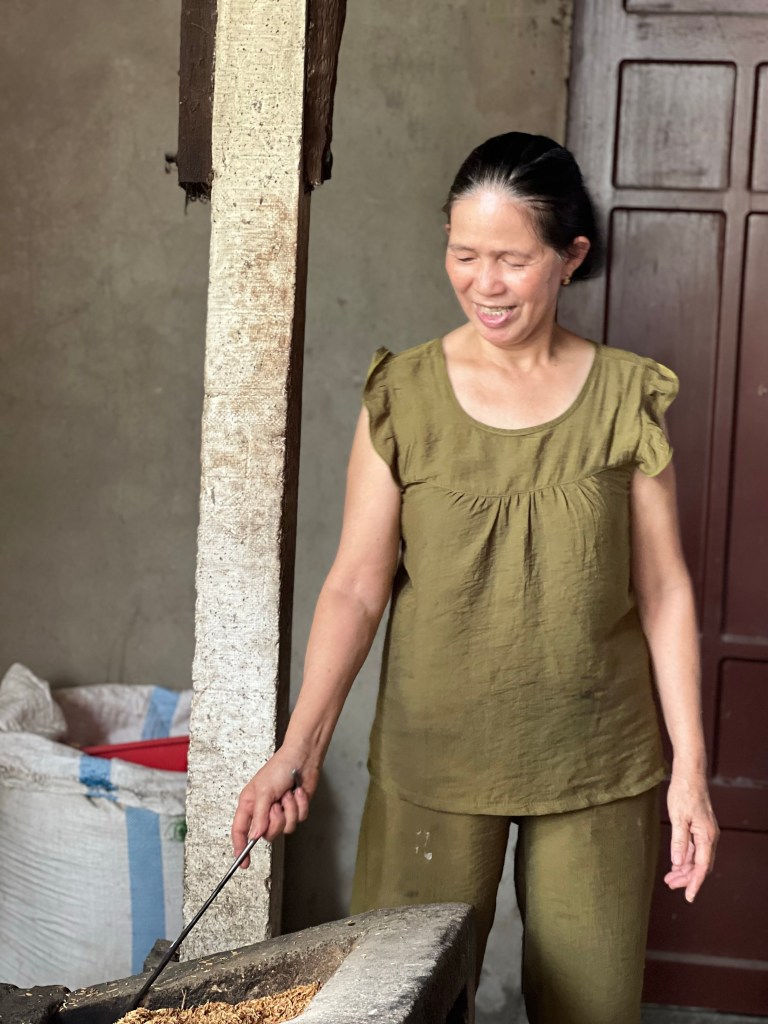
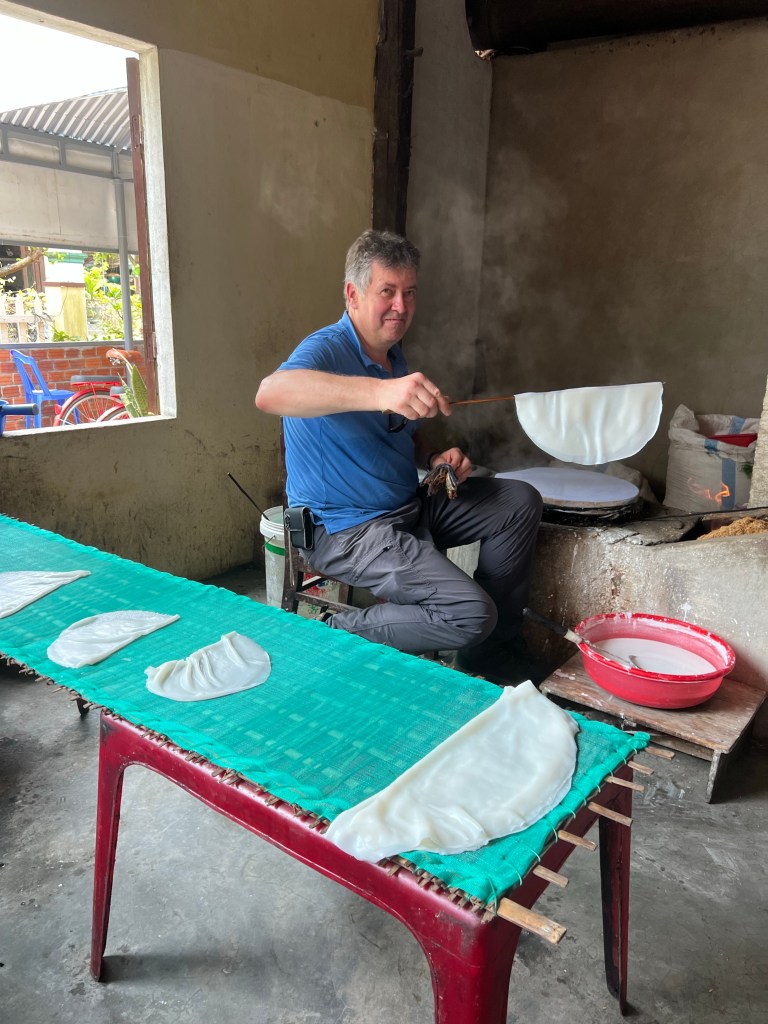
The process starts with soaking the rice in water for about five hours and then grinding this by hand to create a rice milk. This is then ladled on to a flat hot plate, covered in cotton glaze, making a thin layer, which cooks for 30 seconds. It is then carefully removed with a bamboo stick and laid out to cool and finally passed, one by one, through a sort of mangle which slices them into strips. Not hard, but a lot of time to produce a humble noodle, which 95m Vietnamese seem to eat at almost every meal.
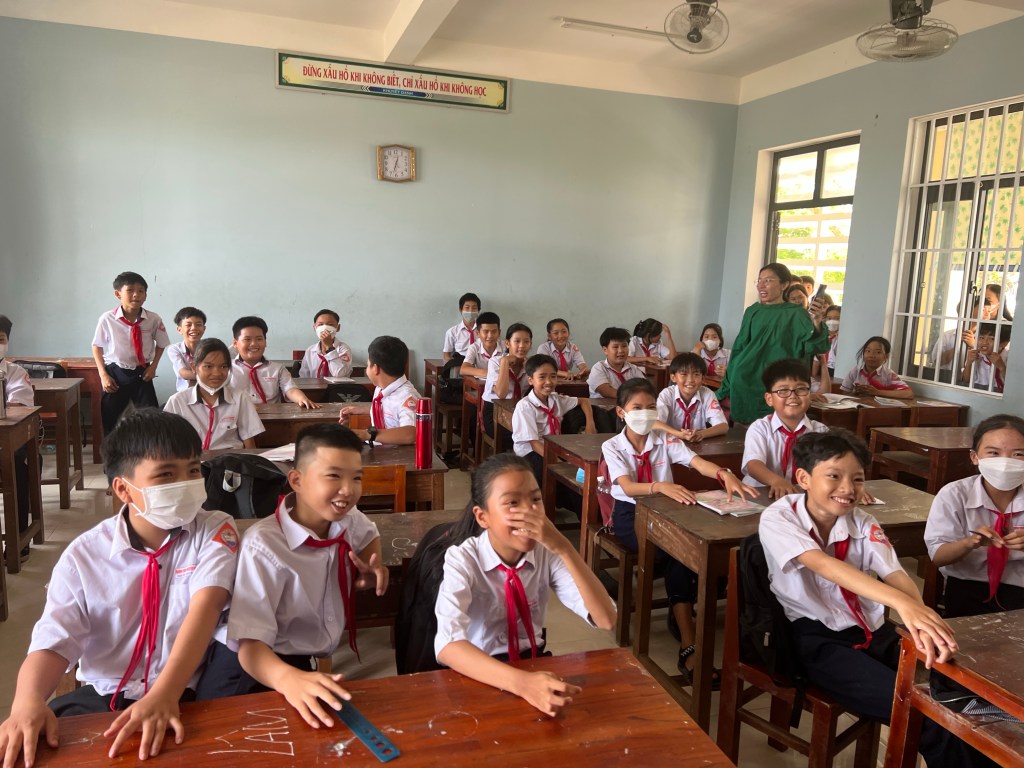
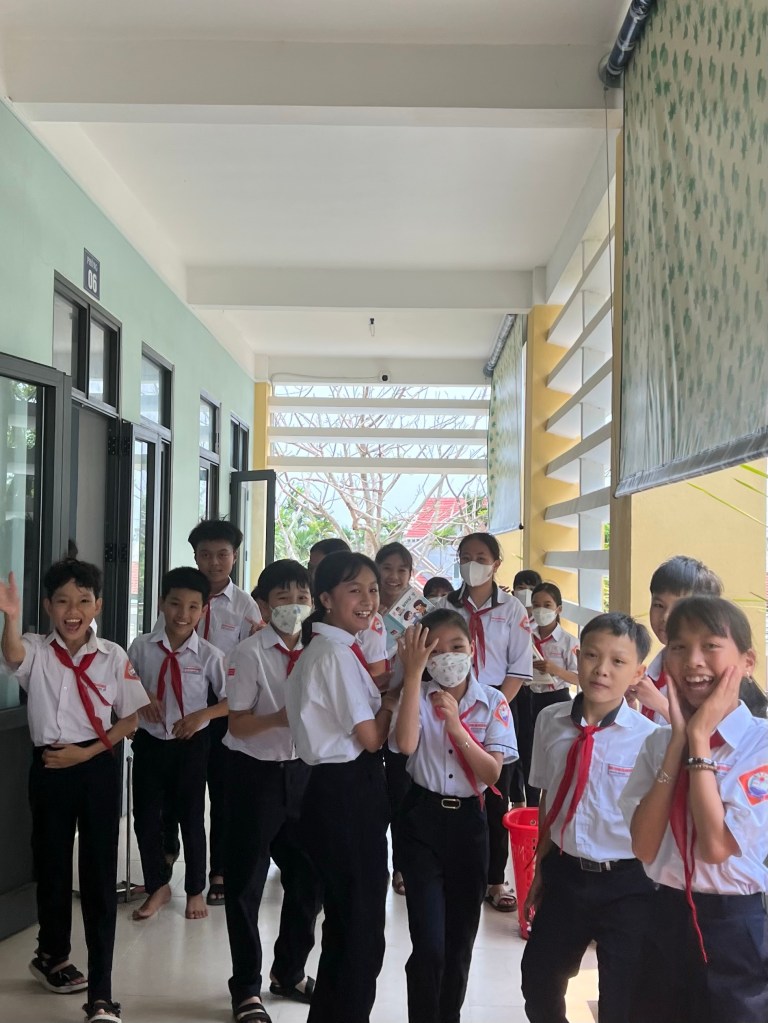
We peddled off, passing a school, where the afternoon shift of the day had not started. I had mentioned to Man that we would love to see a school, so in we went, creating complete havoc. Goodness knows what the village must have thought was going on, as the roof was almost raised with squeals of excitement from all the children. Once again, we gave a quick English lesson, causing much hilarity!
Short break back in the hotel and then back into the town for those who had ordered suits to have their fittings. Ha and I went off shopping together, off the beaten track, where there were some lovely shops selling different things from everyone else, and perhaps more genuine – who knows? A friend of Ha’s had suggested a particular shop which we went to and suddenly I too succumbed to getting a pair of emerald silk palazzo pants made…. by tomorrow lunchtime!
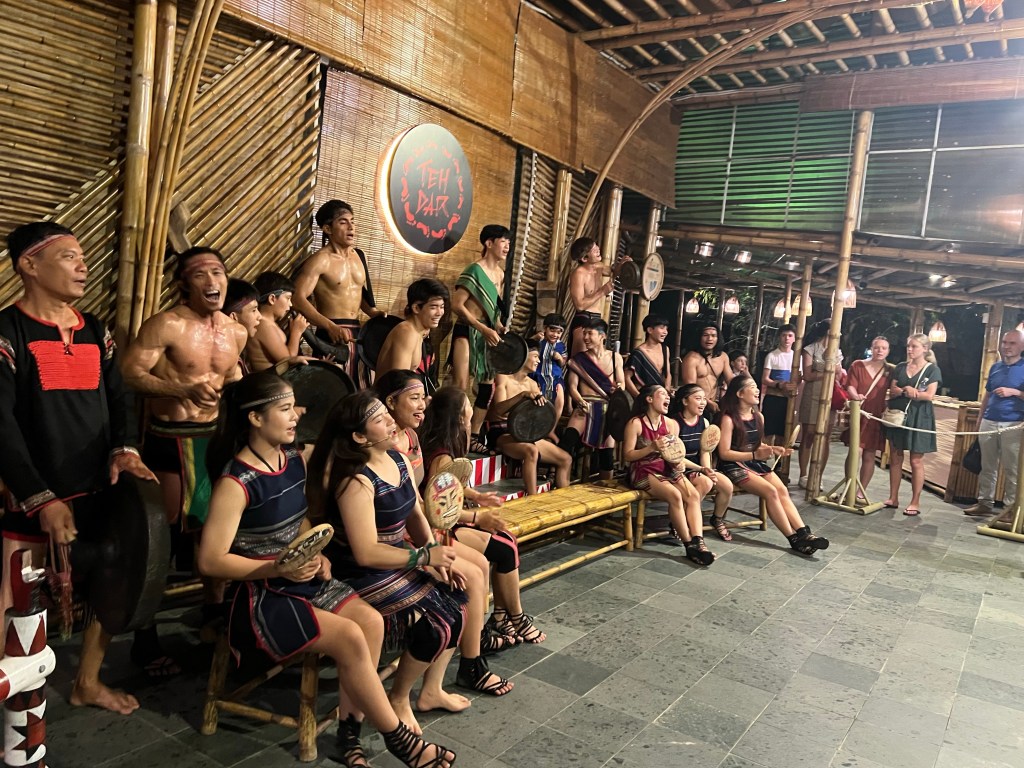
There was a show called Teh Dar that Ha had recommended and I thought looked rather good. I encouraged a few of the others to come along and sat very nervously through a rather slow introduction, but it was in fact, completely brilliant. Described as a ‘bamboo circus’ it was a story telling blend of acrobatics and contemporary dance – a mini Cirque de Soleil, performed by a group of tribal dancers from the highlands to rather hypnotising music played on traditional tribal instruments. Everything was bamboo, even the dome shaped ‘Lune’ auditorium. The strength, fitness and talent was incredible…. I told the manager he should try and bring it to the Edinburgh festival… I think he thought I was mad!
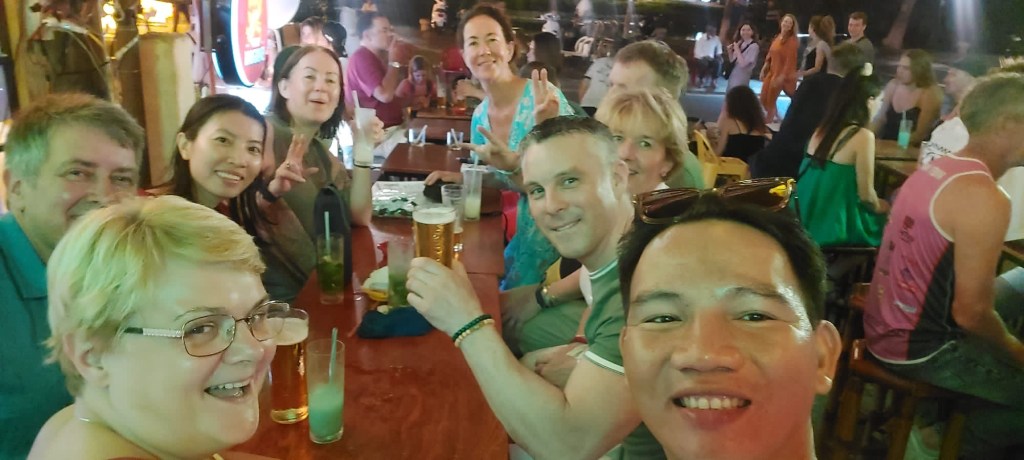
Later that evening we went to the Mr Bean Bar where Man was working, and had just one or two cocktails. My goodness the Irish like a nice drink…
 EC-Rider Travels
Leave a comment