
This morning we visited the Royal Palace, which was near the hotel overlooking the river. It is the official residence of King Sihamoni, so only part of the palace is open to the public. Neurosis about the king getting COVID, or perhaps one of the king’s men, meant we had to wear masks, despite being outside! There were hundreds of school children entering as we did, so we waited, while our guide told us about his king.
Despite being one of fourteen children of King Norodom Sihanouk, and the son of his seventh wife, Sihamoni was chosen to succeed his much revered father when he abdicated in 2004. His mother, the Queen Consort, Norodom Monineath, had a French/Corsican father and looks surprisingly European. She met Sihanouk at 15 when he awarded her first prize in a beauty pageant. Their son, King Sihamoni was born two years later. He was educated in Czechoslovakia, where he became a great lover of the performing arts and particularly classical ballet!
In 1976 he returned to Cambodia, after receiving a forged telegram from the Khmer Rouge ‘signed’ by his father demanding his return. He and his immediate family were put under house-arrest, in the Royal Palace, for the next three years, living in fear of their life. Many of his wider family were killed by the Khmer Rouge. After the war, the king returned to Europe and started teaching ballet in Paris and formed his own dance company, Ballet Deva. He lived in Paris for almost twenty years, becoming president of the Khmer Dance Association and Cambodia’s delegate to UNESCO. He also followed in his father’s footsteps (a prolific filmmaker) and produced a number of arts films.
In 2004 King Norodom Sihanouk abdicated and Sihamoni stepped into his father’s very large shoes, many say reluctantly and became king. Unlike his father, who was a popular man of the people, Sihamoni is reserved and apparently rarely seen
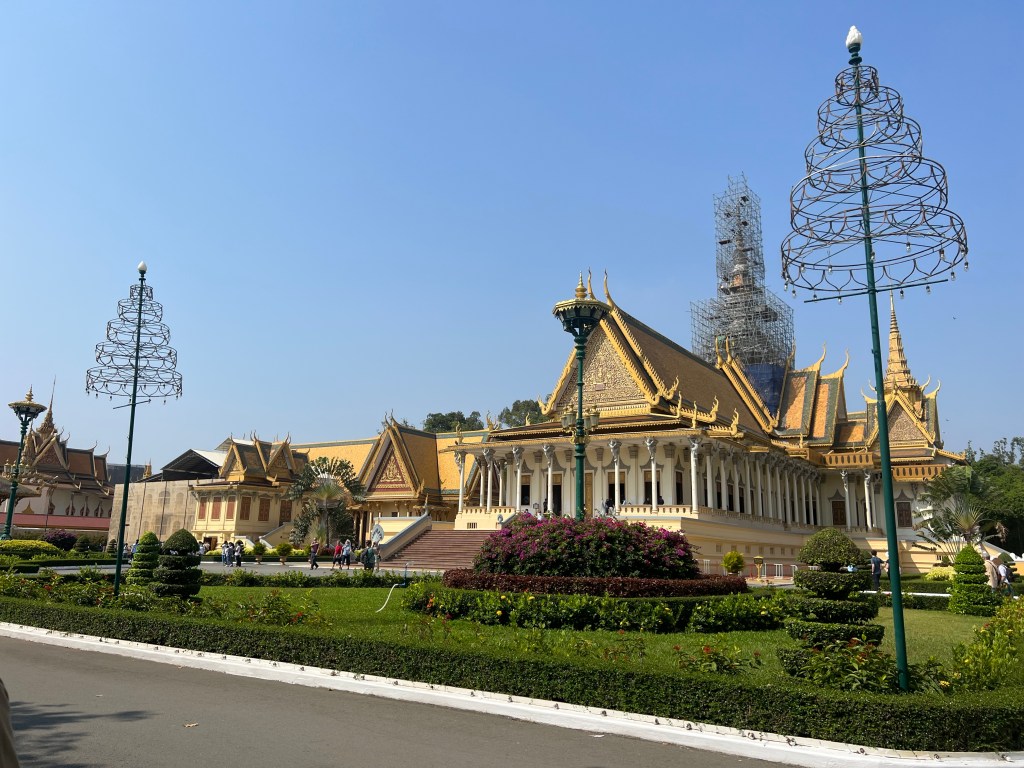
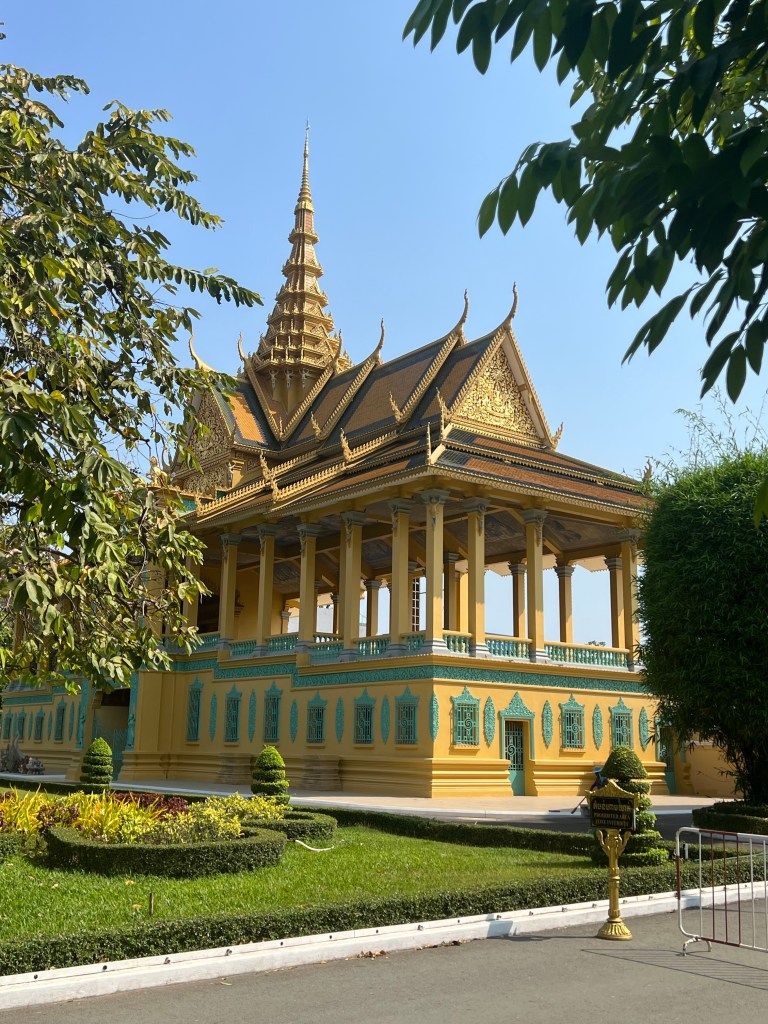
The palace was originally constructed in 1434, abandoned for a 100 years when the capital was relocated to Oudong and then reconstructed between 1863 and 1870. It is relatively understated in comparison to the Royal Palace in Bangkok, but has a striking structure with the classic orang/red Khmer roofs and ornate gilding.
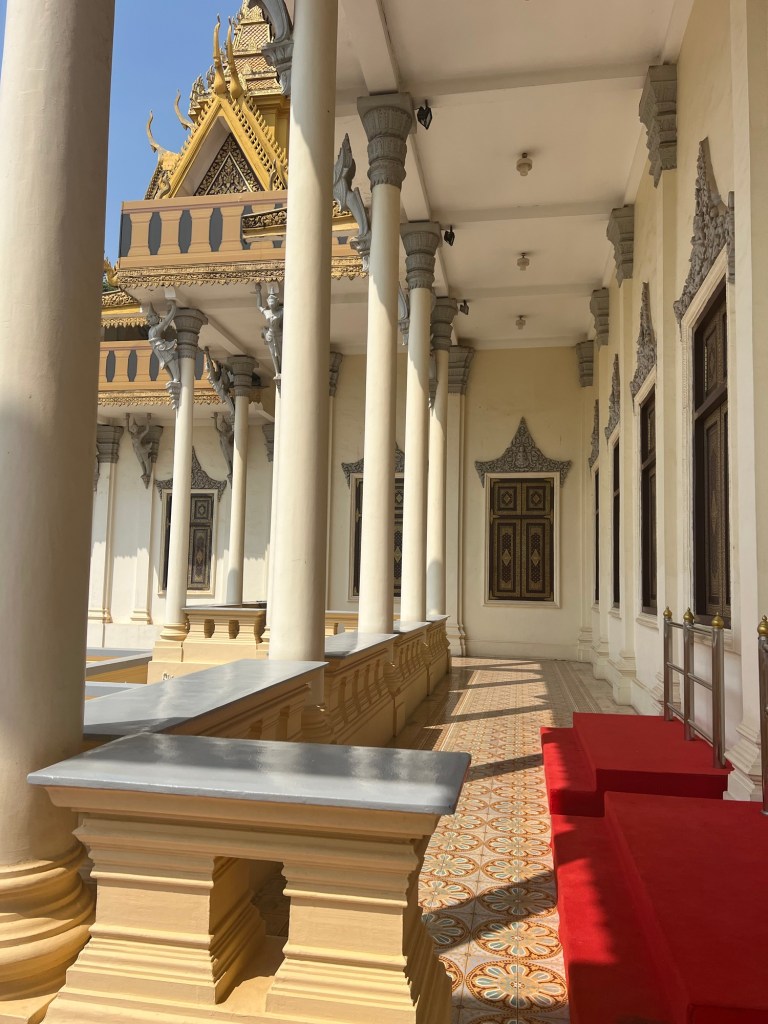
The students appeared to just be having their photo taken on the steps of the Throne Hall, so once this had happened we went up to have a look. The immaculate cross-shaped building has three spires, the central one being 59m high and crowned with the four-faced head of Brahma. The public are not allowed inside but from the door you could just see three royal thrones. The Hall is still used today as a place for religious and royal ceremonies and as a meeting place for guests of the King. It had a beautiful ceiling and attractive painted walls.
Next we went to see the Emerald Buddha, within the Silver Pagoda so named for its floor, which is covered with 5,329 solid silver tiles (5 tonnes of silver). The staircase is made of Italian marble. The Emerald Buddha, is a Baccarat-crystal sculpture sitting on a gold pedestal. Below it are many other Buddhas including a life-sized one of solid-gold (weighing 90kg) adorned with 2086 diamonds. ,
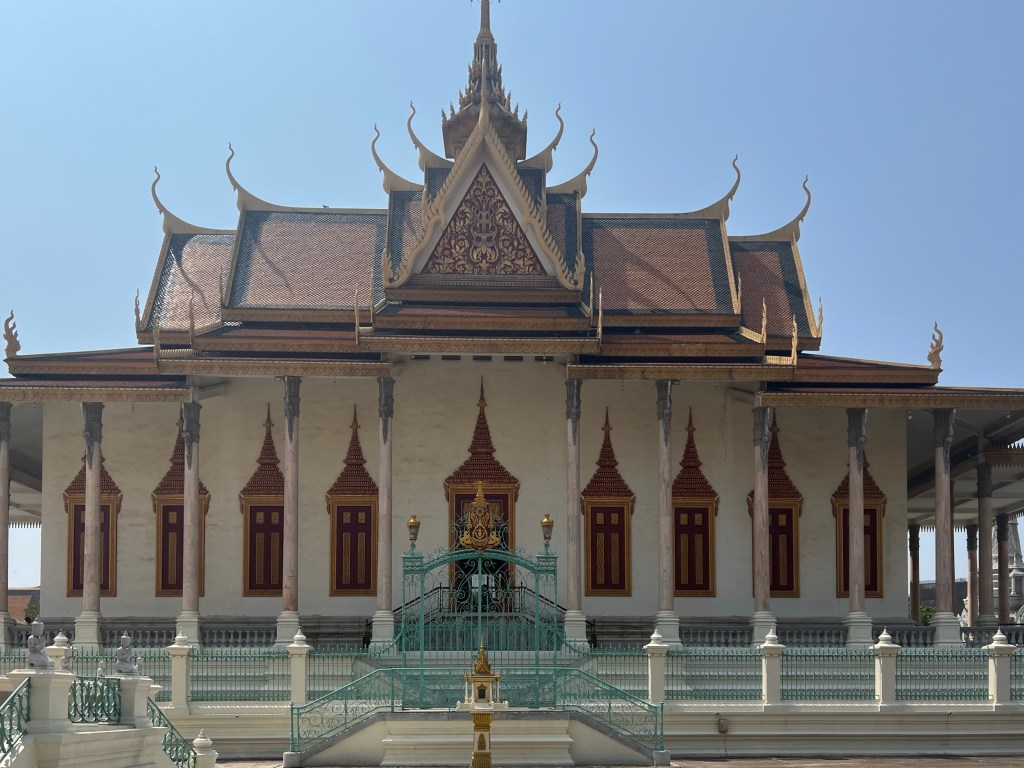
The pagoda was originally constructed of wood in 1892 for the royal family and rebuilt in 1962. It was preserved by the Khmer Rouge to show their concern for the conservation of Cambodia’s cultural riches, although more than half of the contents have been lost, stolen or destroyed.
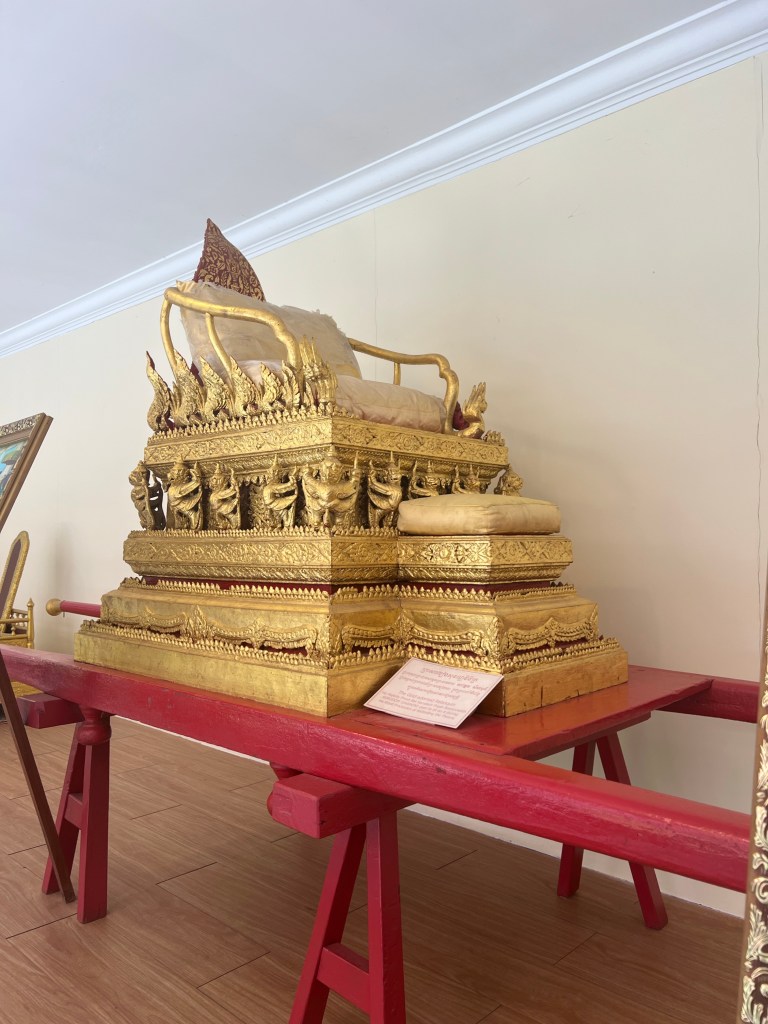
We also saw a collection of palanquin used to carry the king and members of the royal family. Not very big and looked pretty rickety. We also saw where the last king used to keep his ‘white’ elephant.
We then went to the Tuol Sleng Genocide Museum. This was a truly harrowing few hours visiting what was, Security Prison 21 (S-21) – the largest centre of detention and torture in Cambodia. It was a former high school and was taken over by Pol Pot’s security forces in 1975. Between 75-79 almost 20,000 people, held at S-21, were murdered at the Killing Fields of Choeung Ek. It was one of 96 such torture and execution centers established by the Khmer Rouge.
Pol Pot (real name Saloth Sar) was born in 1925, the son of a farmer. At six, he was sent to Phnom Penh to live with his brother and attend a French school. In 1949 he won a scholarship to study radio electronics in Paris where he became involved with the French Communist party and young, left-wing Cambodian nationalists who later became his fellow leaders in the Khmer Rouge. By 1963 he had adopted his revolutionary pseudonym, Pol Pot, and spent the next 12 years building up the Communist Party. He became Prime Minister of the new Khmer Rouge government in 1976 and advocated a radical Communist revolution, wiping out all Western influences to creat a solely agrarian society.
This started by the Khmer Rouge evacuating everyone from the cities, on the pretext they were under attack and would be safer in the country. In fact they were divided into units, children, young people up to 45, and older, with men and women being separated. They were all given standard black uniforms and shoes, had to cut their hair and give up any jewellery. They were in what they called collectives and had to work up to 14 hours a day, with almost no food. Our guide was six at the time and spent his day collecting cow manure. Men and women were not allowed to meet.
Anyone who had had a connection with the government, monarchy, army, diplomats, intellectuals was considered an ‘enemy of the revolution’ and suspected of spying. They would be taken, with their families, to S-21 where they were tortured, for several months, to try and extract information and if they survived, would then be taken to the nearby killing fields and murdered – often clubbed to death as ammunition was too valuable to shoot them.
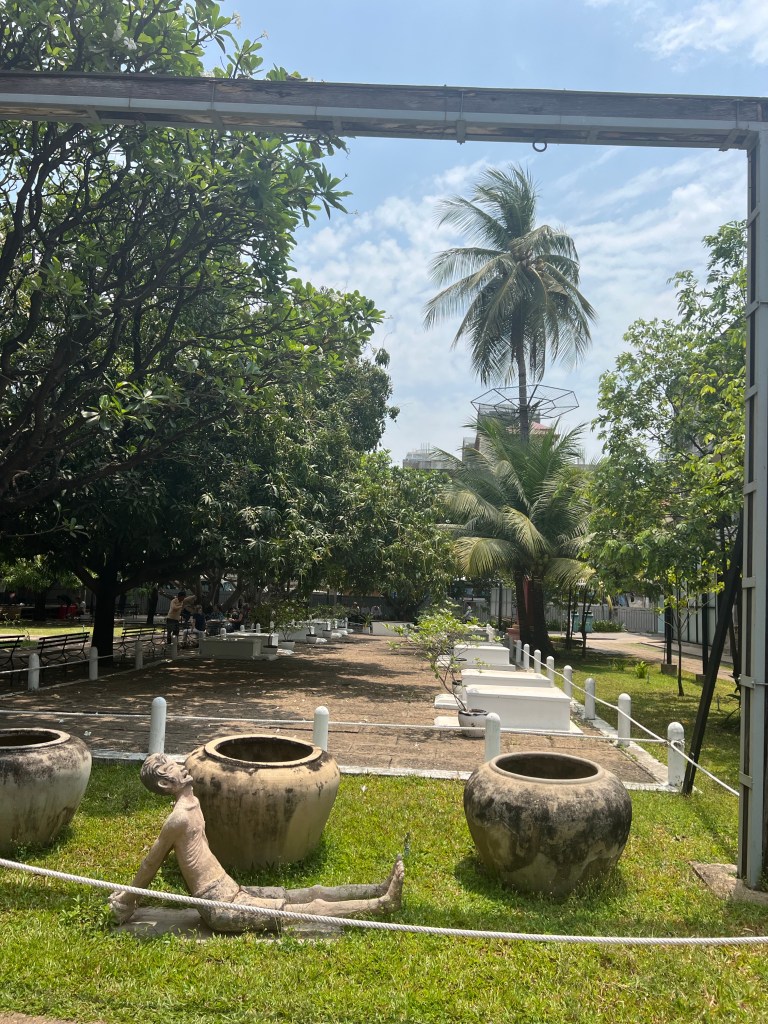
The five buildings of the school were enclosed in electrified barbed wire, and the classrooms converted into tiny prison and torture chambers. The windows were covered with iron bars and barbed wire to prevent anyone escaping or committing suicide. The cells for the general prisoners were minute, about three foot wide and just long enough to lie down on the floor with only a shackle and an old US ammunition box as their loo. Those of higher rank had a larger space, a metal bed and a window, but still just the ammunition box. The playground outside the classrooms, was turned into a torture chamber and you can still see the gallows where they hung prisoners for hours and the huge pots, which would have been full of excrement for prisoners to be dunked into, head first. Other tortures included, women’s nipples being cut off, eating excrement, finger nails being pulled out. They were then forced to write their own confessions.
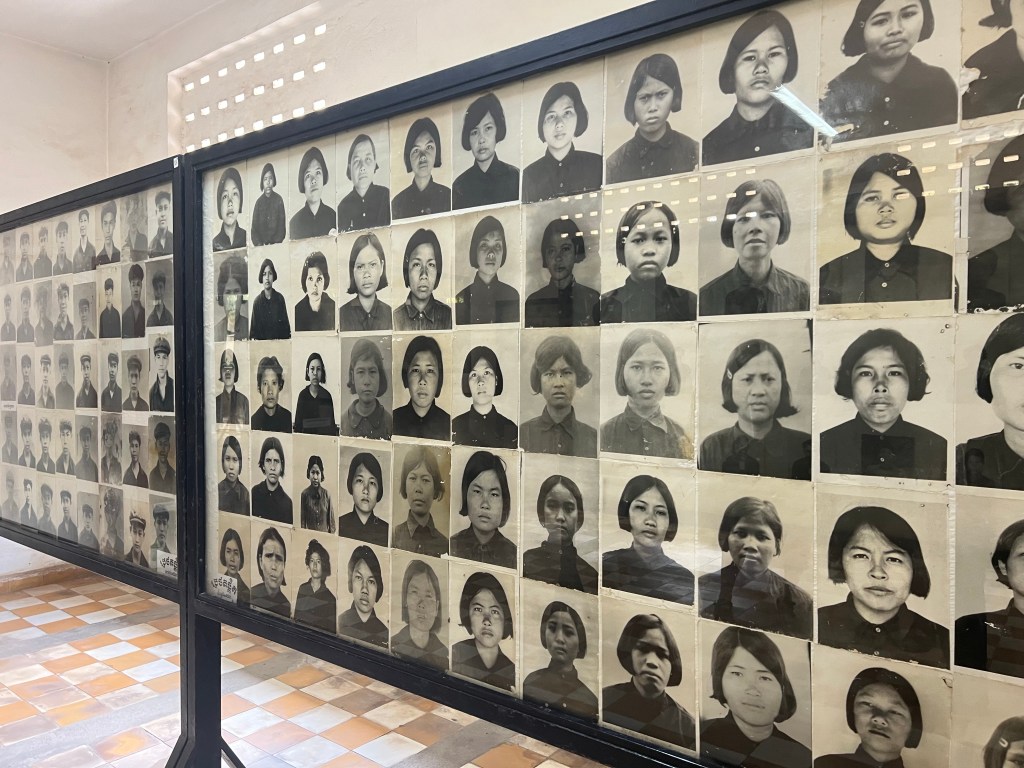
Meticulous records were kept and all prisoners were photographed often before and after their torture to prove to their superiors they were carrying out orders. There was room after room of these black and white photographs of desperate, scared men, women and children, killed by this barbaric regime. A number of foreigners from Australia, New Zealand and the USA were also at S-21 before being murdered. An average of 100 prisoners were being killed every day. In total over 3m were murdered by the Khmer Rouge.
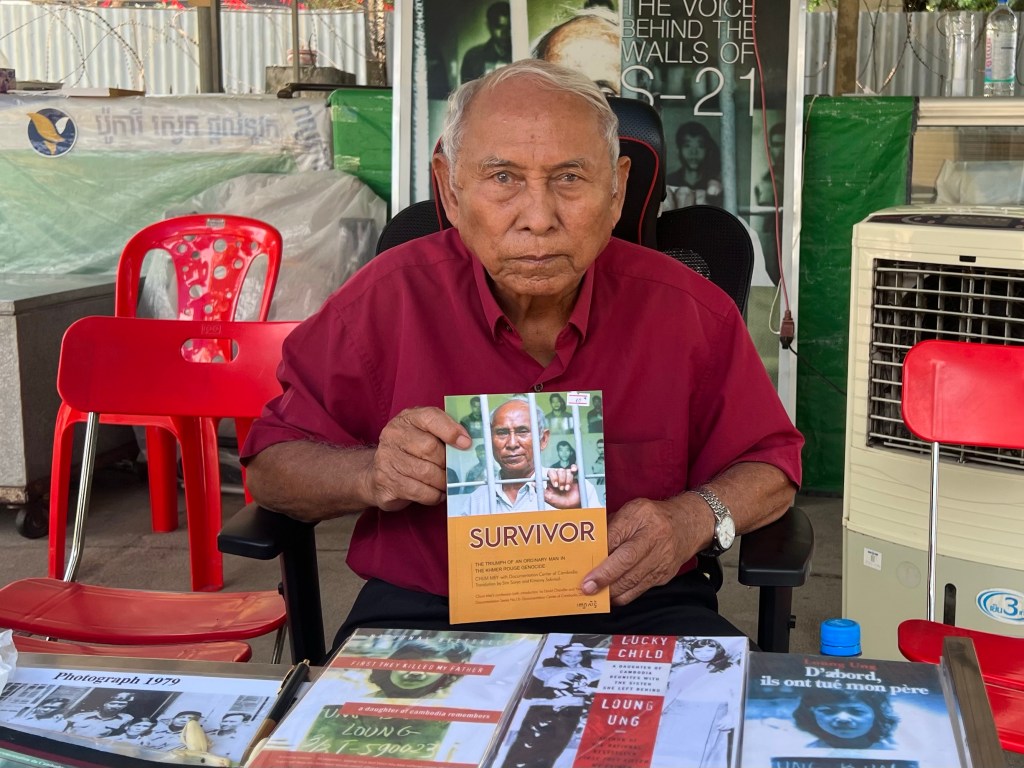
When the Vietnamese army liberated Phnom Penh in early 1979, they found fourteen men in the larger cells – who had been tortured to death and so badly mutilated they were never identified. They are buried in the courtyard. Just seven prisoners survived and only because they had skills the Khmer Rouge wanted. Two still alive today, Bou Meng an artist, who Pol Pot liked to paint him and Chum Mey, an engineer who knew how to mend a typewriter. Sadly, they now spend their days having photos taken and selling their books to tourists.
It took until 2010 for the prison chief Kang Ken Iew to be convicted of war crimes. He died in prison while serving a life sentence. Pol Pot died in 1998, apparently natural causes, while serving a life sentence imposed on him by his own Khmer Rouge.
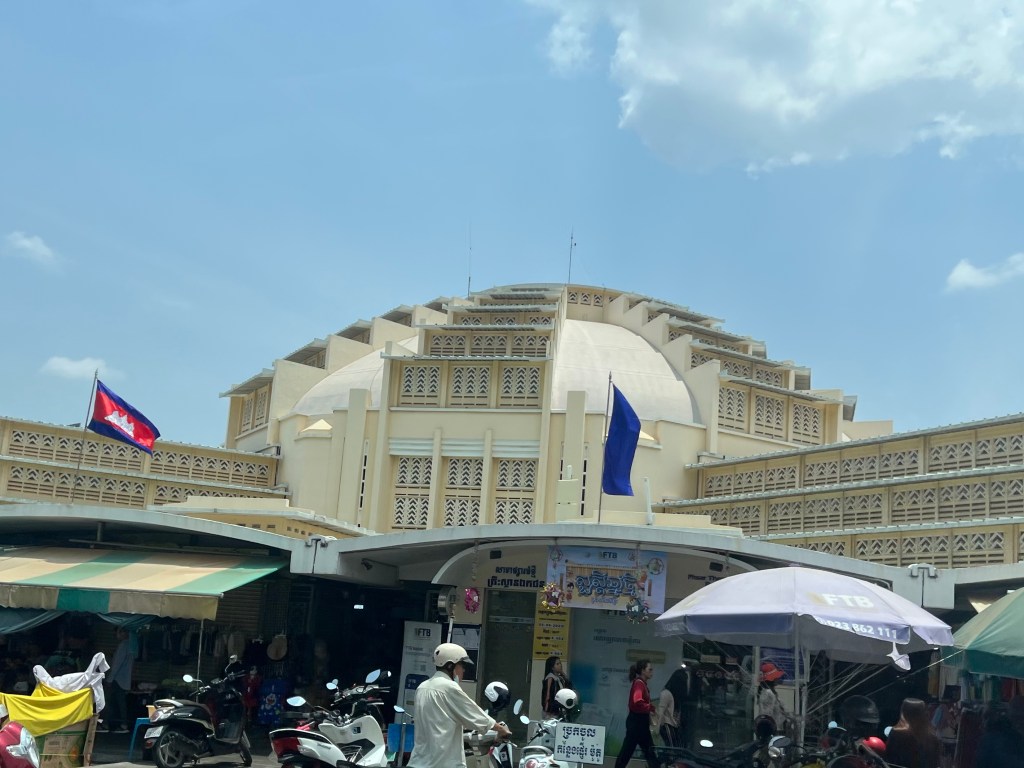
On our way back to the hotel we did a quick drive around the city seeing some of their impressive government buildings (funny that), the Central Market, built by the French in 1937 and the Royal Railway Station (1932) where Pol Pot held his first Khmer Rouge leadership meeting.
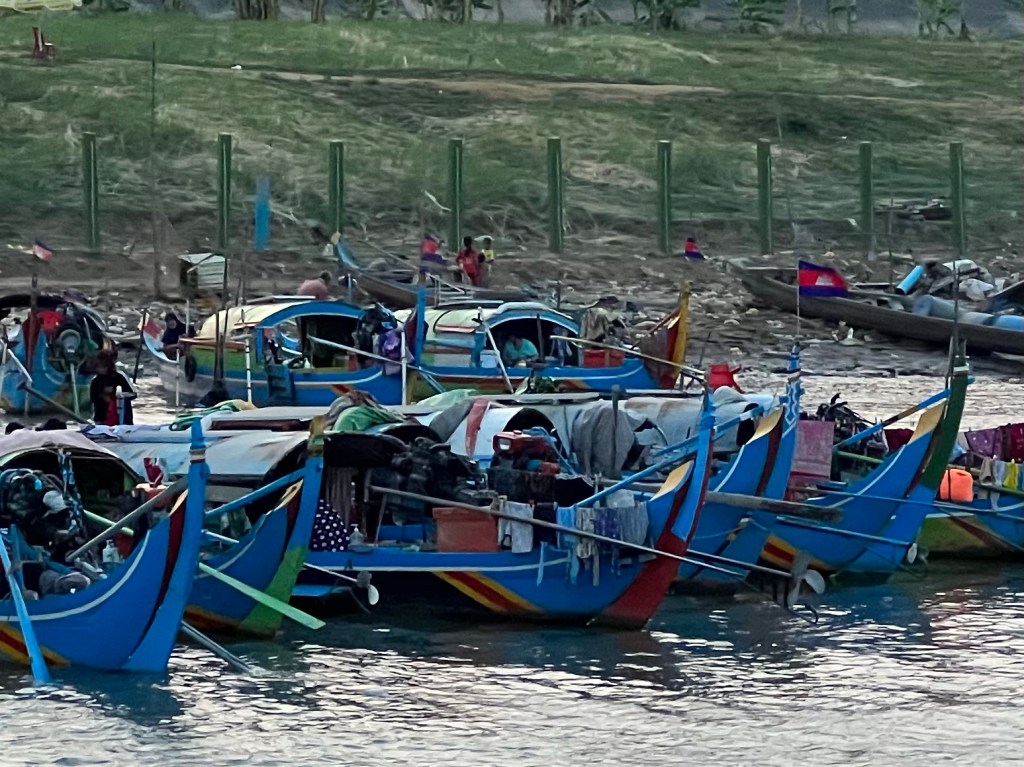
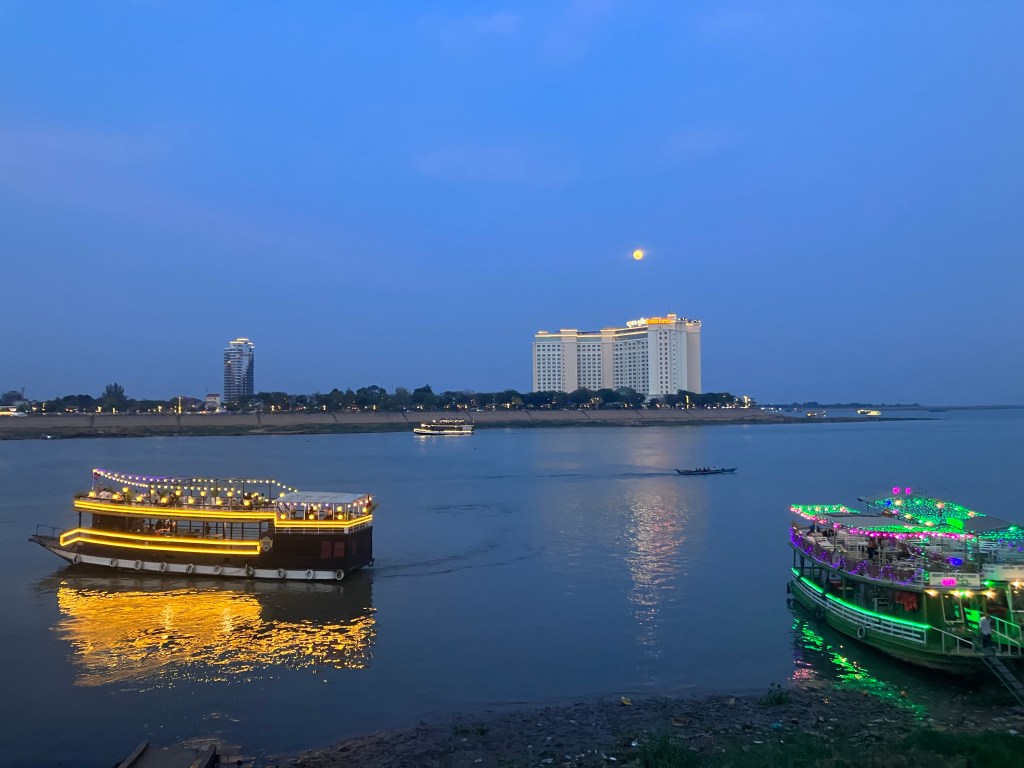
We met with Wann again in the evening and went on a ‘sunset cruise’ around the harbour, on the ‘local’s boat‘ (his recommendation), which was lovely. We passed a mass of small colourful boats which Wann explained were the Cham people who were living on their boats, sort of illegally, hoping to get residency in Cambodia.
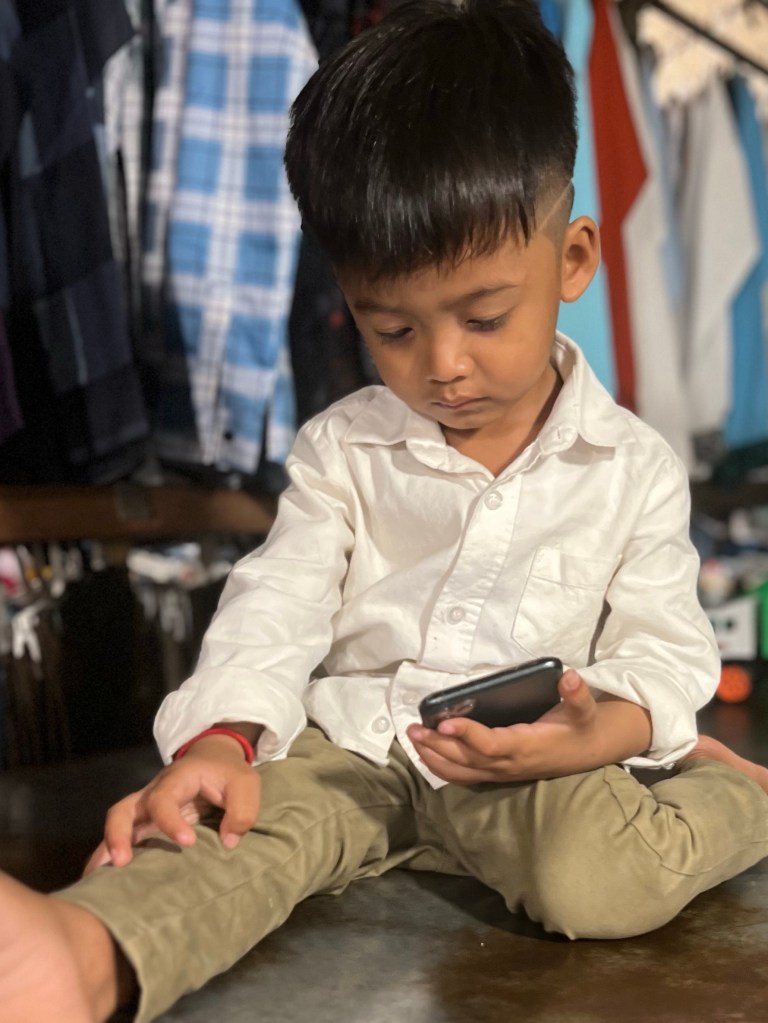
We had a quick look at the night market, but this was all jeans, t-shirts and fake designer wear, but goodness so cheap. We then took Wann out for a rather delicious dinner, in a more conventional restaurant, to say thank you.
 EC-Rider Travels
Leave a comment