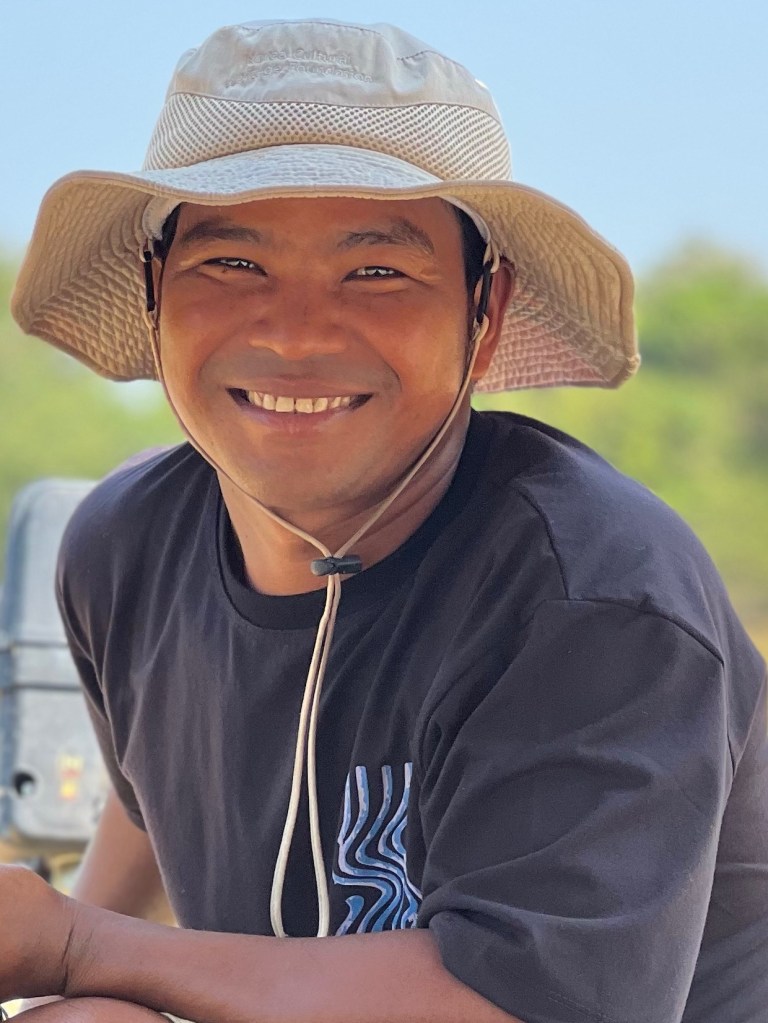
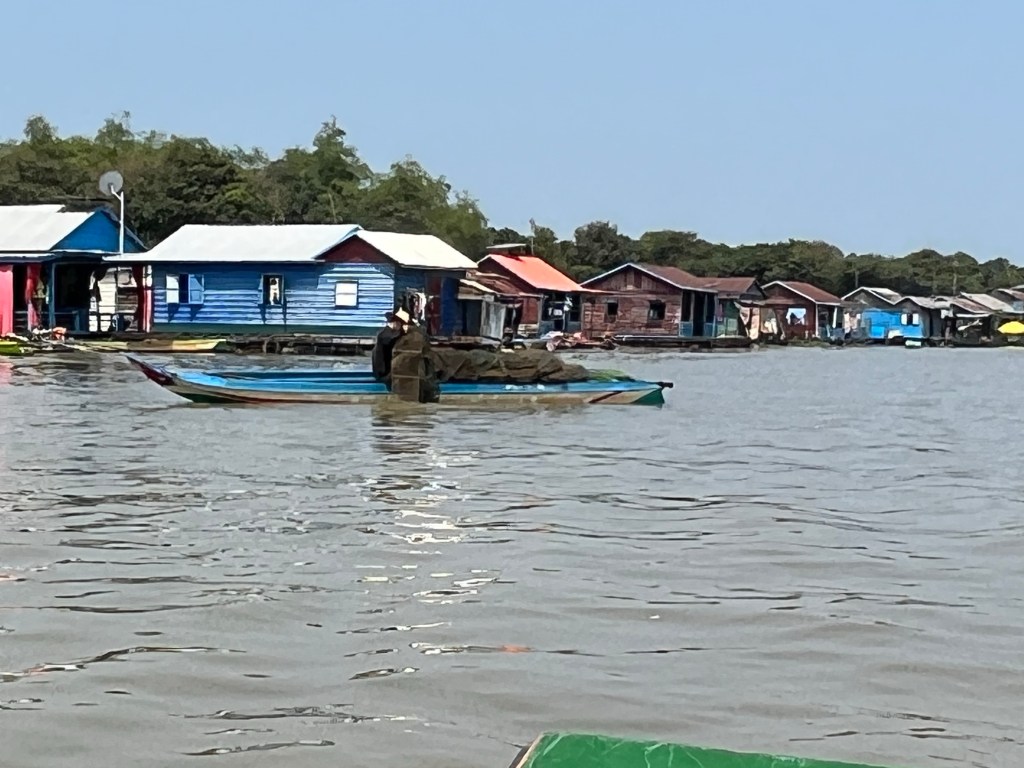
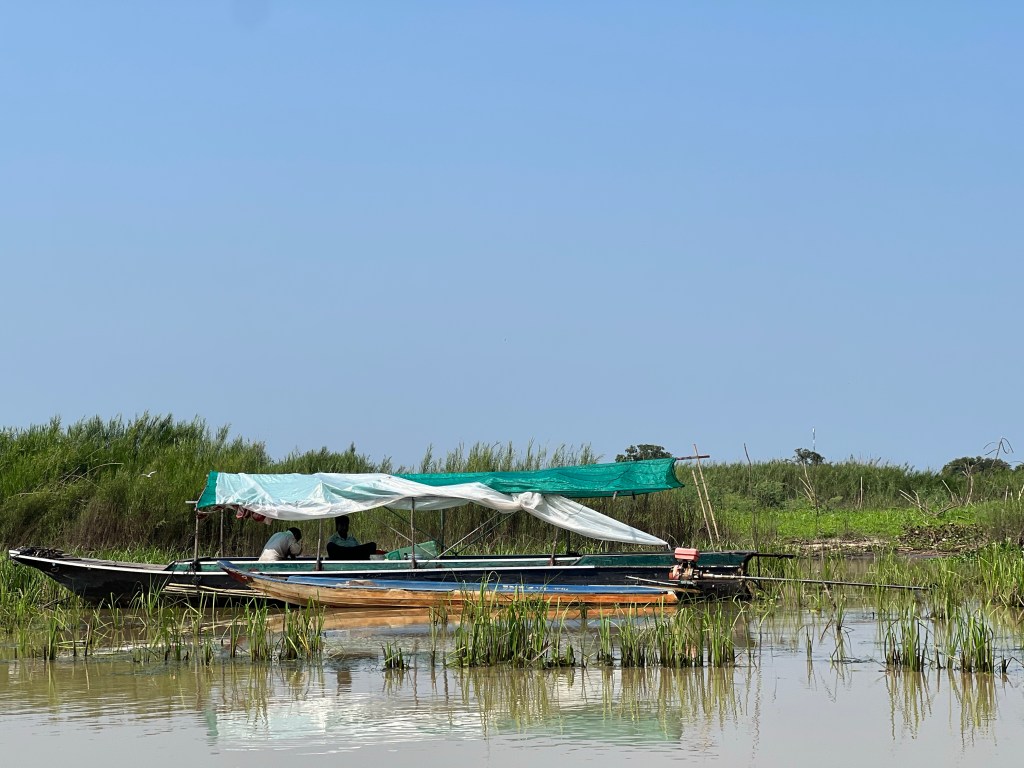
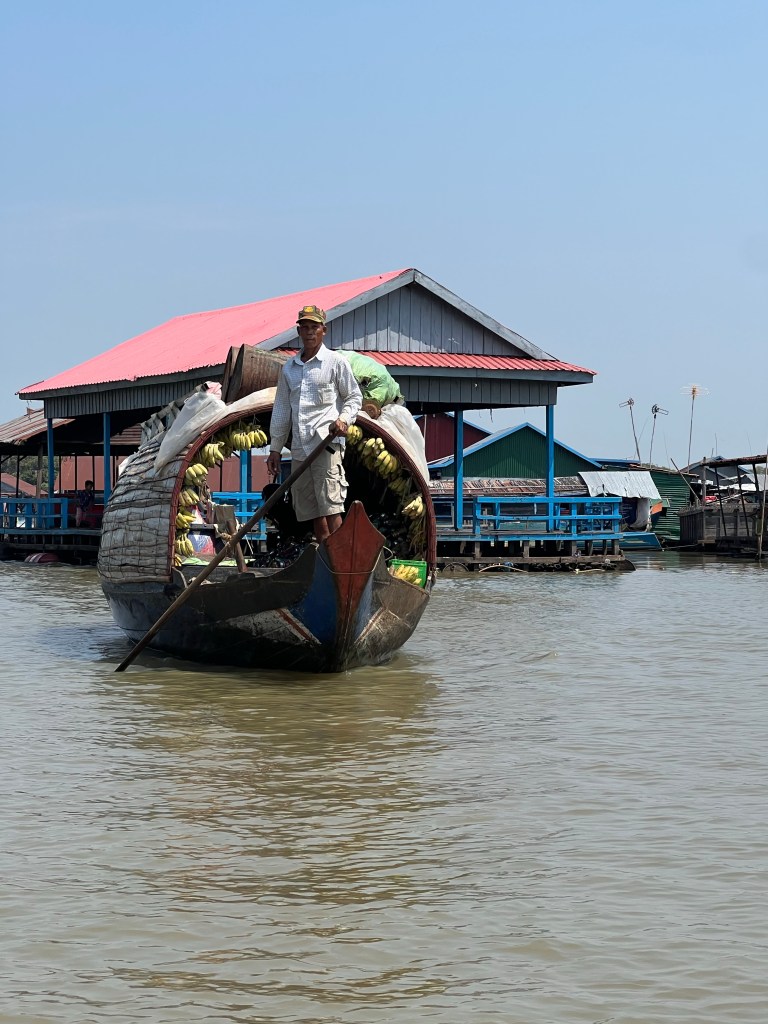
Today was very special, visiting the floating villages of Tonlé Sap. We drove about 40 minutes from Siem Reap, through the countryside and then a further half hour or so along a very bumpy dirt road, which in the rainy season would be under water. We came to the crazy little Port of Mechery, buzzing with life, but no-body really doing much. We boarded our long, flat boat, with, needless to say, the most adorable driver, grinning from ear to ear. We sped up one of the estuaries through our first floating village. This is a community of about 400 families, all living in houses floating on bamboo rafts or, the more sophisticated, on old oil drums. They have no electricity, but many have solar panels for some power or use car batteries. The village is totally self contained with floating shops, markets, pharmacies, dentist, mechanics and most importantly a door-to-door generator to charge the car batteries.
Tonlé Sap is the largest freshwater lake in South East Asia. In the dry season it is approximately 35 x 159km but this doubles or can even triple in the rainy season. There are over 170 floating villages on the lake. As the water rises during the rainy season, the people of this floating village drag their homes back to the edge of the lake, where we joined the dirt road, and there is a permanent Hindu temple built on a hill. These people have no address or postal service but the good news is, if they fall out with their neighbour, they just move elsewhere!
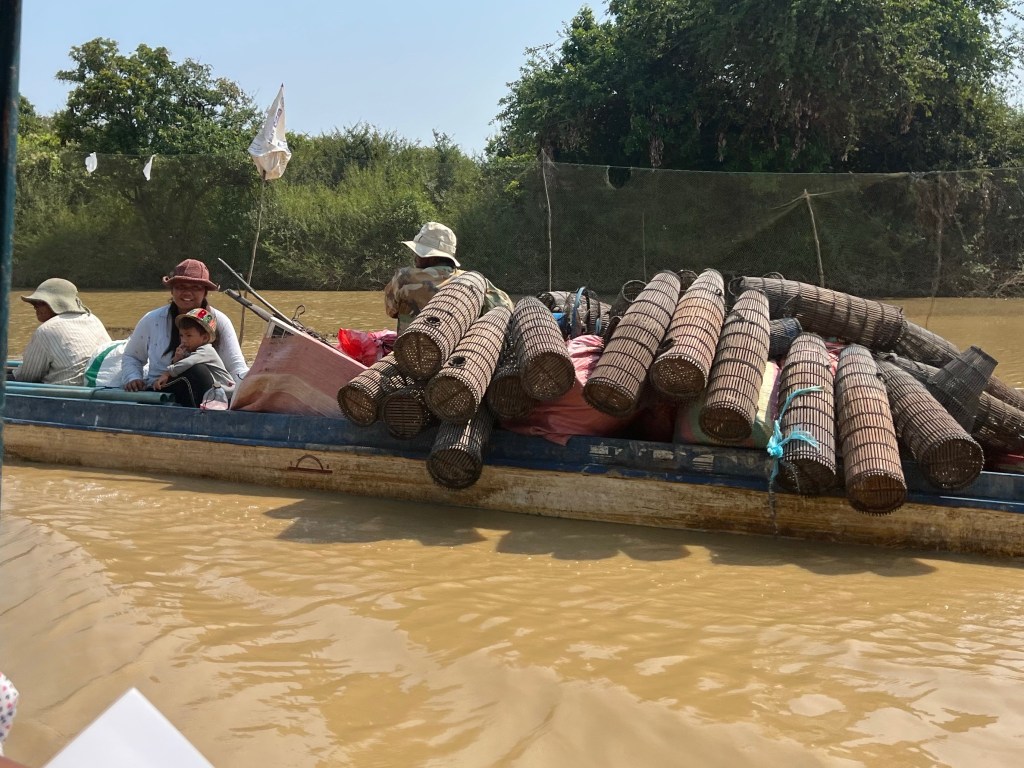
The lake is also home to over 500 species of fish. Many of these are migratory and others breed in the flooded forest areas of the lake, during the rainy season. Fish is thus their main source of food and income with some floating homes having small fish-farms attached plus many, many fishing nets set up along the river. No licence is required and anyone can fish, which they do using all methods – from mosquito nets to dynamite. They attempt a level of sustainability by, in theory, banning fishing in the flooded forest area during the breeding season, however this is almost impossible to police. There is an increasing level of deforestation, reducing this breeding ground and together with the creation of irrigation dams reducing the water level, the number of fish is declining at a worrying rate. Cambodia used to export fish and now has to import from Vietnam. They used to also farm crocodiles but with the exception of the Chinese, this has thankfully, almost dried up.
Plastic, is again a sad issue with plastic bags and bottles everywhere. Despite signs about the dangers and advising how to reduce this, most of the older generation are illiterate and of course there is no form of rubbish collection from these villages.
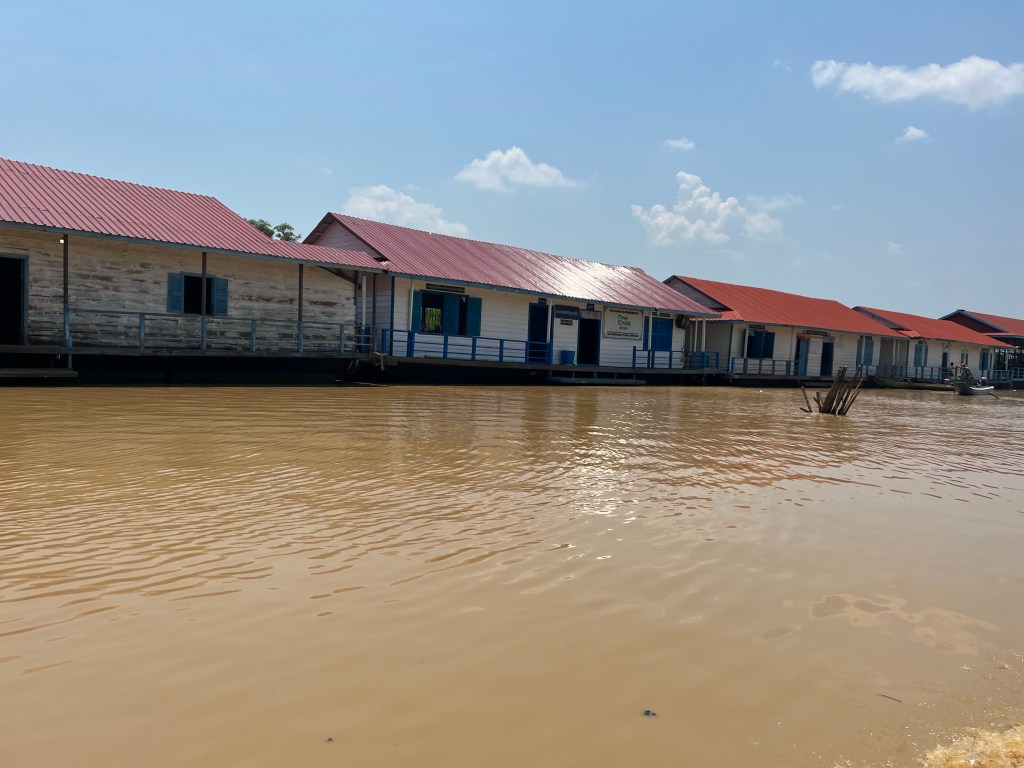
There is now a floating primary school, sponsored by the Catholic Church and also a boarding school on the mainland if parents can be persuaded to let their children go. The church has also provided a water-purifier and simple sewage plant for this village. There is a health centre (of sorts) and a midwife in the village. A crematorium was built for them in 2012.
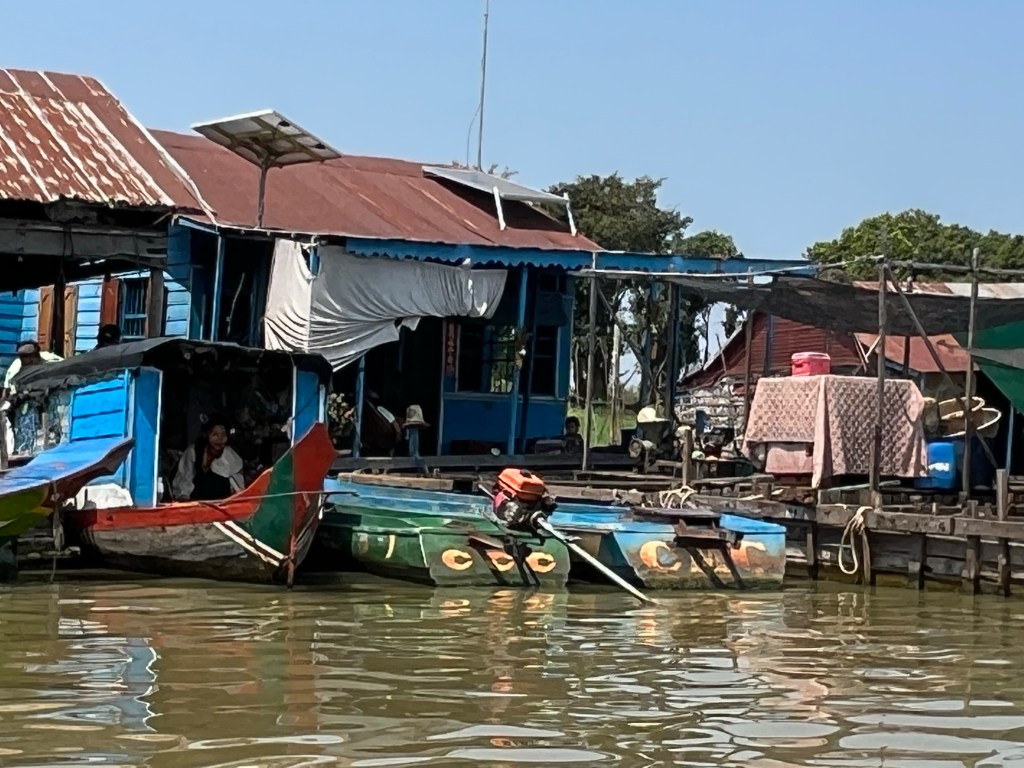
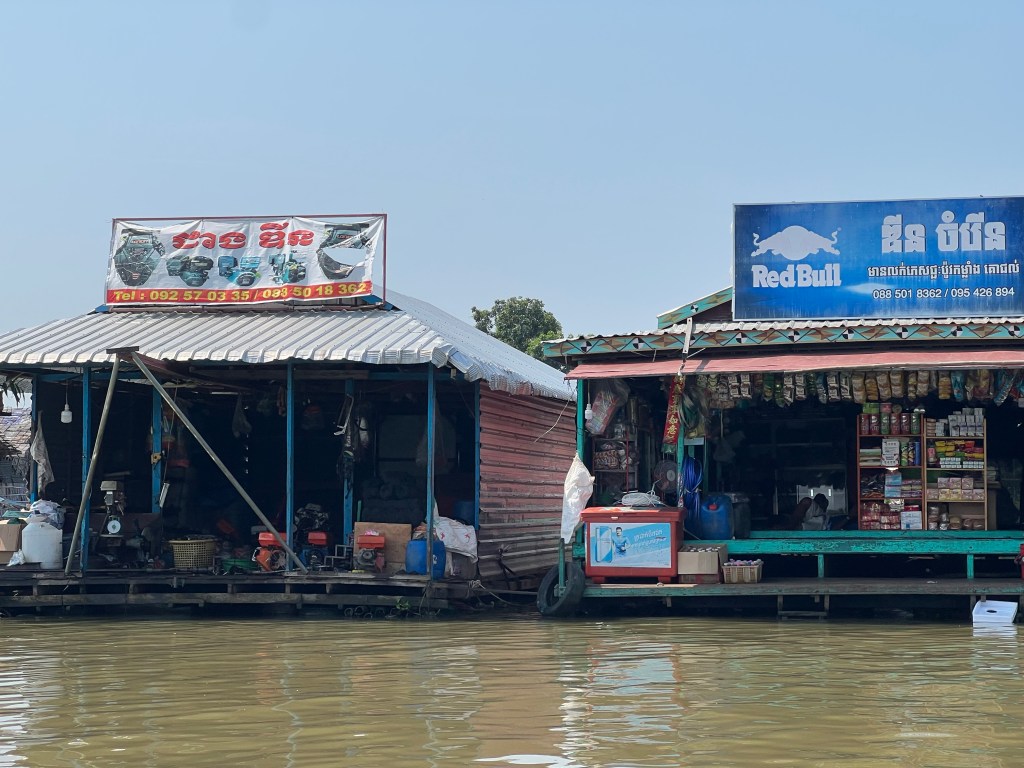
We carried on up the near empty waterways until we reached a second community, Prek Toal, again complete with floating church, schools and village stores. Prek Toal is Tonlé Sap’s largest village with over 1,000 families. It was a hive of activity with people of all ages buzzing around in their colourful, flat-bottomed boats. (apparently there is no driving age-limit) wearing the most amazing number of clothes, including woolly hats and polo-necks! Serena and I were dying of heat in our shorts and thinnest t-shirts. We saw much fish production – paste, oil etc all happening on floating platforms. Others were repairing car batteries, boats, selling oil drums and all sorts of produce, however there were a huge number with no work and ‘just resting’. Once again the children were not at school, apparently another holiday. Rit told us the another shocking fact about the teachers in the public (government) schools who are so badly paid, they intentionally hold back knowledge from the children and charge parents for private tuition. Miss Bailey was not impressed!
In fact he shared a number of pretty shocking facts about the corruption of the country (known to be the most corrupt in the world) and how it is win/win for the rich and lose/lose for the poor, with an ever increasing gap between the two. Over 20% of the population live below the poverty line with no free healthcare except for TB, Malaria and HIV. Although there are government schools, it is not compulsory to go and many families, particularly in the country, cannot afford to send their children. Although he said nothing against the government, he did mention there is no fixed term which perhaps says it all. The current government has now been in power for 37 years!
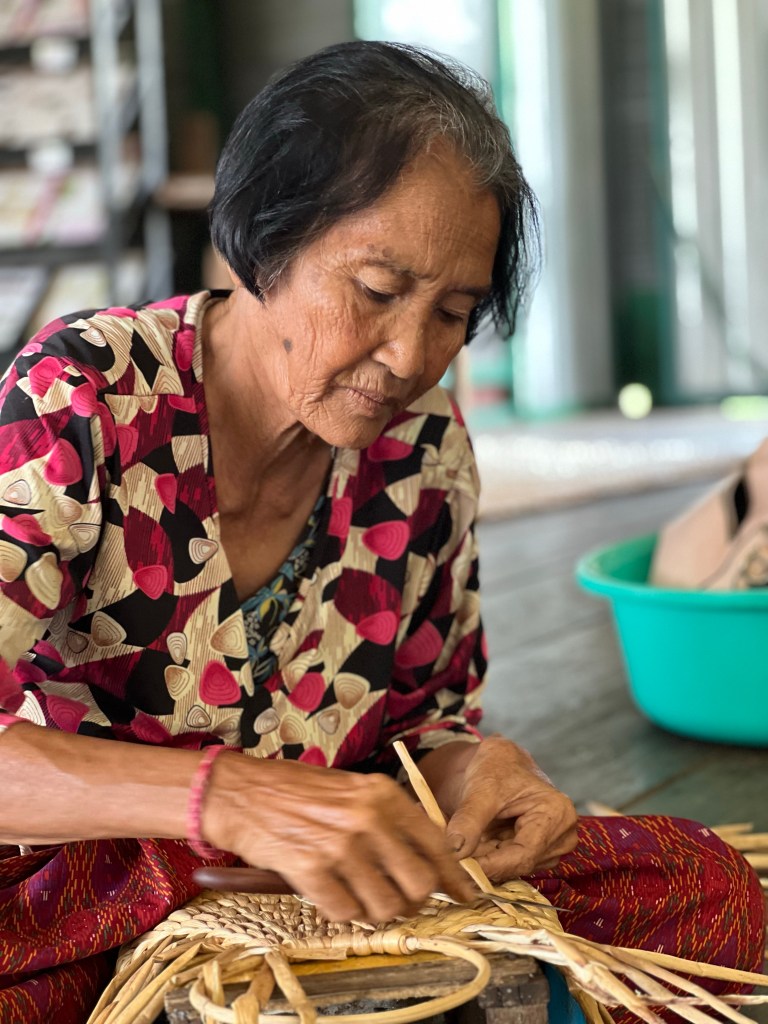
We stopped at a little weaving factory making baskets from the stems of water hyacinth. They were really lovely, but sadly not very squashable in the suitcase.
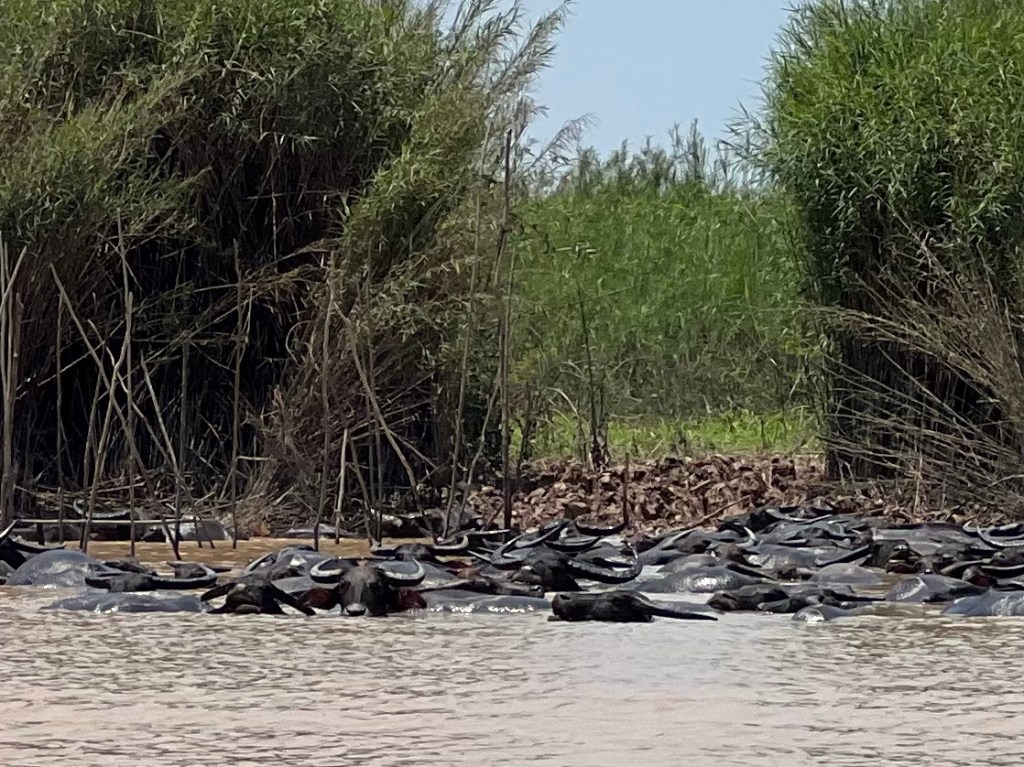
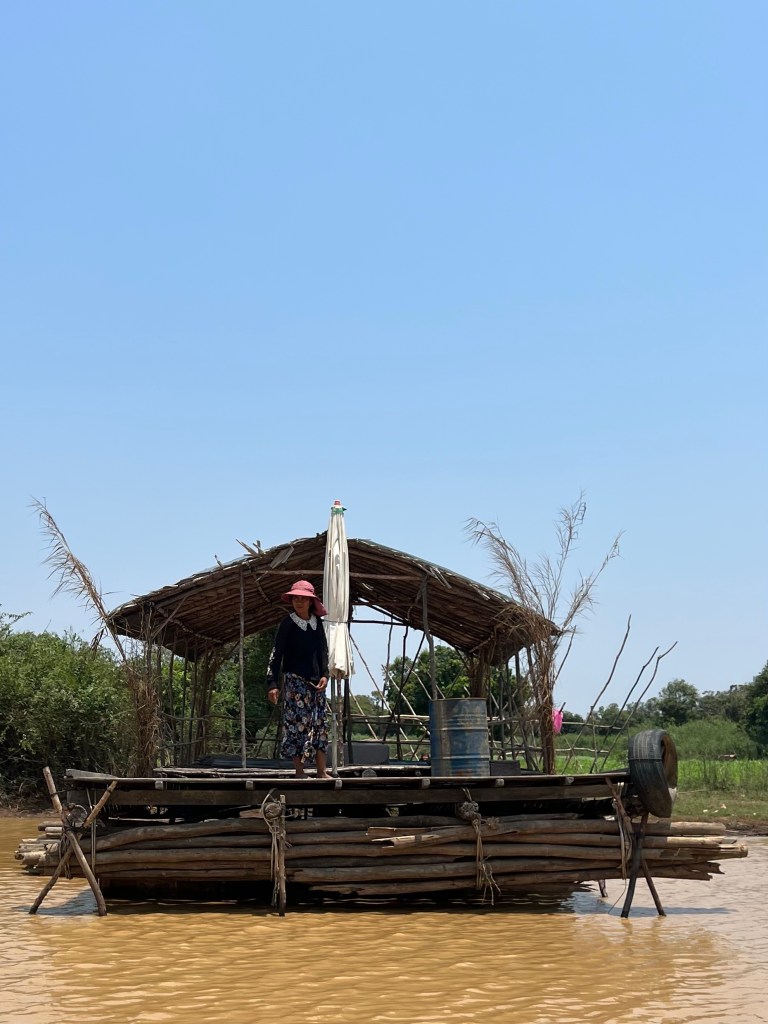
We then went out into the lake itself, which is enormous, looking like the sea and down a different waterway, where we suddenly came to a stop in the middle of nowhere, opposite a mass of buffalo wallowing in the water, to be met by our boatman’s wife and young daughter. Here, the most amazing lunch was produced for us, sitting on a cushion in a little, covered, bamboo raft….. very special. There is a bird sanctuary here, which sadly we did not have time to go to, but we saw some amazing painted and Asian openbill storks and oriental darters, which I of course loved.
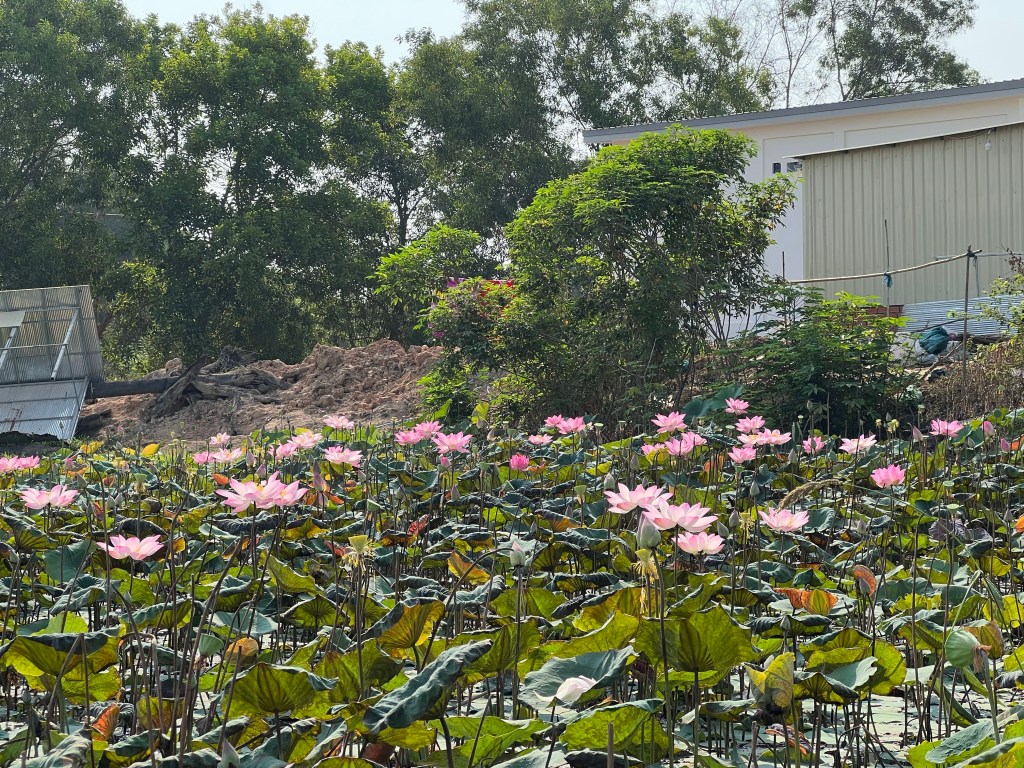
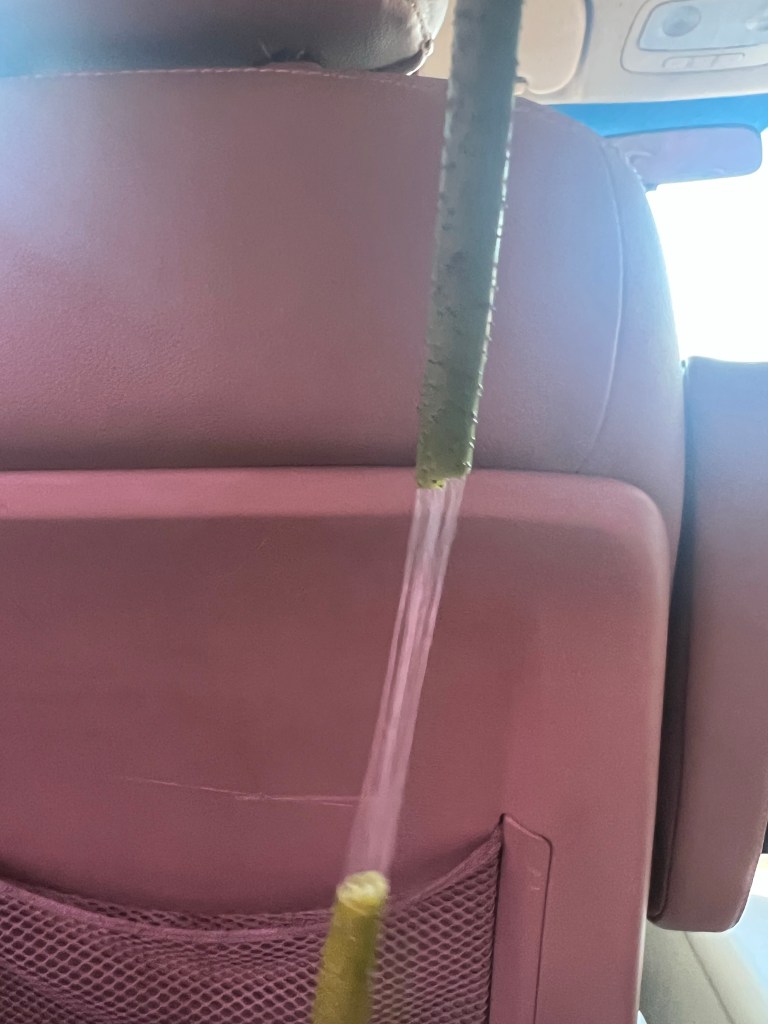
On our return we stopped at a small lake covered in lotus flowers, where Rit explained how silk can be made from their stem fibres – who knew? In fact every part of a lotus is used, the seed is eaten, as is the root in salad and soups, the flower is used in every hotel, folded in the cleverest ways and the leaf can be a plate or even a bag for carrying.
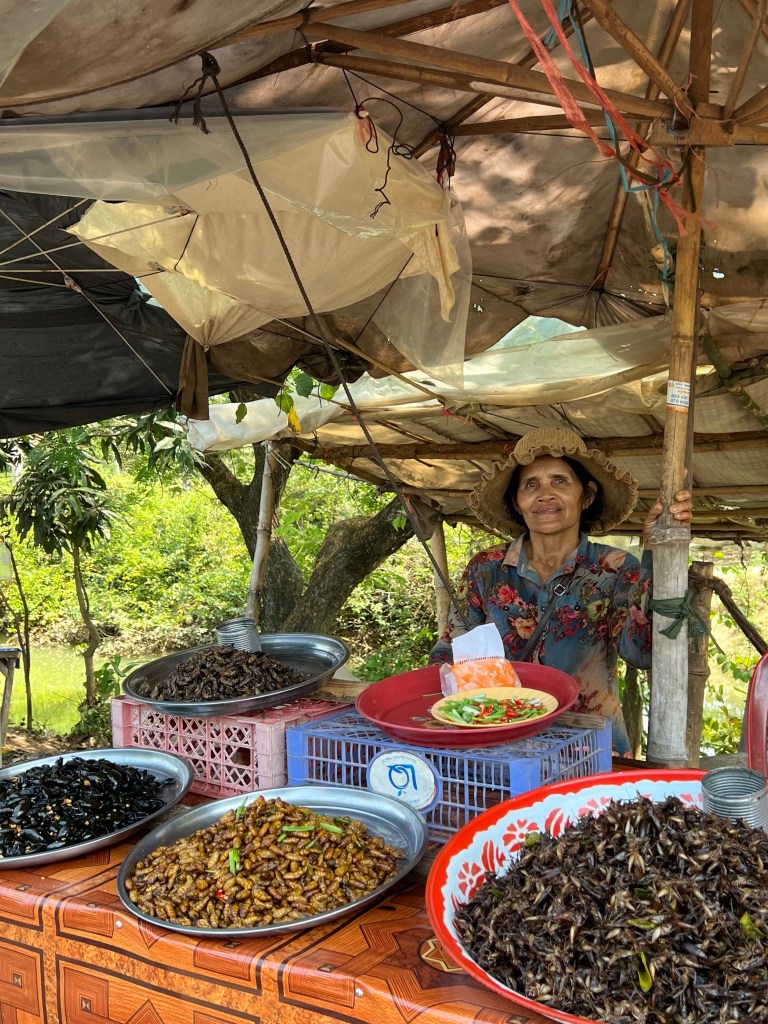
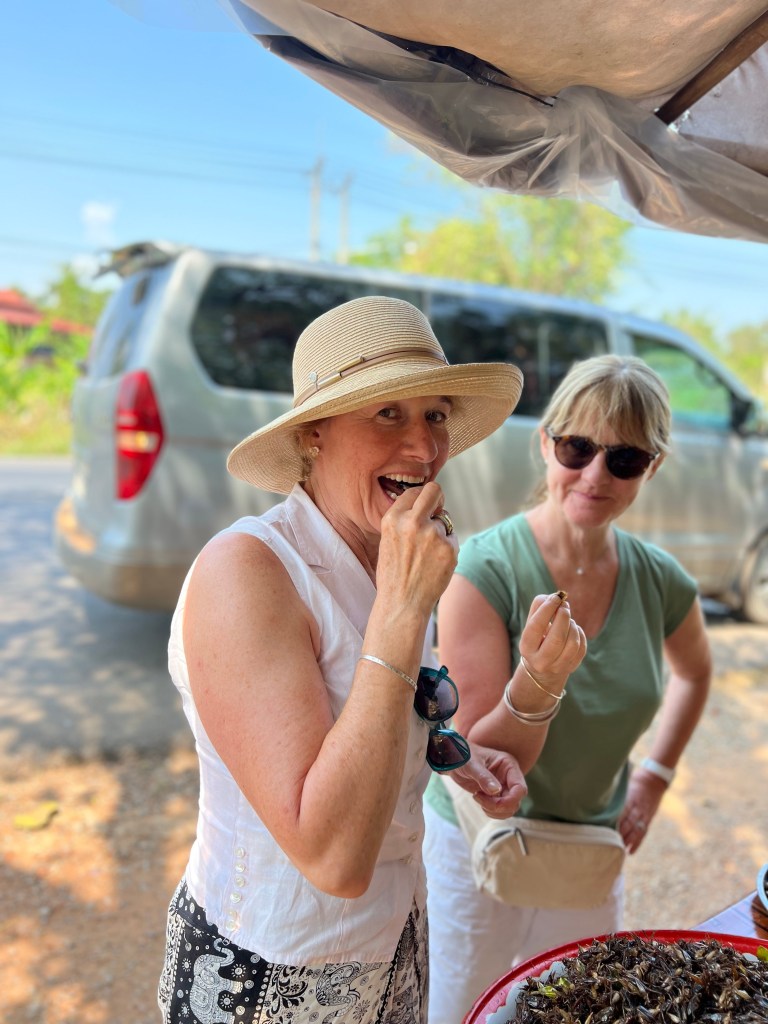
Our next stop was at a stall on the side of the road selling all sorts of things we had last seen on I’m a Celebrity Get me Out of Here …. crickets, silk-worm pupae, water beetles/cockroaches. Apparently all great delicacies! Anyway we thought we should try them and they were in fact rather good, particularly the cockroaches – no wonder they were the most expensive at 25p a cup. Rit bought some as a present for his wife!
That evening we walked to Raffles hotel for a drink, as Serena had heard Jackie Kennedy and Charlie Chaplin had stayed there, so we thought it must be ok. It was not a beauty from the outside but very lovely in, with the most incredible flowers… if slightly suspect uniforms for the poor doorman. But once again, almost empty, we saw literally one other couple. We found the photo of CC and JK and had a nice drink and delicious snack/supper. We could not resist a quick visit to the rather lovely looking shops where we were warmly welcomed by a very good salesman selling beautiful scarves made from lotus silk…. we only just resisted…
 EC-Rider Travels
Leave a comment