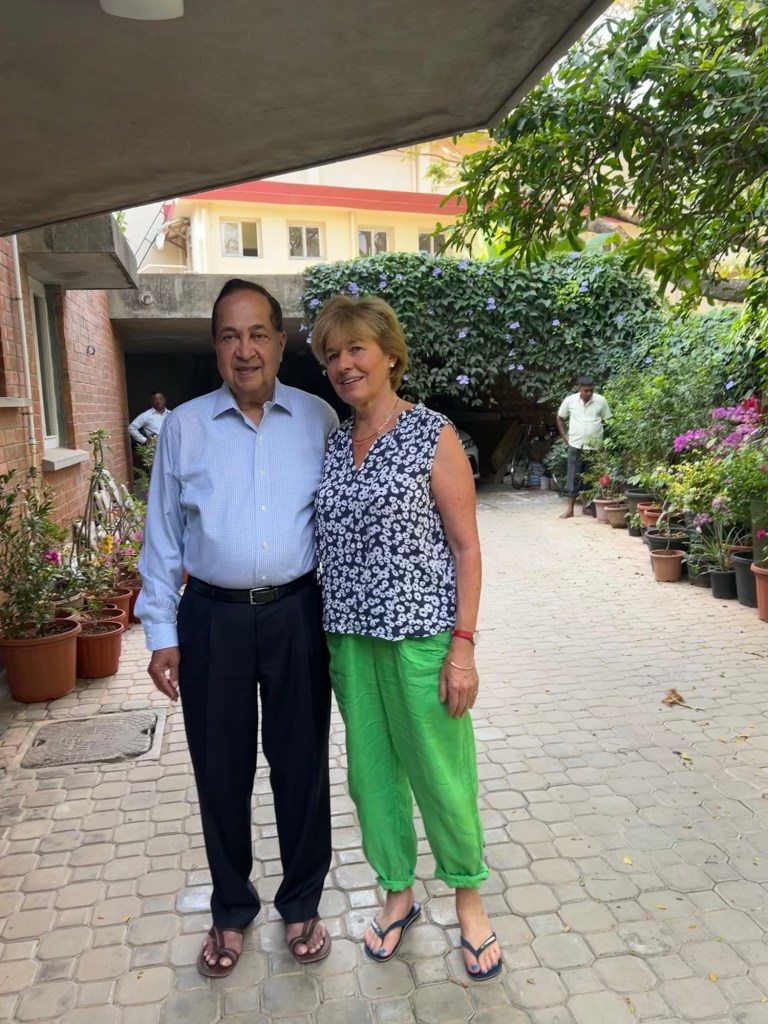
After a delicious breakfast with Ram, looking at the spectacular wedding album of Mariam’s son to Sarah the daughter of another RBS donor, my guide Rebecca, driver Arun accompanied by Christy, the Manager of Banyan Tours arrived. Ram kindly invited them in and they nearly keeled over with excitement at being in his house and meeting the great man himself. After having several photos with Ram, I managed to extract his fan club and leave him in peace. He is such a lovely, gentle man and obviously so highly respected here, I really enjoyed spending time with him. He is one of Rebecca’s all time hero’s and she was still reeling from having met him when I said goodnight to her!
We drove for a couple of hours to the south of Chennai, passing rice fields and mango farms where the trees were in flower. They fruit from mid April and there are over 100 different varieties. The rice is sewn in October, where it sprouts for two weeks and then replanted by hand, one by one, in rows. Relying heavily on the monsoon rains, it requires 40 days in stagnant water, 90 days in total to ripen for a harvest in January – again by hand – largely by women supervised by men!
Pongal, a three day festival, is held in mid-January to celebrate the harvest and the bulls get their horns painted and have a nice massage to say thank you for all their hard work. A second crop will then be planted to be harvested in mid April to coincide with the Tamil New Year. There are two monsoon seasons, the mild monsoon in mid-July and the heavy monsoon from mid-October to mid-November.
There is much talk about North and South India and Rebecca explained that the division is the Indus River, from which the country gets its name. The North tend to speak Sanskrit based languages and in the south each state has its own languages. In Tamil Nadu, they speak Tamil which is over 5,000 years old.
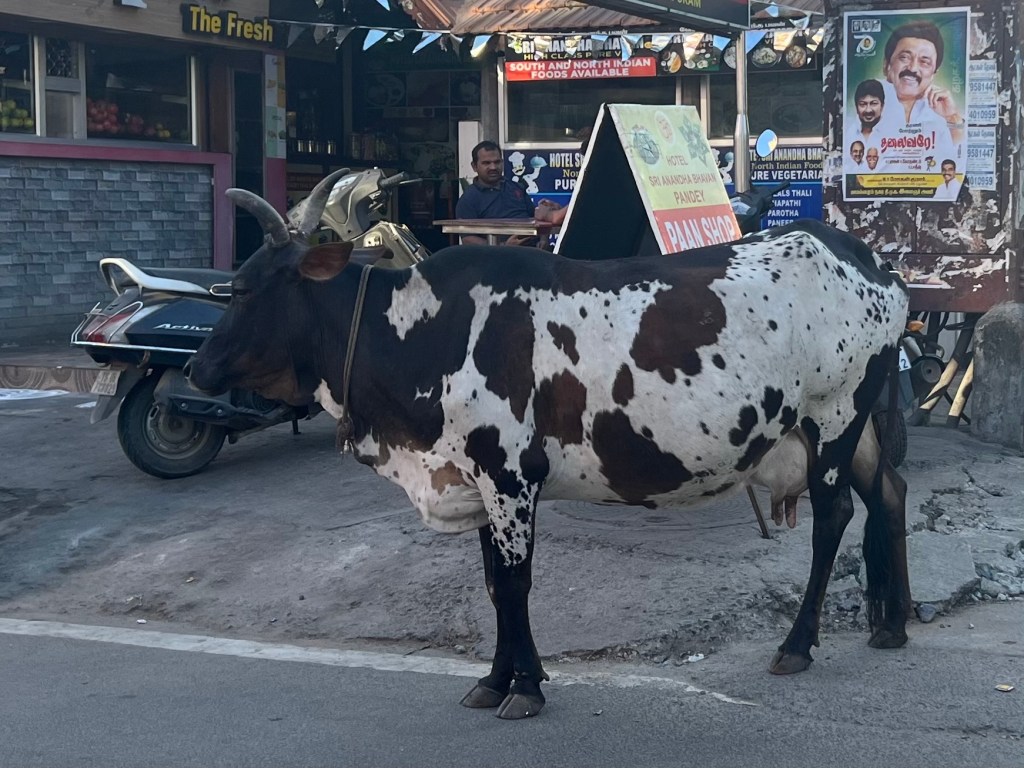
A surprising, little known fact is, although a cow is sacred, India is one of the world’s biggest exporters of beef. It was made sacred to ensure the cows were not all eaten as they are so fundamental to their life for milk and the bulls to work. The same was done with some trees.
After much chat, we arrived in Kanchipuram (meaning gold place) an ancient capital city of the Pallava dynasties. It is known as the ‘City of a Thousand Temples’ which was a somewhat alarming prospect, but we kept it to just two. Apparently every time a war was won a new temple was built and every king who came to power had to build a bigger and better temple so the numbers grew.
We first went to the sandstone Vaikunta Perumal temple, dating back to the 7th century, this is a temple to Vishnu – the Protector of Good. Outside the temple was the temple tank, sadly in a state of disrepair, but would have been where you washed yourself and your clothes before entering the temple. Interestingly it was used by both the Hindu Temple and the Muslim Mosque next door. The tank is filled by the monsoon rains which are measured by how many steps the water rises from the tank – the higher the better!
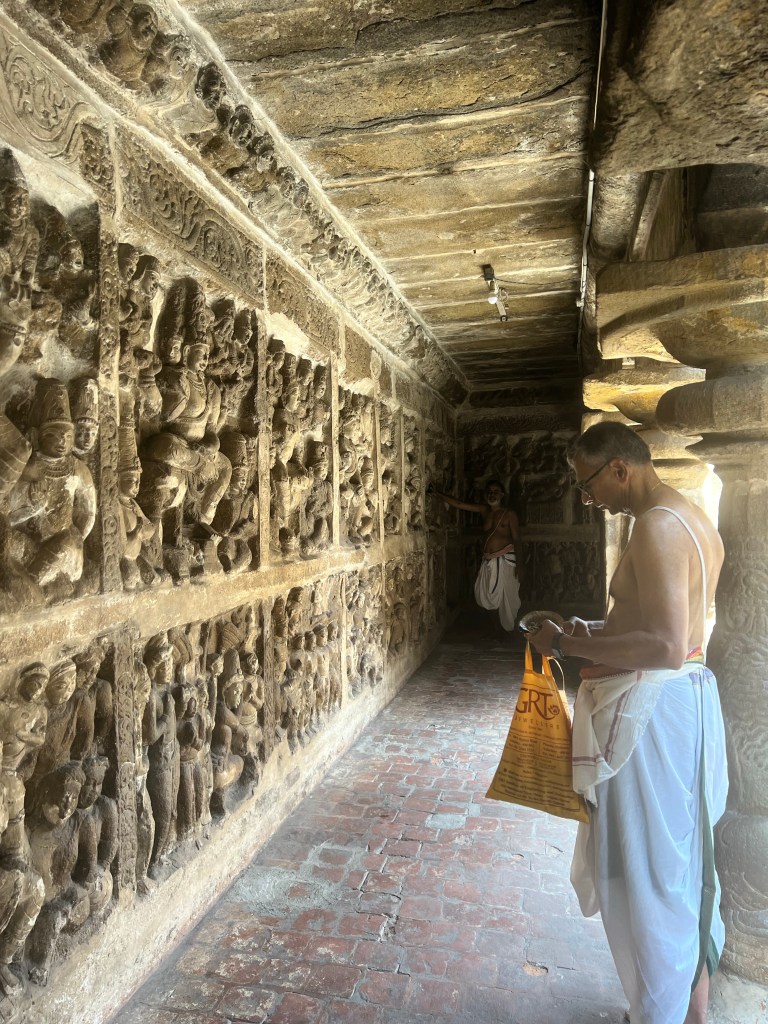
As with all temples, there is first an impressive gate, then a sacrificial alter, a flag mast and a shrine to the ‘vehicle of the deity’ which faces the shrine. In Vishnu’s case it is Garuda the vulture/eagle. You then enter an inner sandstone cloister carved throughout, with Vishnu presented in various guises. Further in still, you approach the shrine itself where a Brahmin prays on your behalf to Vishnu.
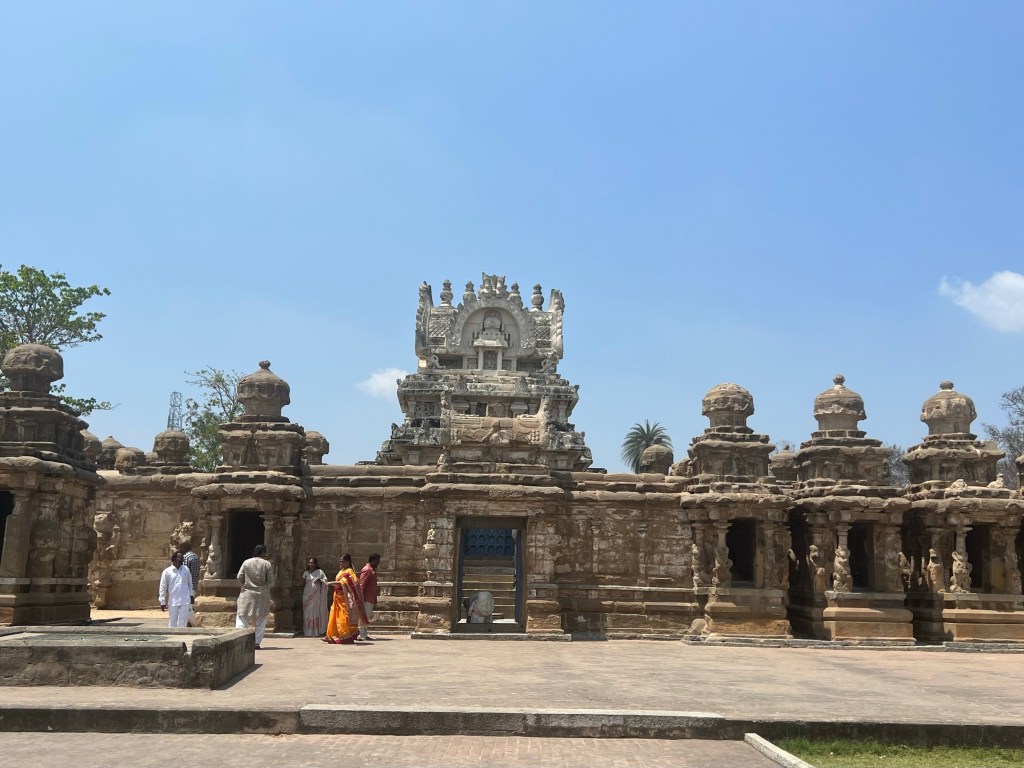
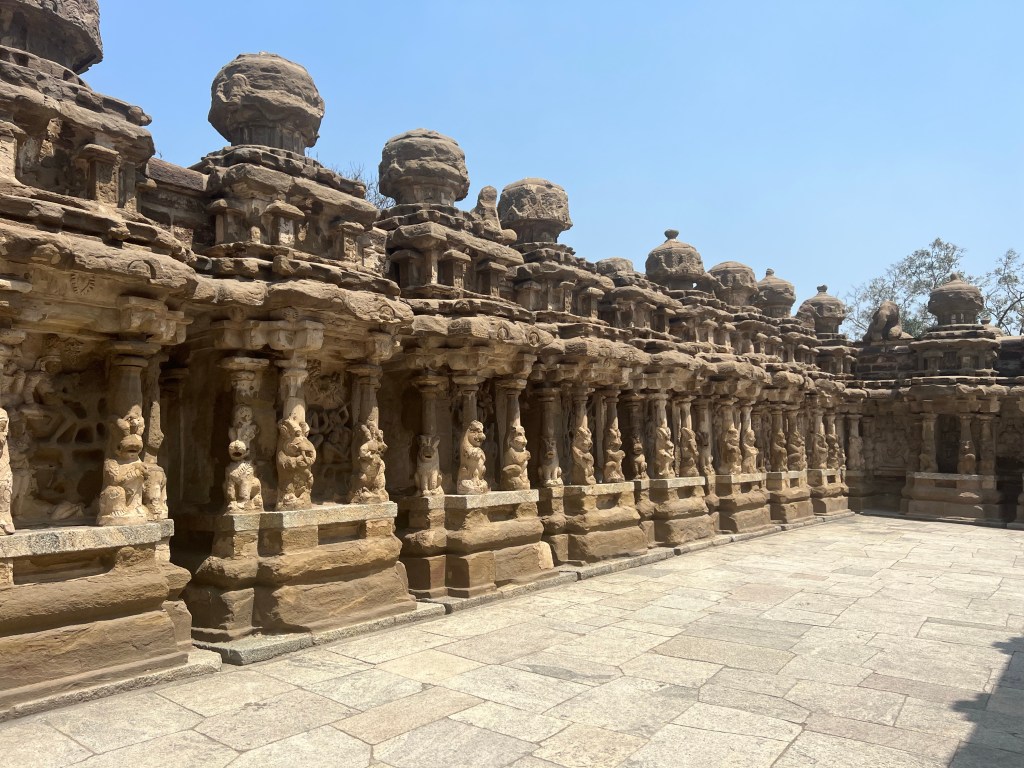
We then went to the Kailasantha Temple, again seventh century, with lion pillars standing on their hind legs as a warning not to harm the temple. It has a granite base to support its massive sandstone structure with a heavily carved outer wall containing fifty-eight small shrines in its niches some with traces of Pallava period paintings. Apparently Buddhist priests also used to pray in these shrines. The main shrine depicts carvings of Lord Shiva and his wife, Goddess Parvati in various dance forms including Lord Shiva in the destructive dancing pose.
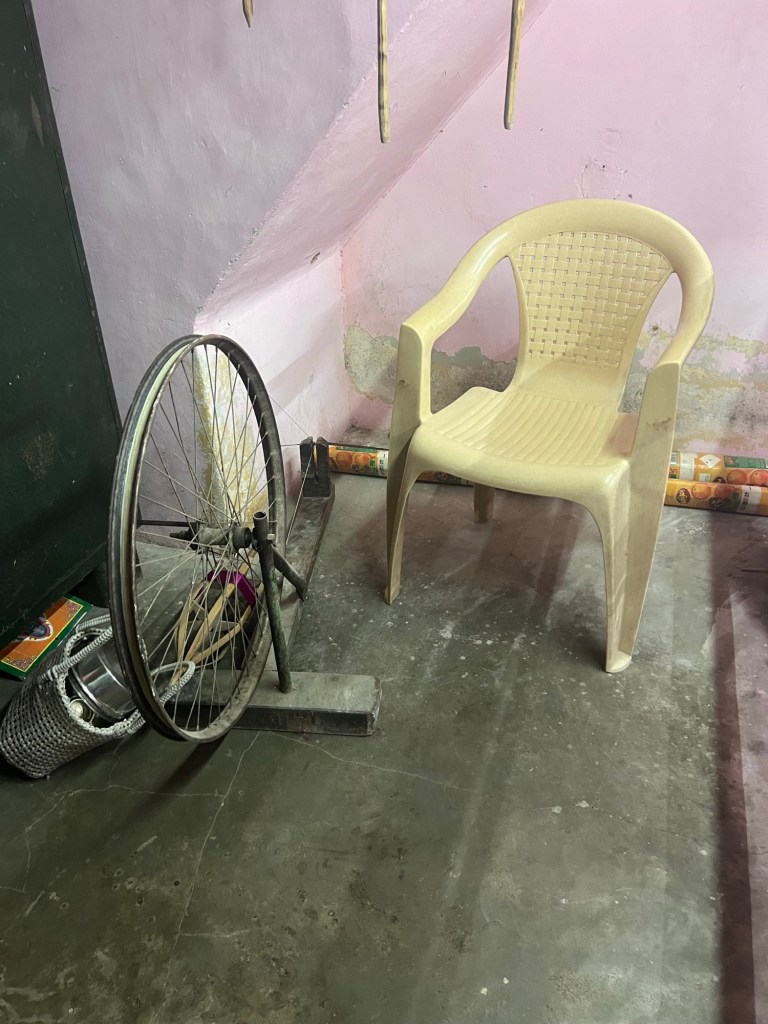
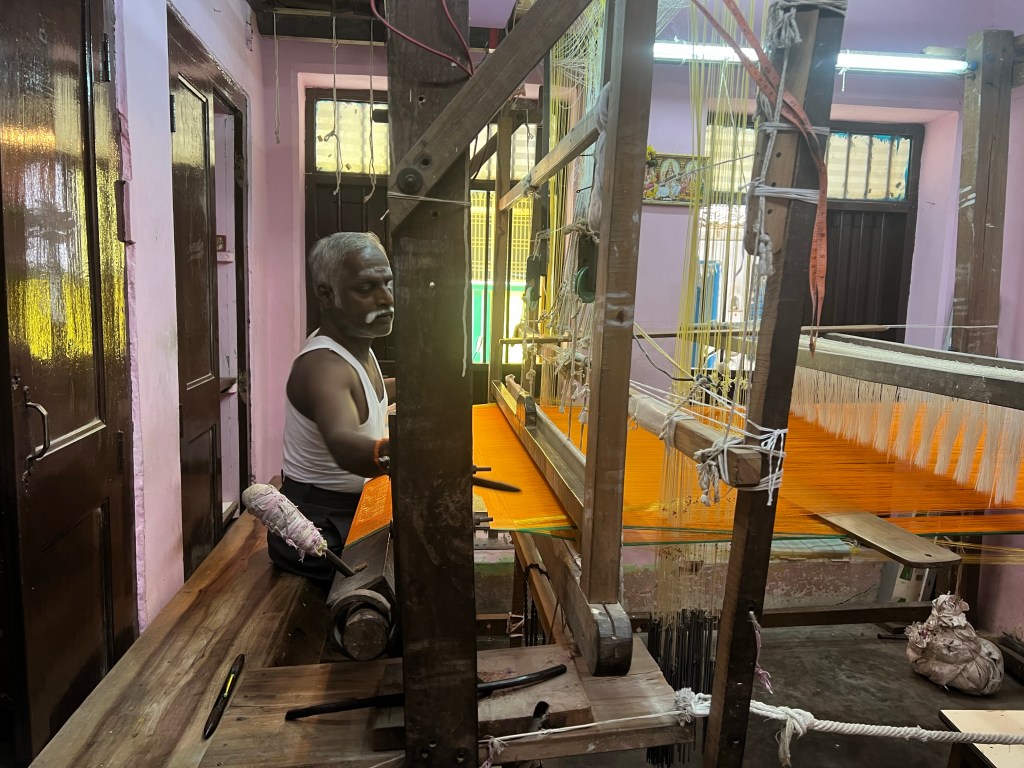
We then visited Sri Varadah silk house and saw the silk weavers at work. Kanchipurum is the centre of silk weaving with over 25,000 families (almost half its population) passing on the skill from father to son. The Government provides a subsidy, on the condition traditional methods are maintained and no machines used. There are 95,000 looms in the town producing the most exquisite work. I watched two men weaving unbelievably complex silk wedding saris, one from memory the other using a punchcard to dictate the pattern. They receive raw silk which they soften, dye and spin – on a bicycle wheel in this case!
It takes ten days to just set up the loom and a further 30 days to weave the 6.5m sari. (A metre, for the blouse and 5.5m for the sari) This would be sold for approximately 30,000 rupees (£300). The heavier the sari (ie the amount of gold, silver or copper thread), the more expensive. A bride will need several saris (at least eight or ten) for her wedding which can go on for up to eight days. Maybe we get off quite lightly after all!
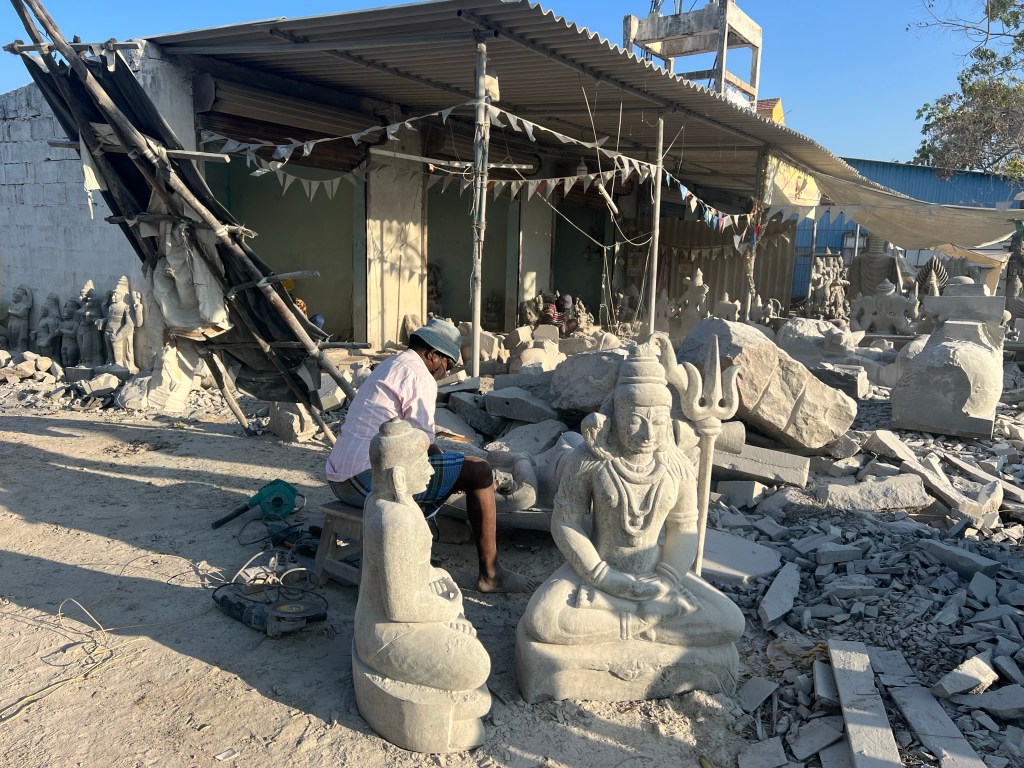
We then drove a couple of hours to the city of Mahabalipuram which is the Pallava’s second city and port, thought to have been used by Greek traders as early as the 1st century. It is now the centre of granite stone masonry and all along the road into the city were craftsmen, in clouds of dust, carving pieces for the temples.
It was unbelievably busy with hundreds of stalls, buses and people everywhere. It is the Festival Maasi Masam and families were processing down to the beach, to dip their toes in the water. Maasi Masam is celebrated from mid February to mid March, the eleventh month of the Tamil calendar, and is dedicated to Lord Shiva. There are many feast days and festivals throughout the month, the big day being tomorrow when they celebrate Paurnami Vratam – the full moon.
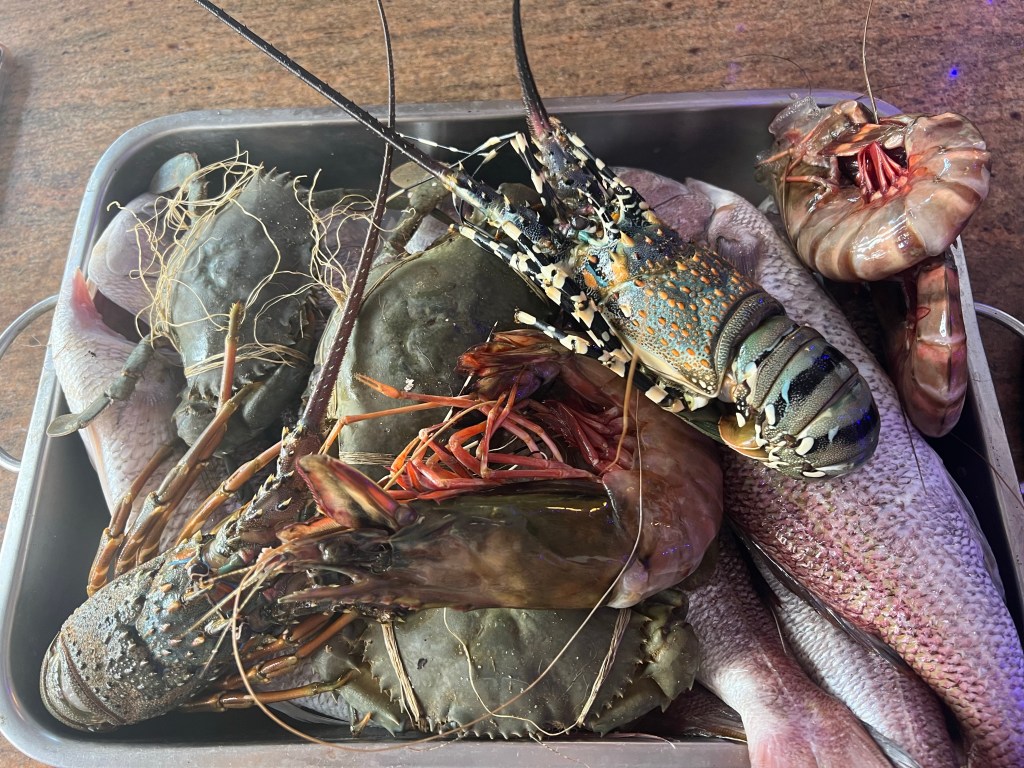
We had lunch in a seafood restaurant where I was presented with a tray of seafood to choose what I wanted. I am pleased I did this before seeing the loos and the kitchen, but it was delicious and I still seem to be standing. Rebecca is wonderful company and we had a very amusing lunch.
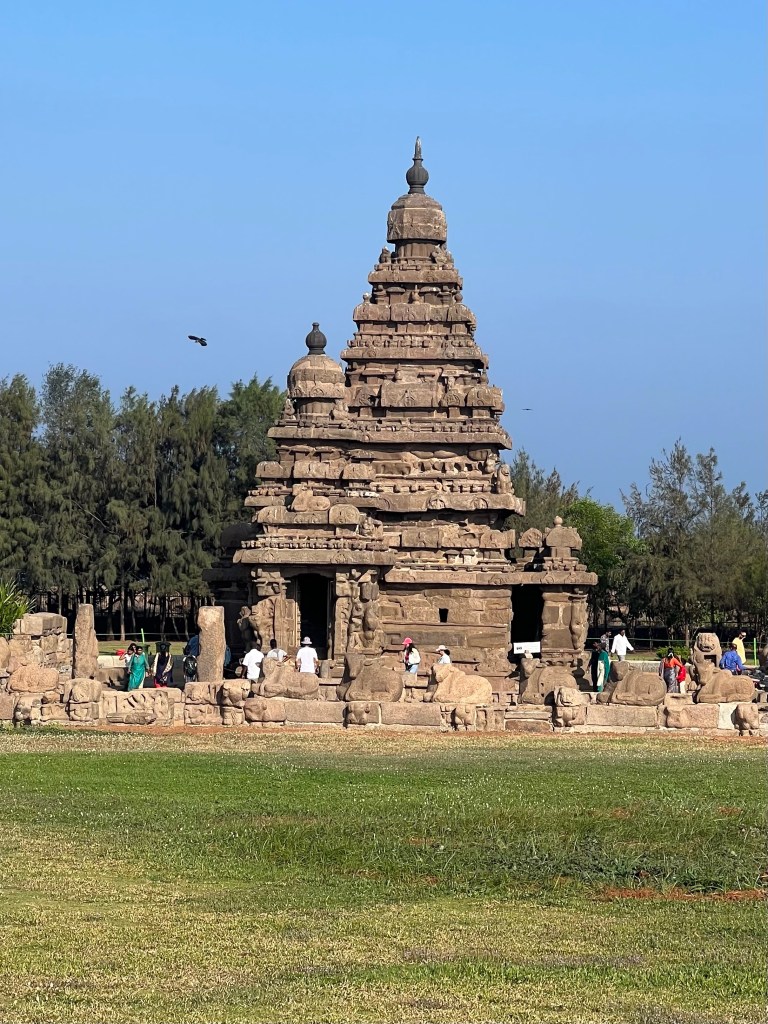
After lunch we visited the Shore Temple a shrine to both Shiva and Vishnu, surrounded by a row of Nandi bulls. It is again from the 7th century and comprises three ornate, granite shrines. Having been buried by the sea, it was rediscovered in the 1920s while looking for granite. Since when it has been a protected monument and declared a UNESCO world heritage site in 2004.
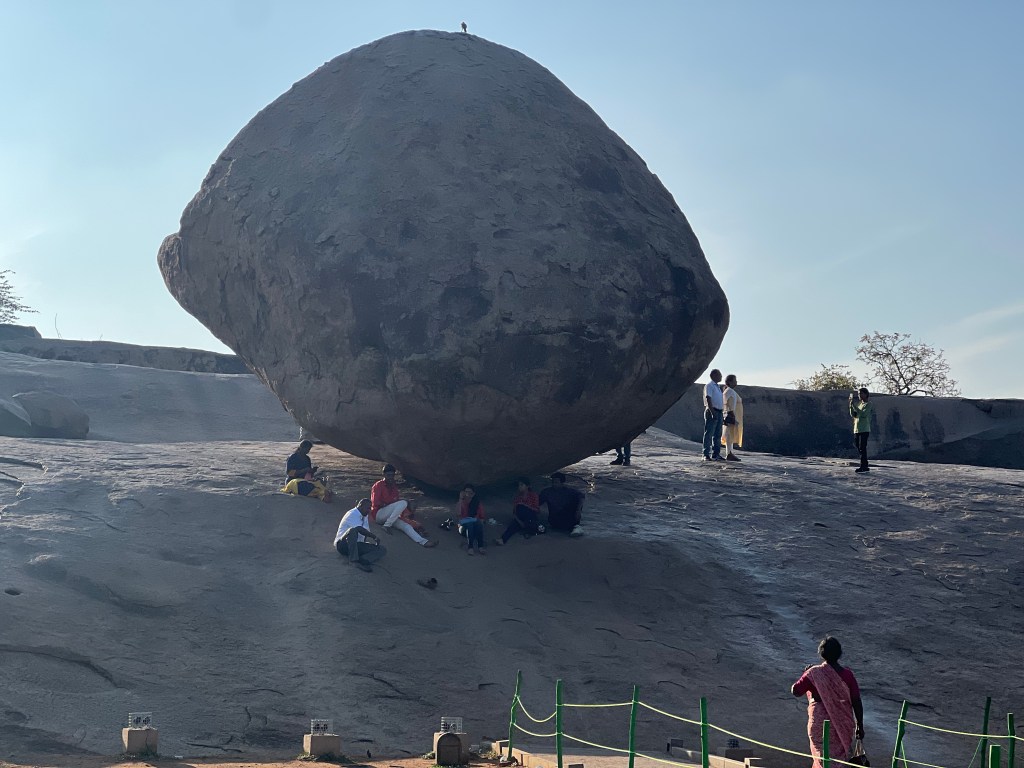
We then went to see the most amazing Krishna’s Butter Ball, a massive boulder, 6m high and 5m wide, weighing 250 tons balanced on the slope of a granite hillock.
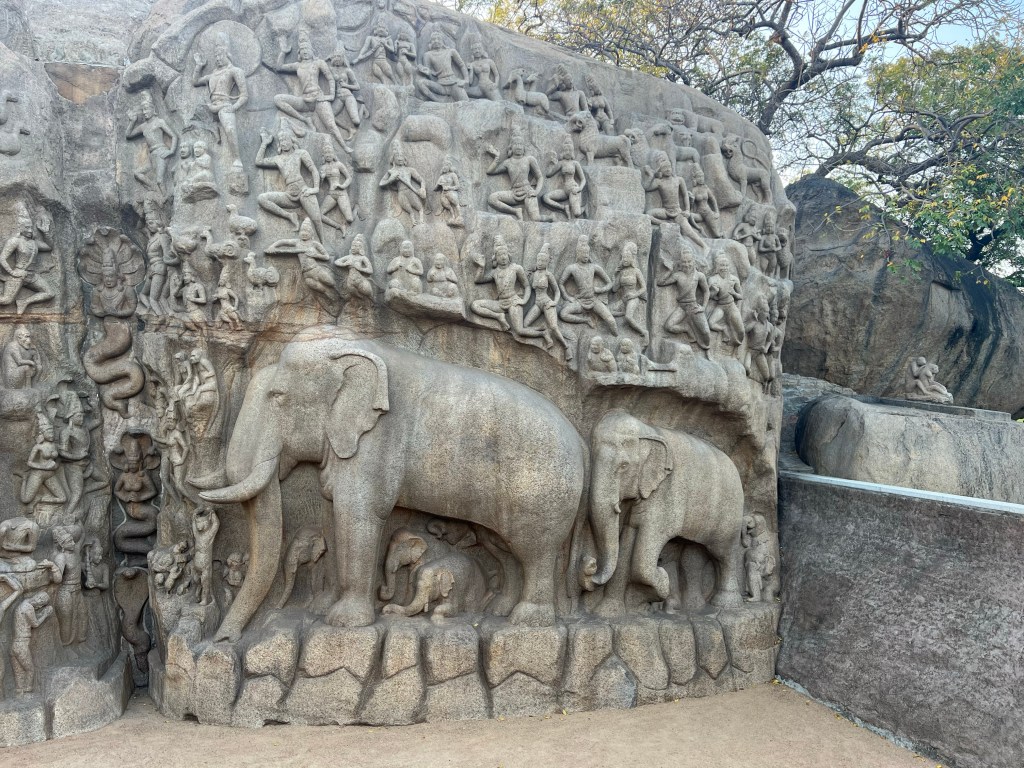
To its left is an enormous rock-cut relief on a single piece of granite called the Arjuna’s Penance or The descent of the Ganges. It is 15m high and 30m long with the most amazing carvings and figures recounting part of Arjuna’s penance. It is divided by a cleft in the middle, implying the flow of the river Ganges. There is a central character on the left practising penance in a state of meditation, standing on one leg as he is visited by Lord Shiva. On the other side, there are figures of wild animals: elephants, cats, lions and deer, along with other gods and a mountain range, most probably intended to be the Himalayas from where the Ganges flows. In the cleft there are figures of nagas (part human, part cobra) connecting Lord Shiva to Lord Vishnu.
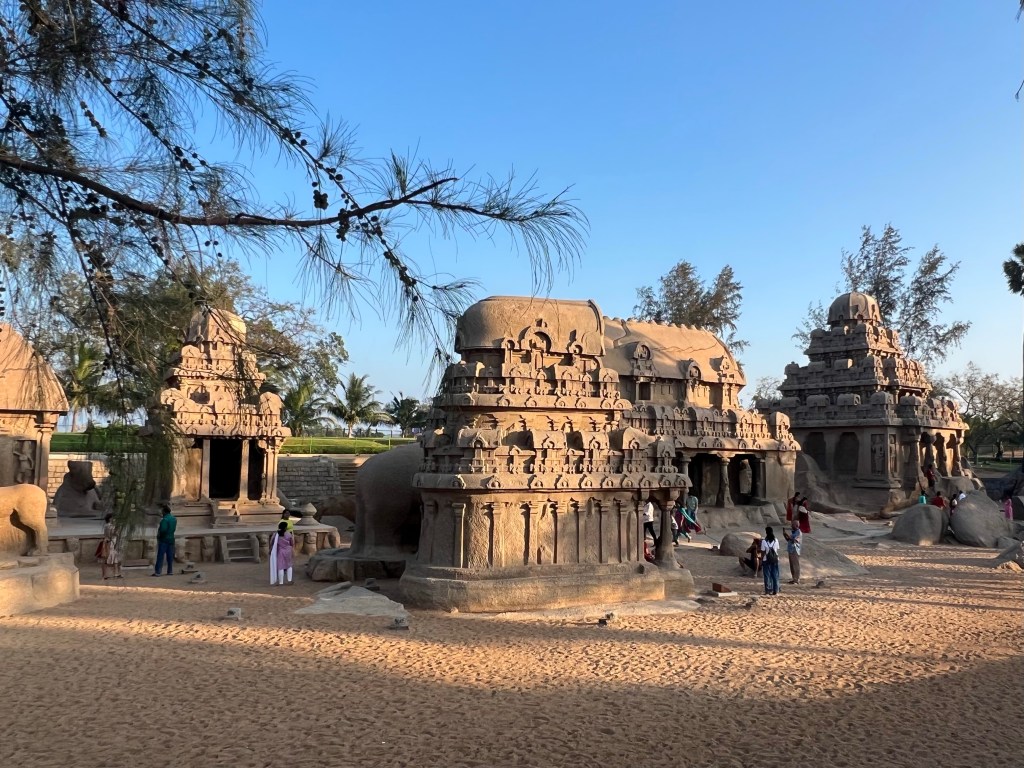
The third monolithic complex, known as The Five Rathas (chariots) are thought to be scale models for a chariot style temple. These are supported by three animals, a bull, a lion and an elephant, some of which were more complete than others. They have no religious significance, as they remained unfinished and were never consecrated.
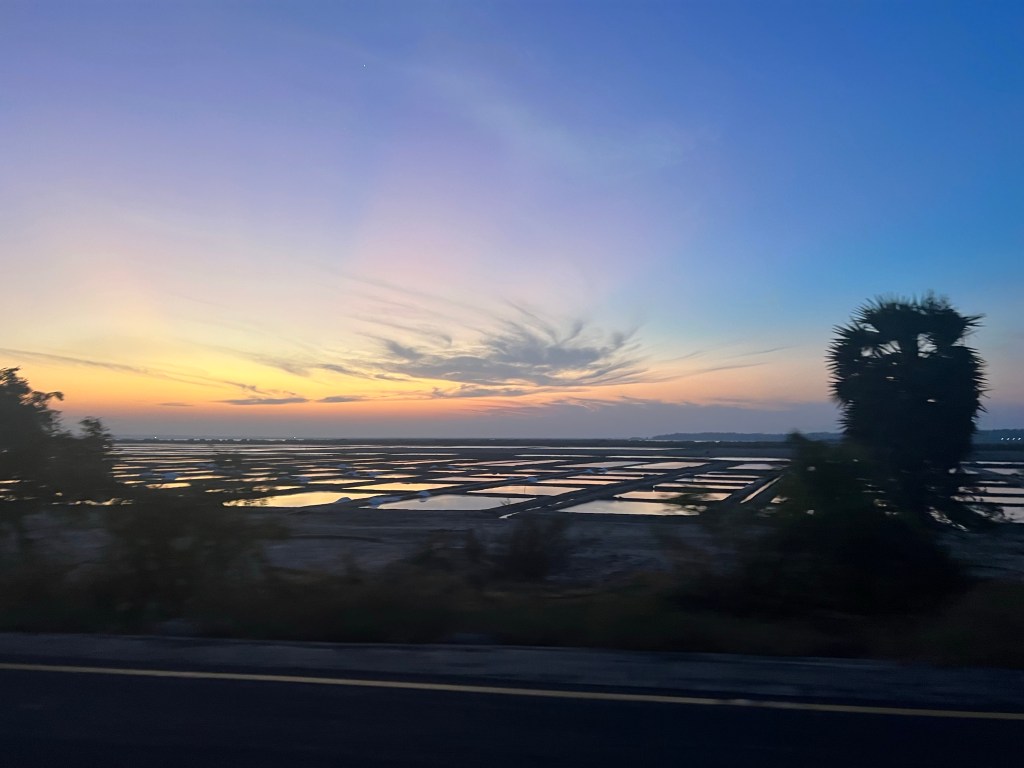
As we headed back to Pondicherry we passed, a number of brightly lit floats on their way to the temples for Maasi Masam, which were also lit up. At the same time the sun was setting over the salt pans – all very beautiful.
We arrived at about 7pm and I am staying in a very sweet hotel called La Villa. Unfortunately you had to book dinner the day before so that was off – but time to catch-up on the blog.
 EC-Rider Travels
Leave a comment