
Joyfully no 3.30 alarm this morning, still we were keen to do a nature walk at 9am so we headed to the ‘town centre’ to meet our guide. Sadly, however, this was also cancelled. It was not raining as yet, but a pretty grisly day so we had breakfast in one of the cafes, went for a short walk round the resort and then headed back to the hotel.
As we had been to Kata Tjuta yesterday (fearing it may be cancelled, due to the rain, today) we changed today’s tour to another sunset tour of Uluru. Although we had done this a couple of times before, this was with a different company, taken by Tyrone, I think the best guide yet. It was another school-day!
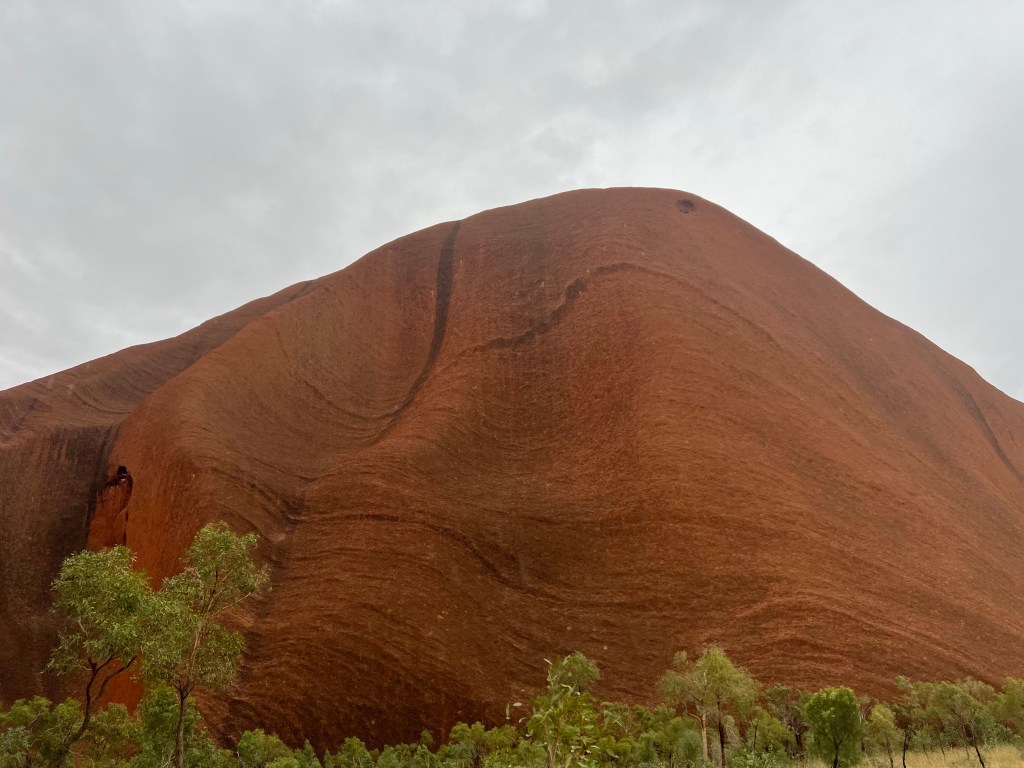
Tyrone told us more about the Aṉangu, the oldest ‘in tact’ culture on the planet. Aṉangu means ‘we the people’ and their ‘country’ covers the largest area of any aboriginal community, almost the size of Victoria. They traditionally have four different languages, with English usually being their fifth. They are nomadic, moving around the Northern Territories and South Australia, coming to Uluru in the dry season (March/April and Sept/Oct). Sitting on an Artesian water table, means there is always water at Uluru and a place of refuge.
The reason the Aṉangu has remained in tact and maintained its traditional customs is because they were isolated for so long. The European settlers did not venture into the outback until the 1870s when camels were introduced and explorers went there in search of gold and minerals. Regular contact with the Aṉangu was not until the 1930s when the Europeans came looking for farmland. They saw the potential of the Northern Territories, however Dingos were a problem if they were to bring sheep, so European ‘doggers’ came to get rid of the dingos. The Aṉangu helped the doggers track the dingos in return for sugar, tobacco, alcohol etc. Not used to such things, this caused diabetes, kidney disease and alcoholism amongst the Aṉangu. The doggers also got many of the Aṉangu women pregnant, starting a generation of mixed race children.
In 1911, the Northern Territory became its own territory, and a reserve was created for the indigenous people. As mentioned before, there are horrendous stories about the treatment of the indigenous people this time including massacres, poisonings, having to dig their own graves and much more. Then of course, there was the mass removal of their children to try and eradicate the aboriginal line all together. Truly shocking. They were apparently considered nothing more than animals and could legally be shot if found on your land …… which was of course, ‘their’ land. It was not until 1967 that Aboriginal people were recognised as Australian citizens.
In 1950 the road was built to Uluru and Kata Tjuta and the surrounding area was annexed and claimed as a reserve. This was soon followed by an airstrip and the first hotels near to Uluru. The Aṉangu were considered an embarrassment and moved on and away from their homes and sacred area. In 1976 fire destroyed 80% of the reserve and the settlers realised that they had much to learn from the Aṉangu regarding fire control and regeneration of the land. In 1985 the title deeds were handed back to the Aṉangu elders and today a co-government structure runs the reserve. When in 1983 The Ayers Rock resort was built, the original hotel complex was handed over to the local Aṉangu. They now have a permanent Mutitjulu community there with a school, medical centre, supermarket etc.
Tyrone also gave a little more insight into the way the Aṉangu live and their values – their Tjukurpa. This is their religious heritage, which explains their existence and guides their daily life. For Aṉangu, Tjukurpa provides answers to important questions, the rules for behaviour, for living together and caring for their land. They are totally non-materialistic and see no value in owning anything more than they need to survive. They also have no desire to conquer nature as we do, ie to climb Uluru – what is the point and what a waste of valuable energy which could be spent on hunting or gathering. Although they now have access to supermarkets, doctors and needless to say mobile phones, they still maintain many of the customs we have heard about. Young men will still be taught to hunt with a spear and the girls how to forage for and cook food/medicine. Their ceremonies and rituals are still very much practiced and sometimes areas of Uluru and Kata Tjuta are closed in order for these to take place.
Tyrone also explained that the creation stories, we have been hearing, are believed, literally, by the Anangu as how the creation came about and the stone formations we have been shown, are their literal remains. This is another reason why they are so sensitive about photographs being taken of their sacred sites, as they believe their ancestors are there and their images should not be reproduced. They also believe that when someone dies, they should not be disturbed so they will never mention their name again.
When we arrived at Uluru to start our walk to the Multijulu waterfall, there was a guide on the emergency phone to the rangers as two people had carved their initials in the the rock-art cave. Unbelievable! According to Tyrone, this may well result in the Aṉangu closing this cave to the public for ever more.
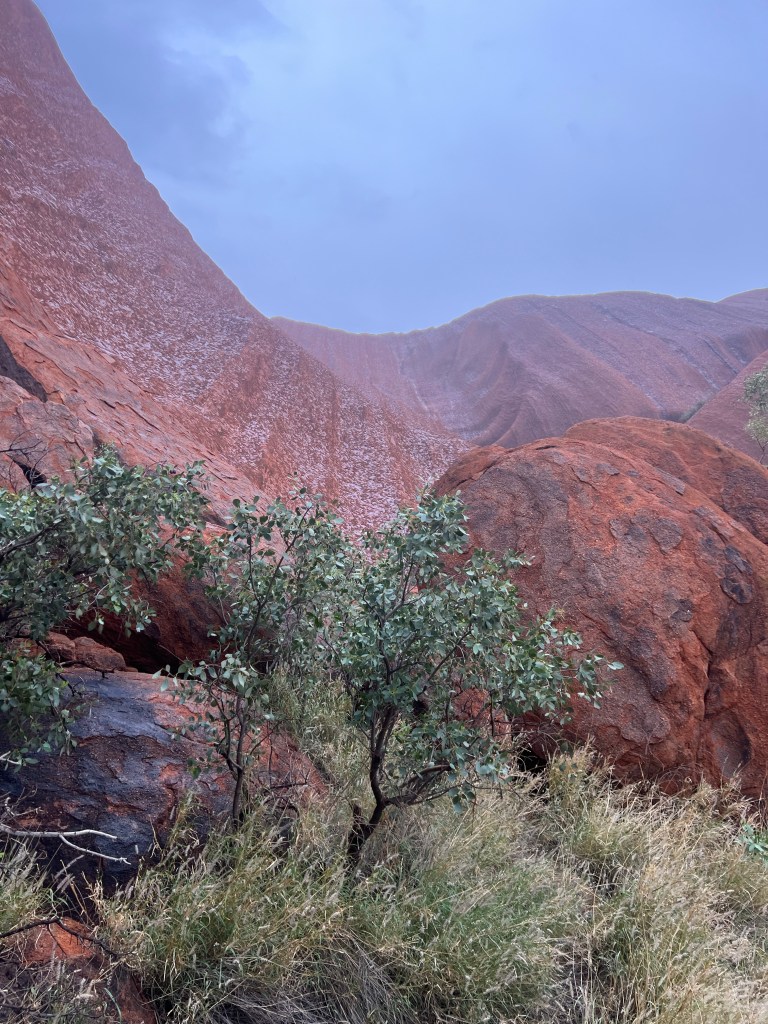
Following our walk to the waterhole, which looked different again in the rain; we went to the sunset platform to watch the non-existent sunset in the pouring rain, helped by a nice glass of champagne and some rather good cheese. We had still not had a definitive answer as the the nature of Sarah’s emu egg, so we thought we would try Tyrone on this. Looking at it from the path, he was no clearer so asked some of the Aṉangu women to have a look. They were initially very excited and leapt over the fence (as only they are allowed to) but on closer inspection, they fell about laughing as it was definitely a moulding paddy melon, apparently tasting so disgusting, it would ‘kill a camel’!
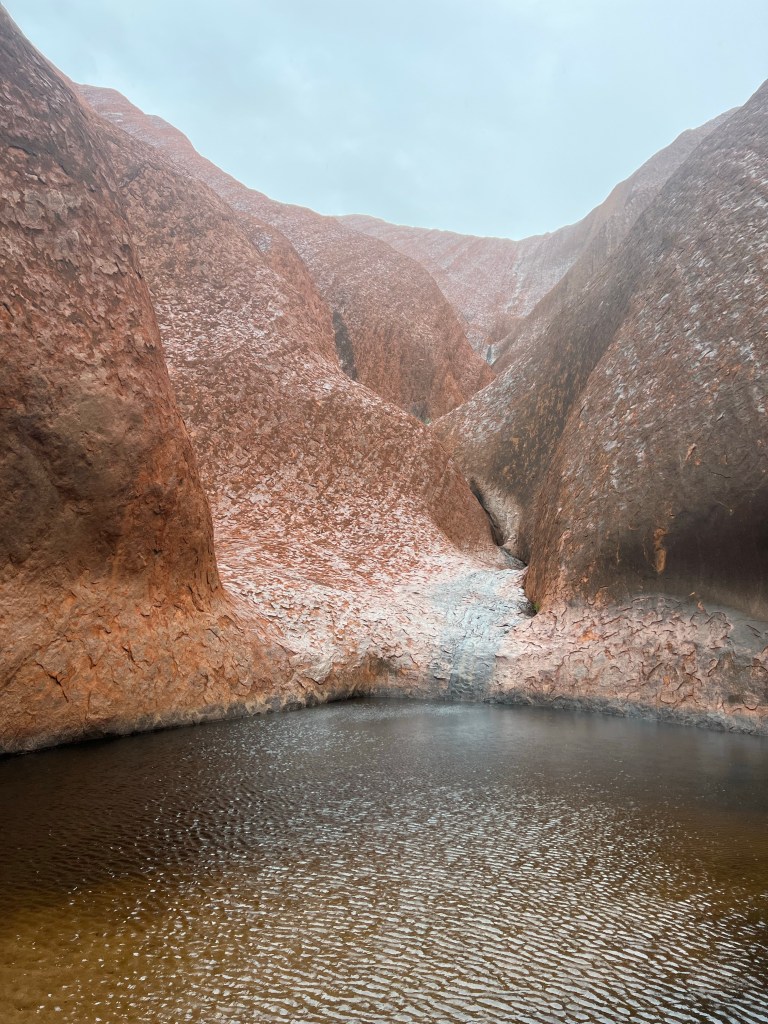
Our Astro tour with Todd was sadly also cancelled this evening as there were still no stars in the sky, so we had supper in the hotel bar, with a lovely Melbourne girl called Katherine, who had also worked in London for a number of years. It was now raining hard, and Sarah and I decided we had to see Uluru in the rain so, at the very last minute, booked another 4.30 bus to take us there. So it is now bedtime 😴
 EC-Rider Travels
Leave a comment