
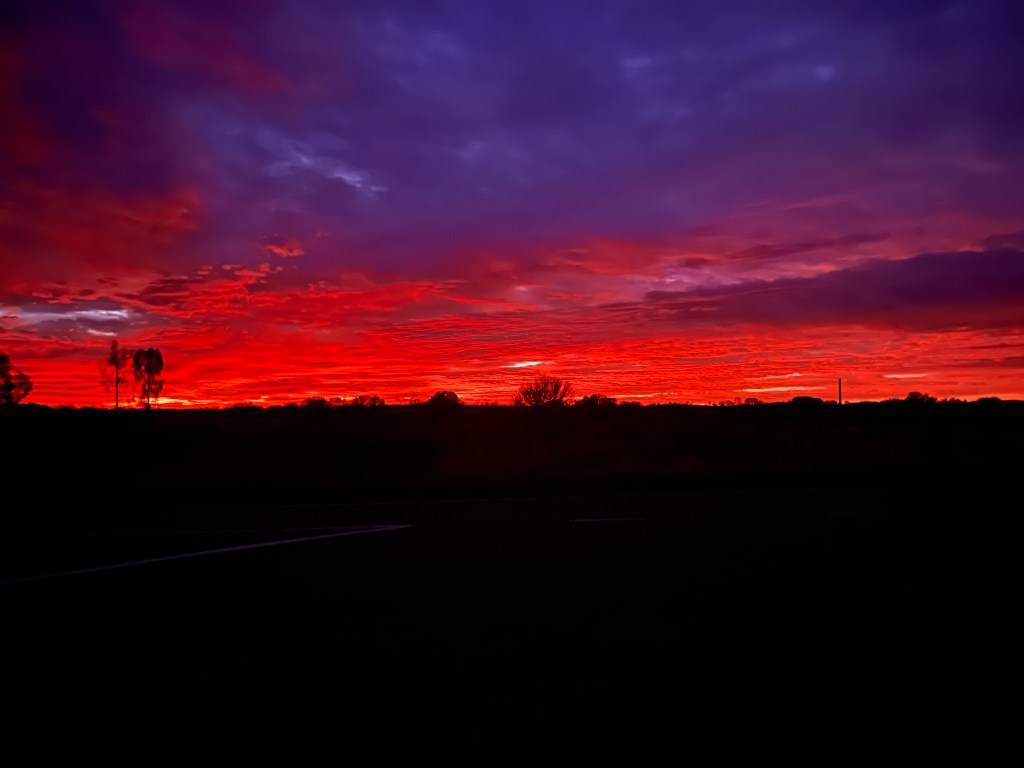
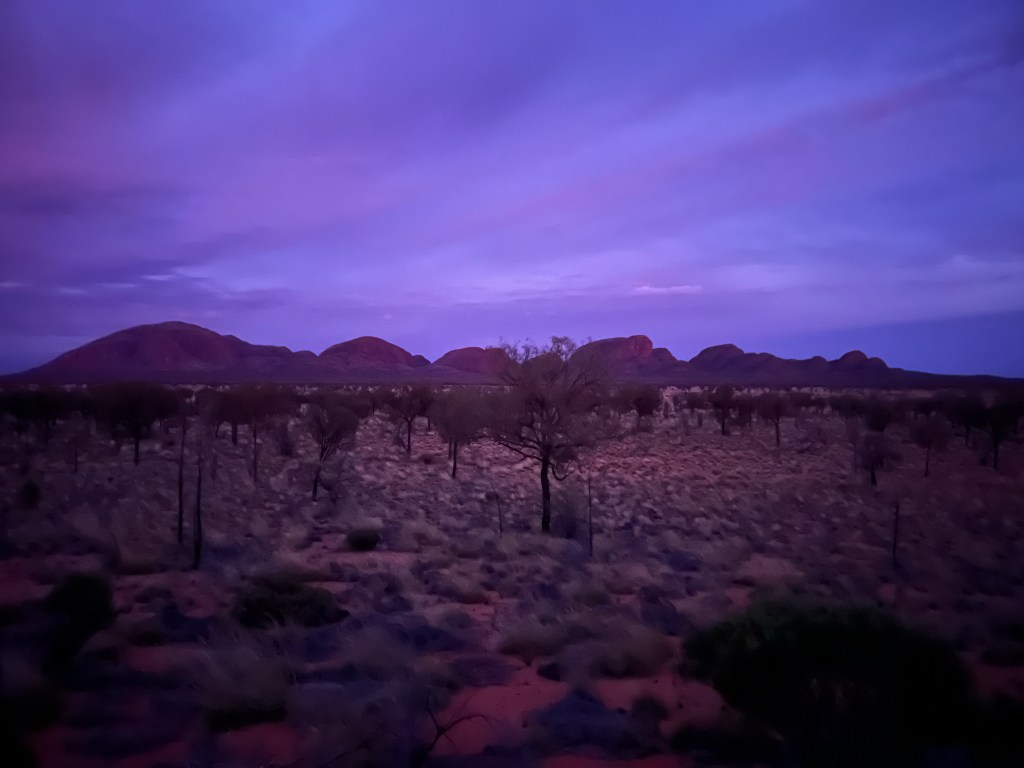
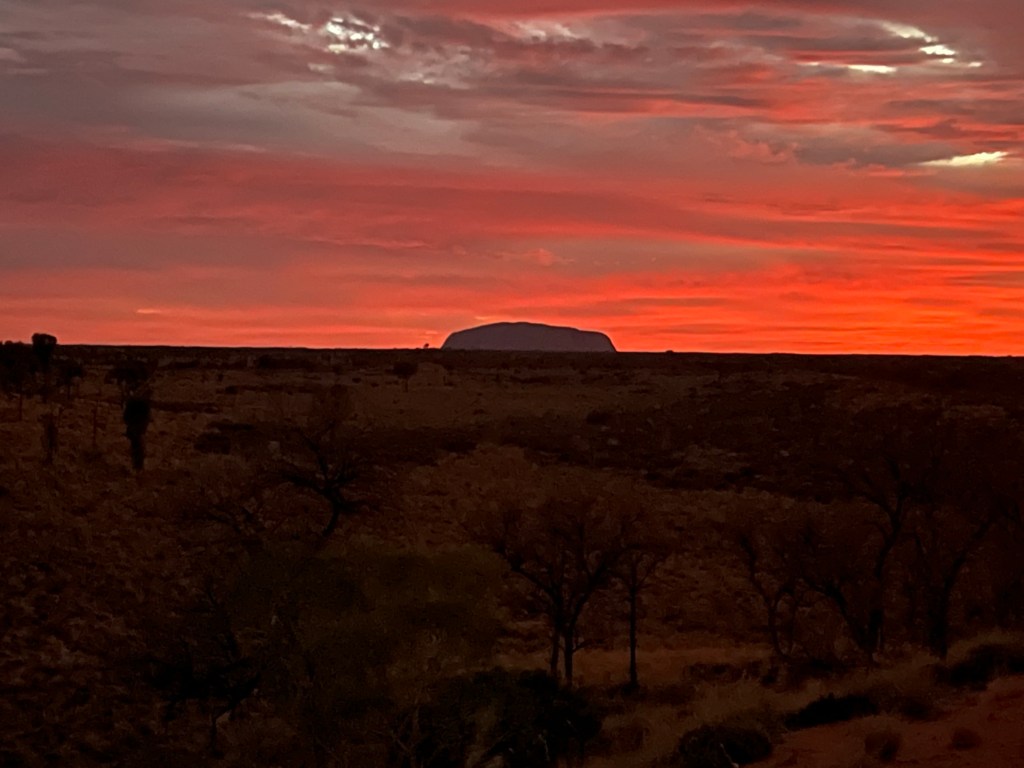
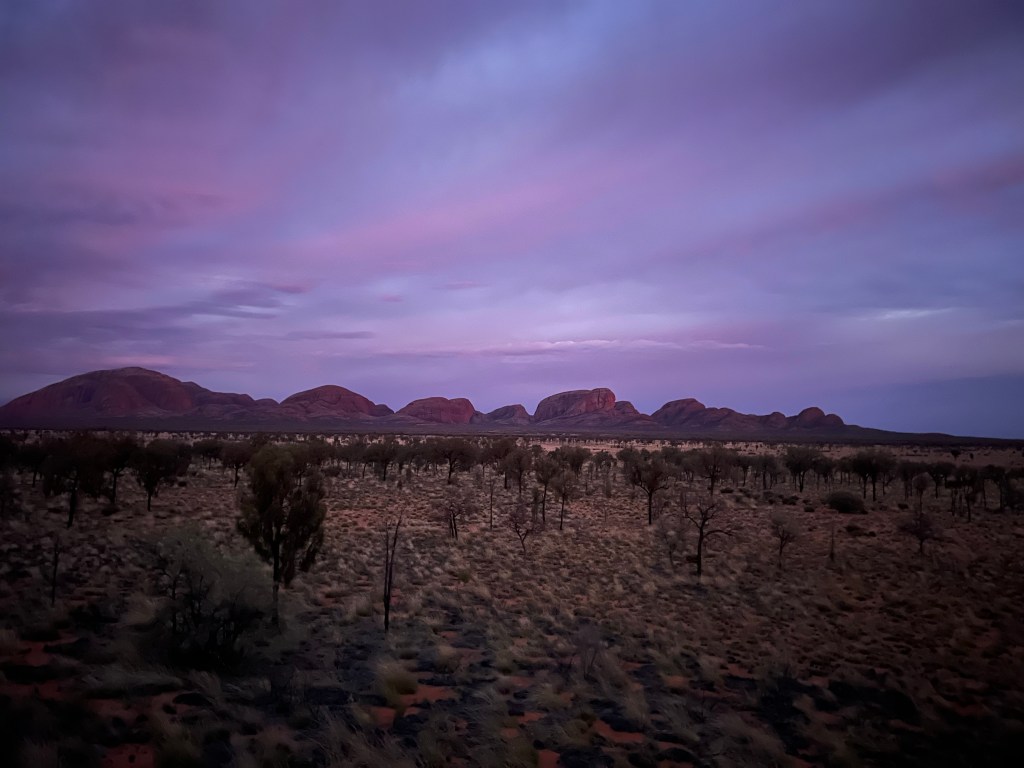
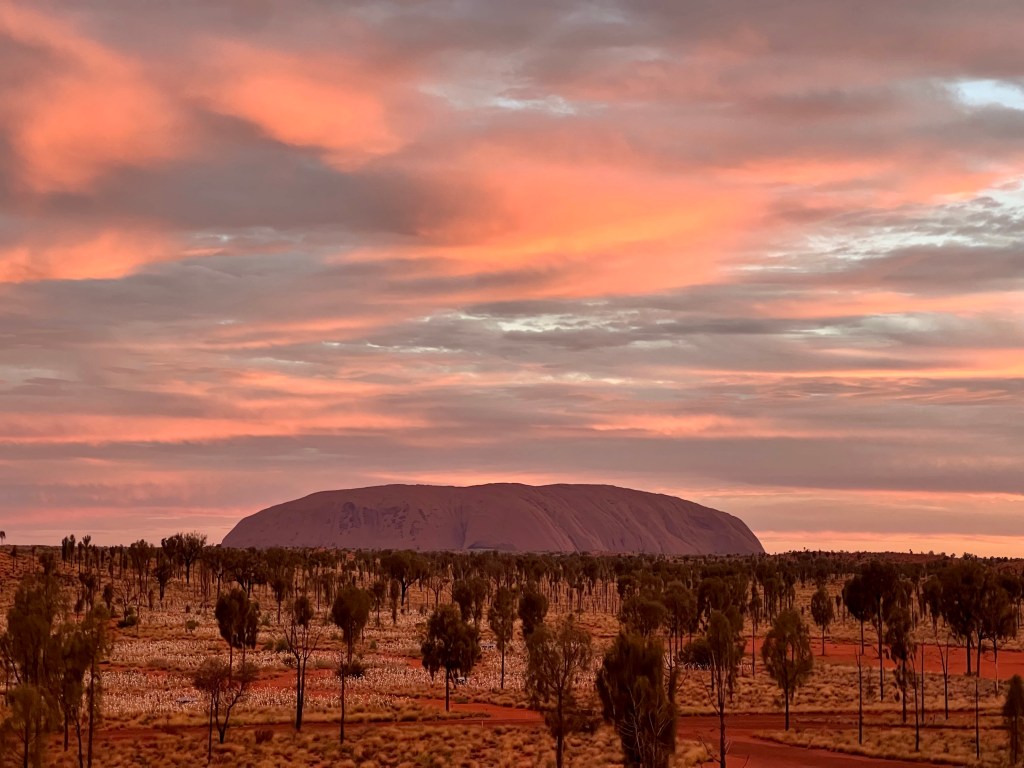
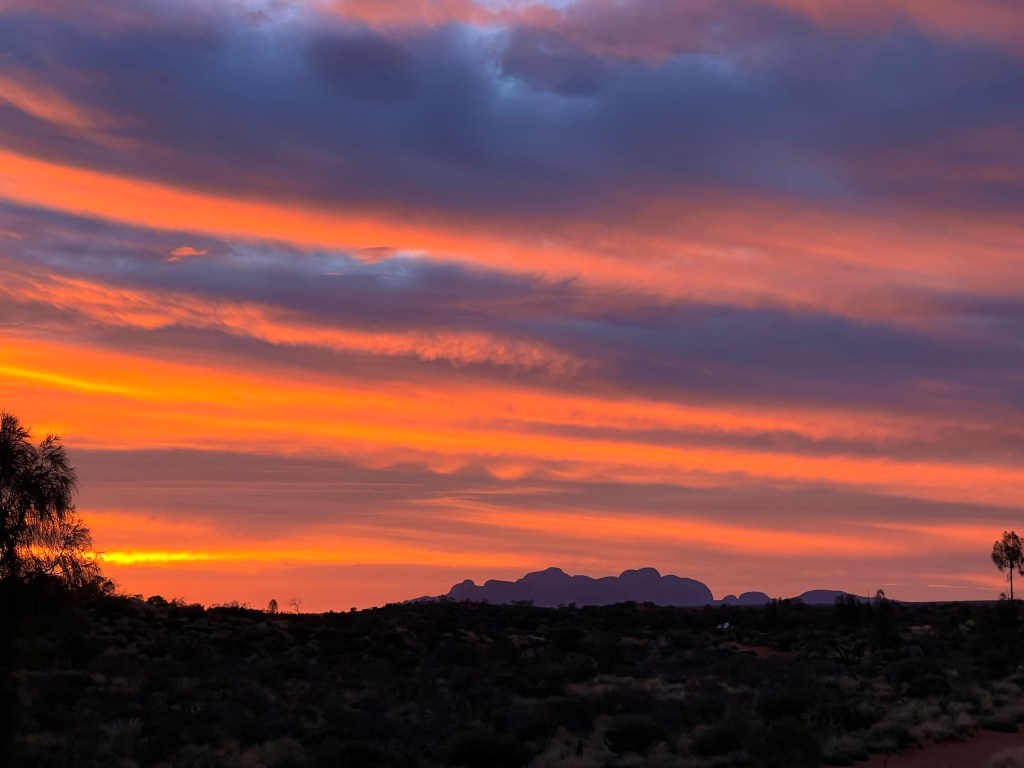
We left at 4.30am to see the sun-rise over Kata Tjuta, meaning’many heads’ in the local Pitjantjatjara language. This is a group of 36 large, domed rock formations, approximately 40km west of Uluru. We were driven at great speed by ‘Snakebite’ to a viewing spot where we could see both Uluru and Kata Tjuta wake-up. Despite the cloud, we had the most stunning sunrise, turning them both a kaleidoscope of different blues, purples and pinks.
Snakebite, who I feel had been doing this job for some time, then drove at breakneck speed to Kata Tjuta, regaling stories of his snakebite and 5% chance of survival etc etc! I felt our chances were not much better, but somehow we also survived the drive and went on a short walk into the Walpa Gorge. This is a natural creek that carves its way between the two tallest domes of Kata Tjuta, culminating in an oasis. This has an extraordinary ecosystem, which harbours some rare plants and apparently animals. A native tobacco, which is dried and mixed with white ash and chewed to relieve hunger, thirst, tiredness and give a general feeling of well-being! The rare spear-wood which is incredibly strong, flexible and lightweight and used to make spears. Sadly, animals and birds were not in evidence; there has apparently been quite a decline in recent years.
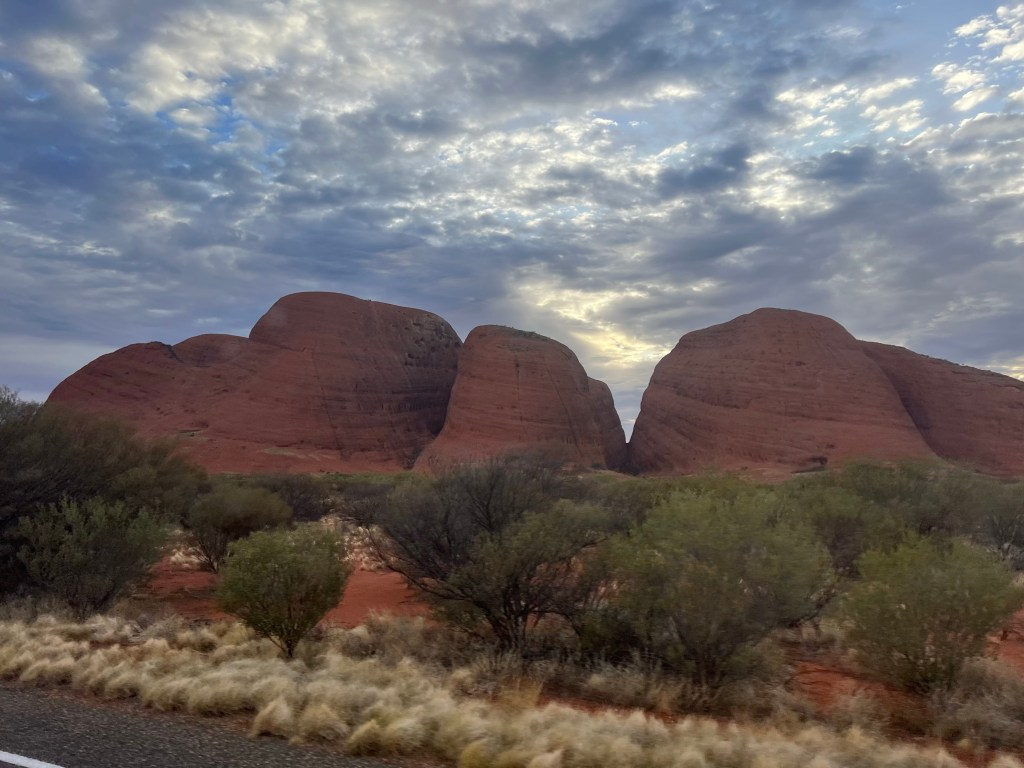
The first non-Aboriginal person to see Kata-Tjuta was the explorer Ernest Giles, who named the largest dome Mount Olga, after Queen Olga of Württemberg. Mount Olga (or the Olgas) was the official name until in 2002 when it was formally given the Aboriginal name, Kata Tjuta.
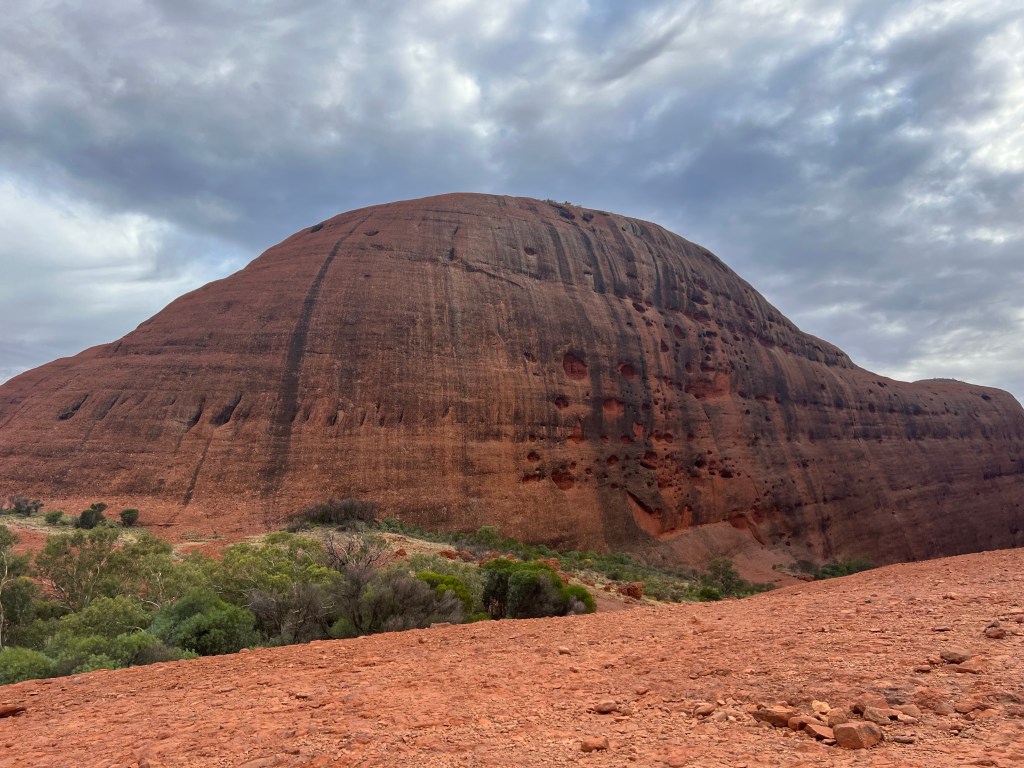
Rising over 546 metres above ground level, Mount Olga, the highest point of the Kata Tjuta is more than 200 metres higher than Uluru. Kata Tjuta is 22 kilometres in circumference, so again bigger (and in some ways more impressive) than Uluru.
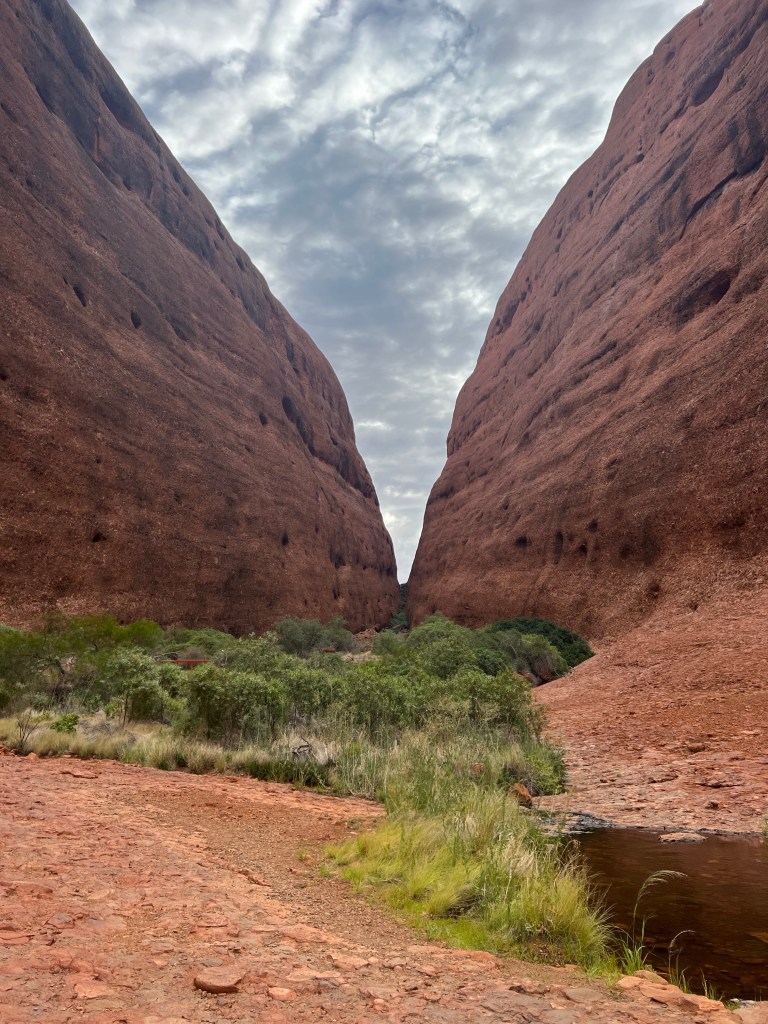
Kata Tjuta is sacred to the Aṉangu people and forms an important focus of their spiritual life. It is a men’s sacred site and may not be visited by the Aṉangu women. Many of the legends surrounding Kata Tjuta are not disclosed to outsiders, particularly women as, according to Aboriginal tradition, if a woman learns about ‘men’s business’, she is susceptible to violent attacks.
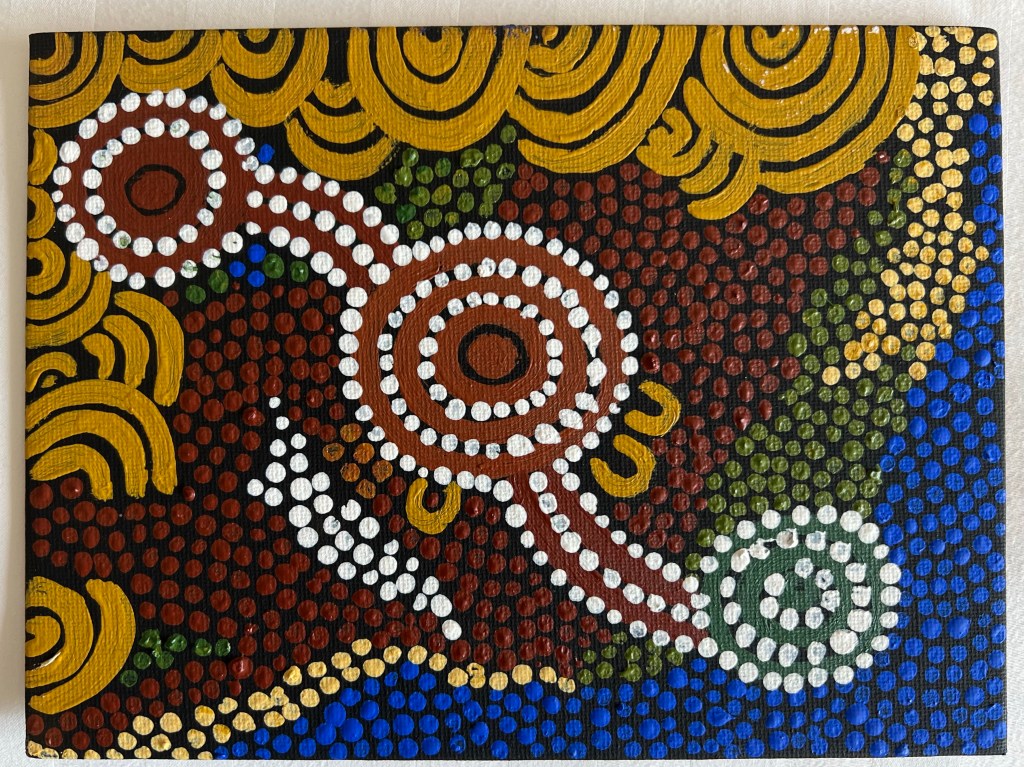
We returned to the hotel in time for a quick breakfast and a ‘dot-painting’ class taken by a lovely Aboriginal lady, called Sarah, translated by Michelle. She started by explaining many of the symbols they use in their art by drawing them in the sand; as they would have done until introduced to canvas and acrylic paints in the 1970s. Pictures are usually depicted as a birds-eye view looking down from above, eg a person is a u-shape being the impression they would leave in the sand. They can be identified by what they have beside them, a straight line would be a woman’s digging stick and several lines would be a mans hunting tools. They usually tell a story, often a journey or a situation and, when explained, make very much more sense and are rather moving. Their use of dots is more recent and is much more skilled than it looks.
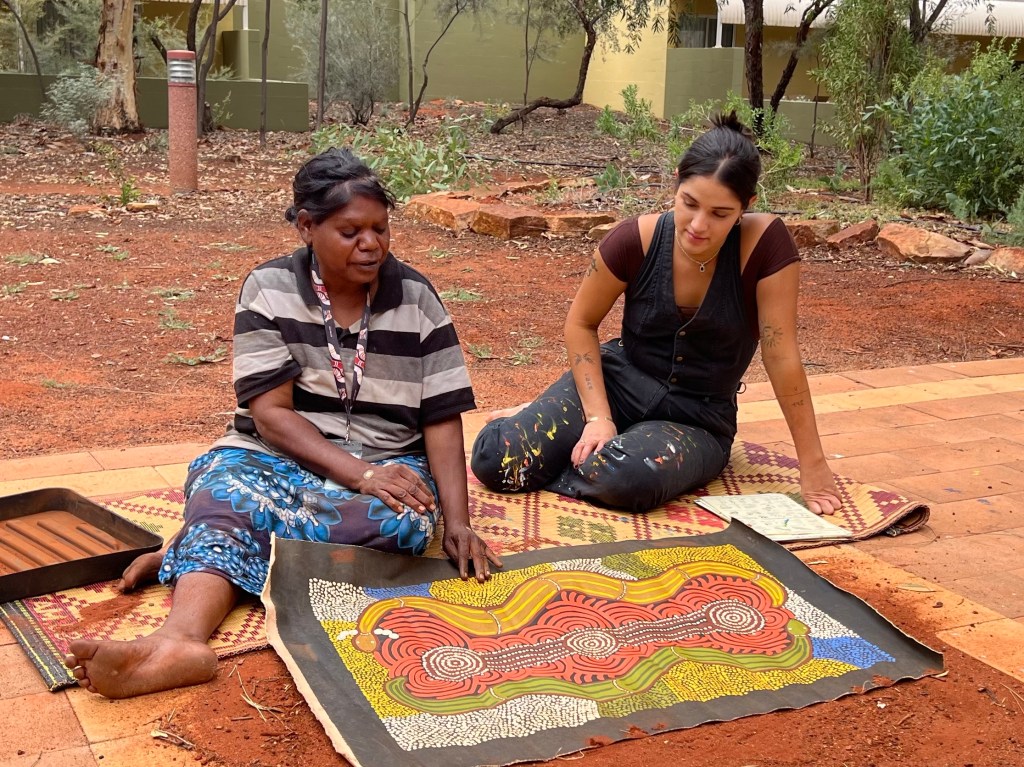
It was then over to us! Needless to say, my artistic friend was very good at it and created a really lovely painting telling the story of our arrival in Uluru. Mine looked as though it had been done by a three year-old and was snuck into the bin!
In the evening we had the most amazing dinner overlooking the Field of Light. We joined about fifty others and sipped champagne as we watched the sun go down on Uluru and Kata Tjuta. Despite a cloudy sky, it was utterly beautiful, including a rainbow.
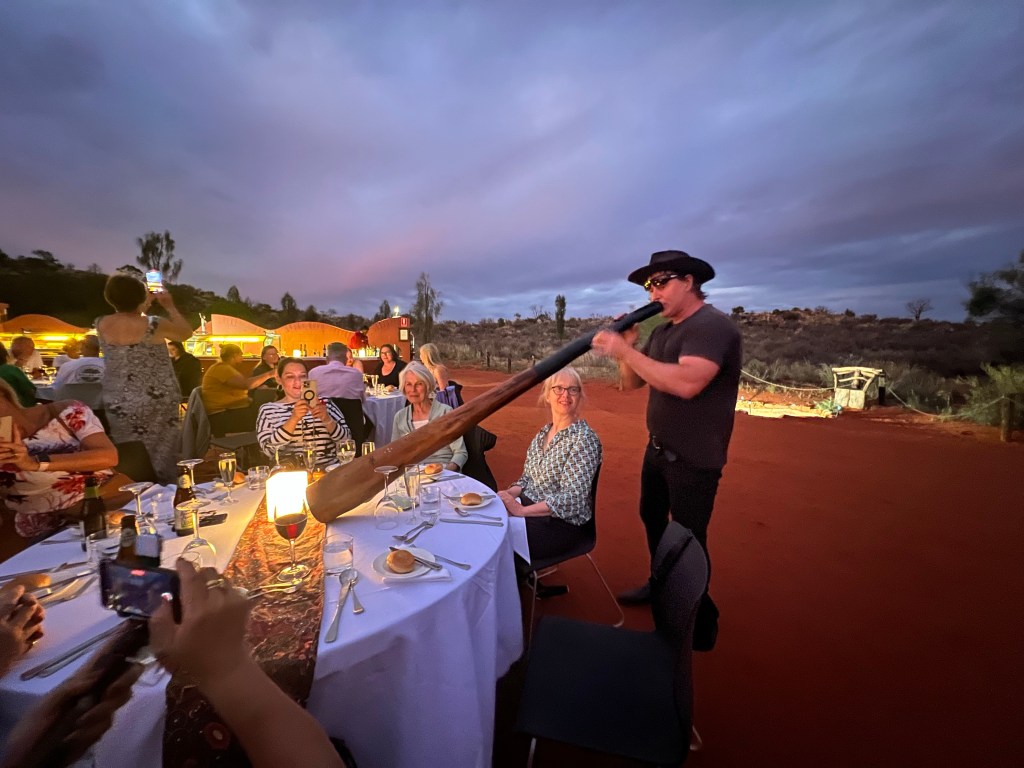
We then walked a little way into the desert to be seated for a delicious ‘bush tucker inspired’ dinner. We were serenaded by our friend on the didgeridoo and served a really good dinner. I tried kangaroo (feeling a bit 😔) but have to confess it was rather good. We had a very chatty table and a great time. During dinner Todd took the floor to talk us through the infamously beautiful southern sky at night. Sadly it was its night off – not a single star or even the moon! Undeterred Todd continued explaining what we would see if we could!
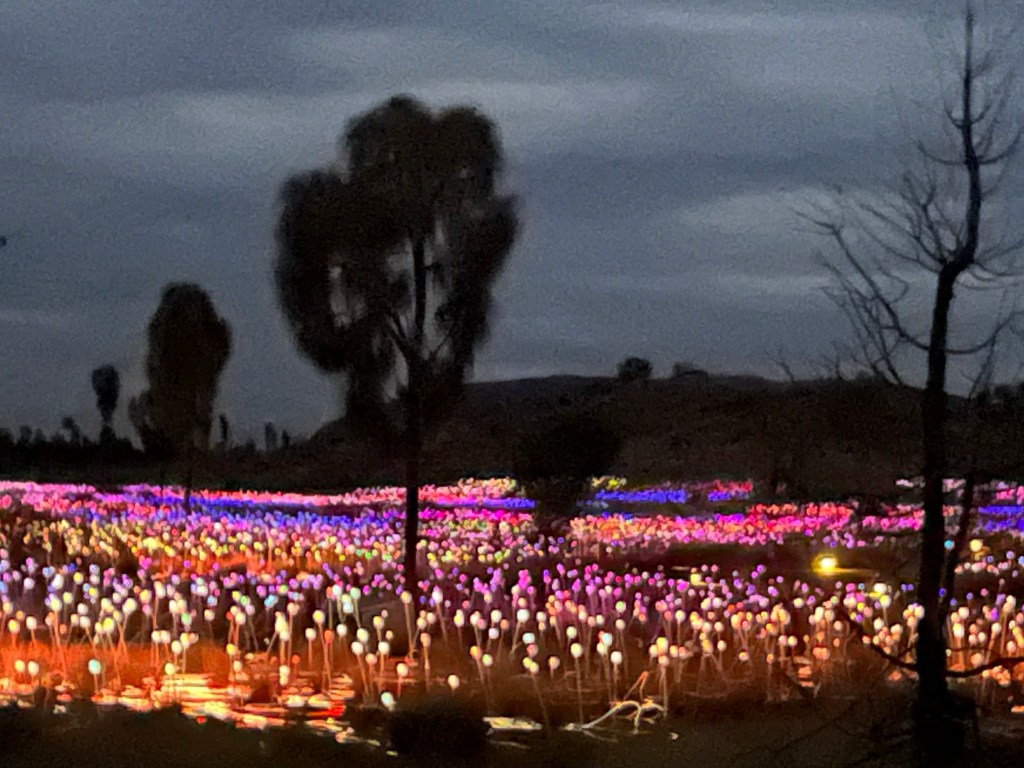
As darkness fell, the Field of Light started to illuminate and as far as we could see were swaying lights of reds, ochre, violet, blues, greens and white, looking like a giant dot-painting. It was quite breathtaking. It is the creation of Wiltshire designer, Bruce Munro who has created Fields of Light all over the world. This is his largest and covers over 49,000 square metres and comprises 50,000 lights. It was his first solar-powered work (not many power outlets here!), but is apparently less designed and geometric than his others, reflecting the untameable nature of the desert. He was inspired by a visit to Uluru in 2016 and claims this experience gave him the courage to become a full-time artist. William Magill worked with him is his early days!
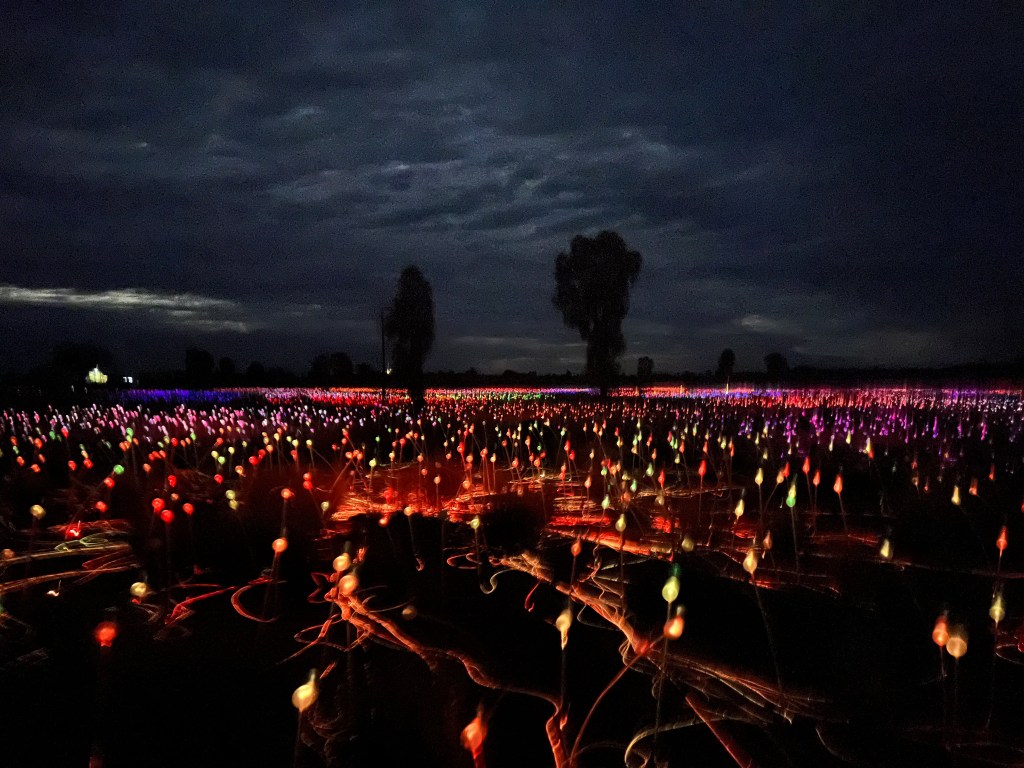
The installation, named Tili Wiru Tjuta Nyakutjaku or ‘looking at lots of beautiful lights’ in local Pitjantjatjara, is embraced by the Aṉangu and though initially intended as a temporary exhibition, has been extended permanently.
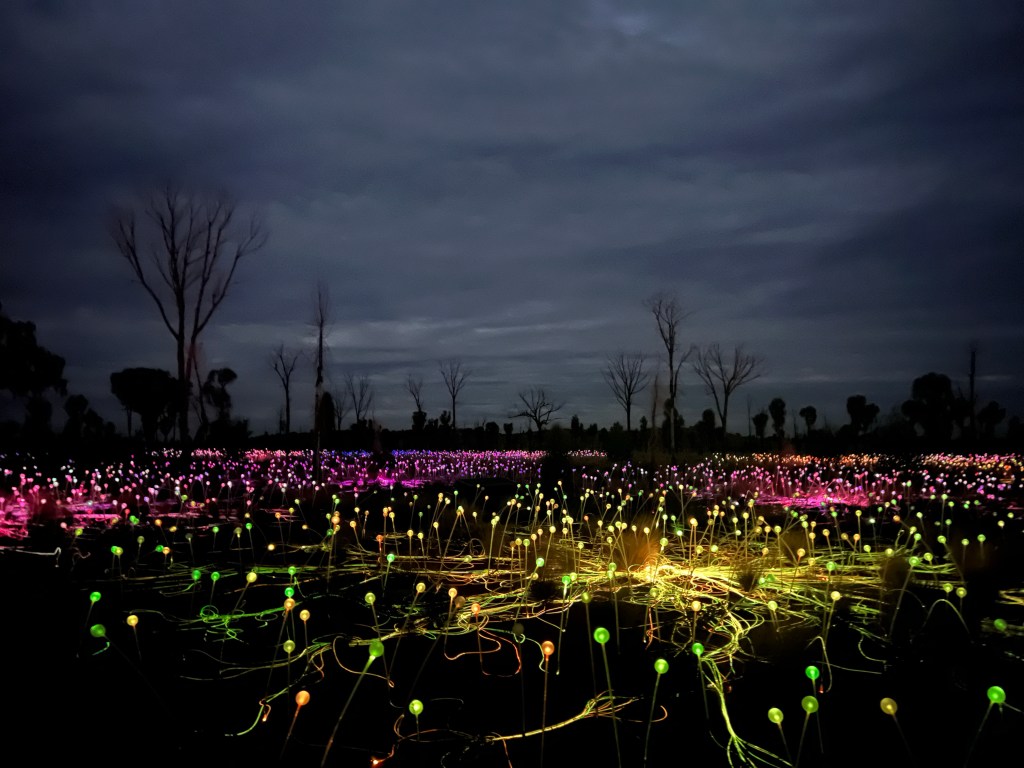
After dinner we were invited to walk through the meandering paths of the Field of Light – very special. Sarah got talking with Todd who was fascinating. He had come here to see his indigenous friend on a training scholarship and never left. Starting as a cleaner, he worked his way up to being a guide and the resident astronomer – incredible. He is now married to an local Aṉangu girl with two children.
We happily collapsed into bed – quite tired after our 3.45am start!
 EC-Rider Travels
Leave a comment