
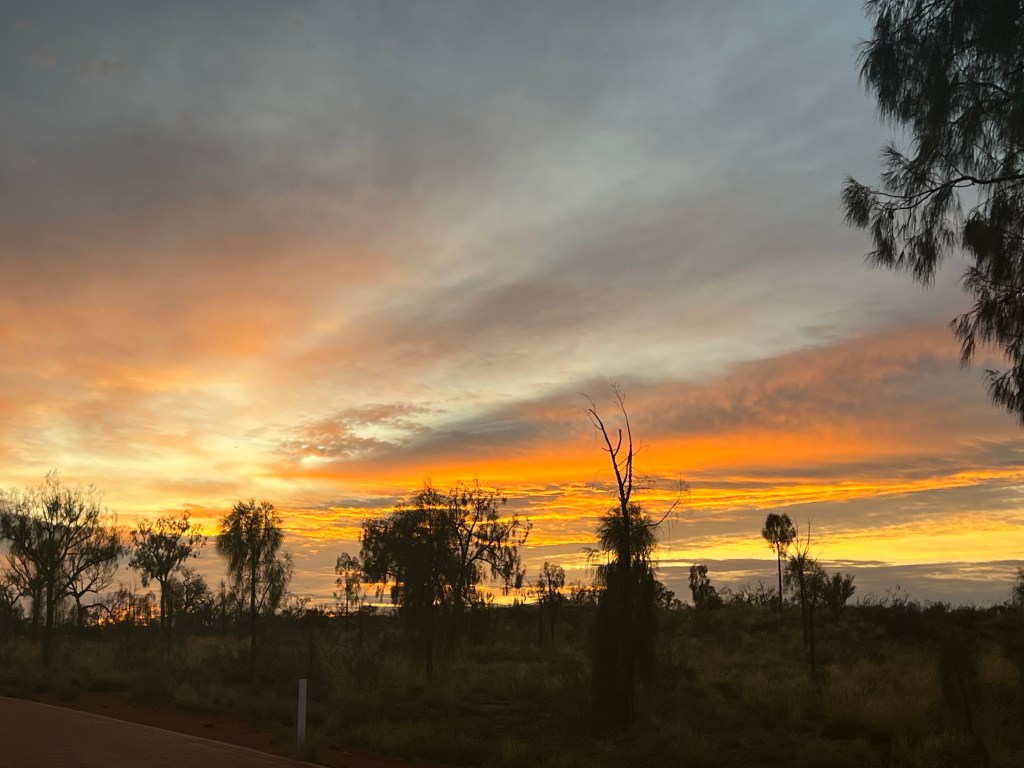
Another 4am start! as we headed out on a minibus with Nadine for our first Uluru experience. We were taken to a viewing spot to see the sunrise. We were facing west with the sunrise behind us but it was still pretty amazing watching the sun come up on one side and the impact of this on Uluru on our other. It changes colour constantly going from grey to purple to pink to orange – stunning. Uluru is another one of the world’s great sites you have heard about all your life and fear that it may not live up to expectation, but once again, it did not disappoint.
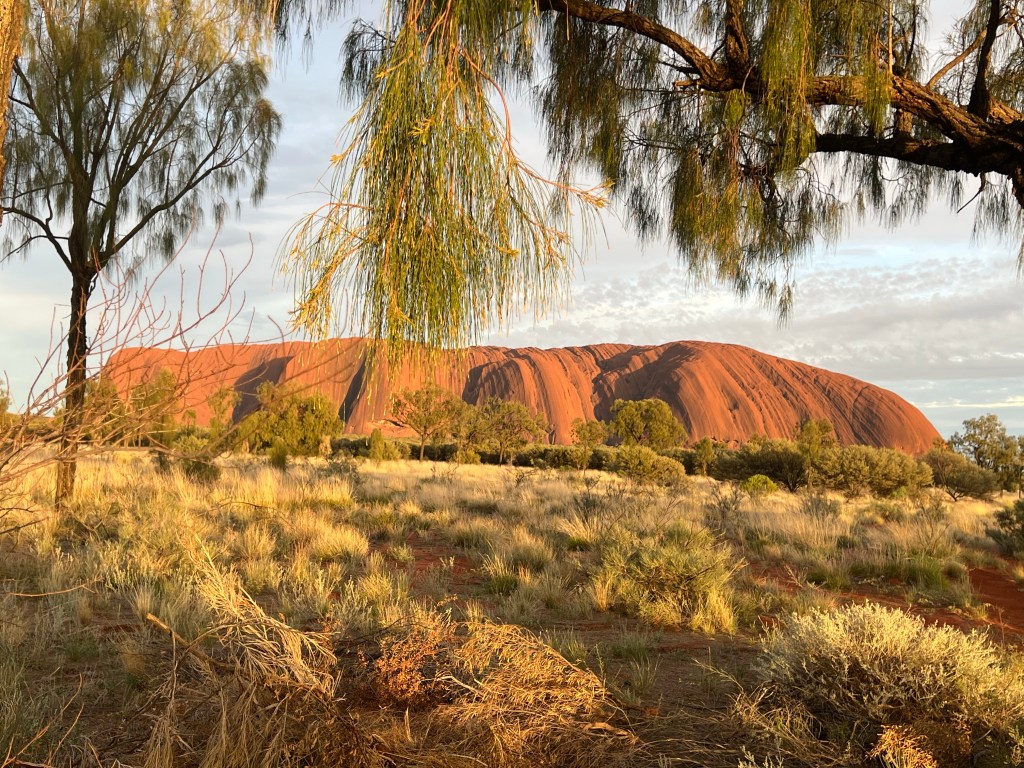
Nadine explained that the arkose-sandstone monolith, stands 348 m (1,142 ft) high, with a further 5-6km lying underground. It is thought to be over half a billion years old and has a perimeter of 9.4 km (5.8 miles). Both Uluru and the nearby Kata Tjuta have great cultural significance for the local Aṉangu people, the traditional inhabitants of the area, with various parts of the rock being sacred to them. It is naturally black but its heavy iron content is oxidised forming iron oxide (rust), which turns it red. The sandstone is very porous and takes in water, which over time has frozen and caused the many splits in the rocks, and much of it is hollow.
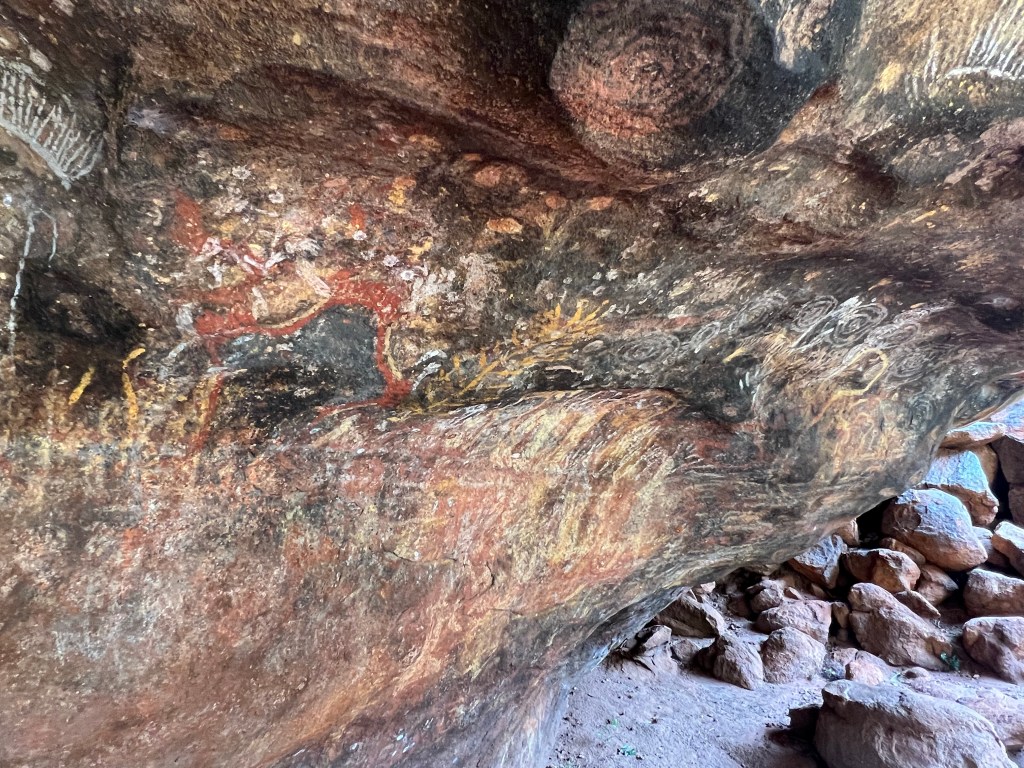
We drove closer to Uluru and we went on the short Kumiya walk to the Mutitjulu waterhole. Along the way we saw a number of caves where the Aṉangu would have met to teach, hold ceremonies etc. Some of these contained some aboriginal rock art which had been created and preserved by the aboriginal people for 3-4,000 years. It is painted in ochre and charcoal and had many layers of pictures, symbols and figures painted on top of each other. These have been used by the Aṉangu for thousands of years and are still used today, alongside sand drawings, paintings on canvas, to teach children the creation stories and ensure the continuation of knowledge.
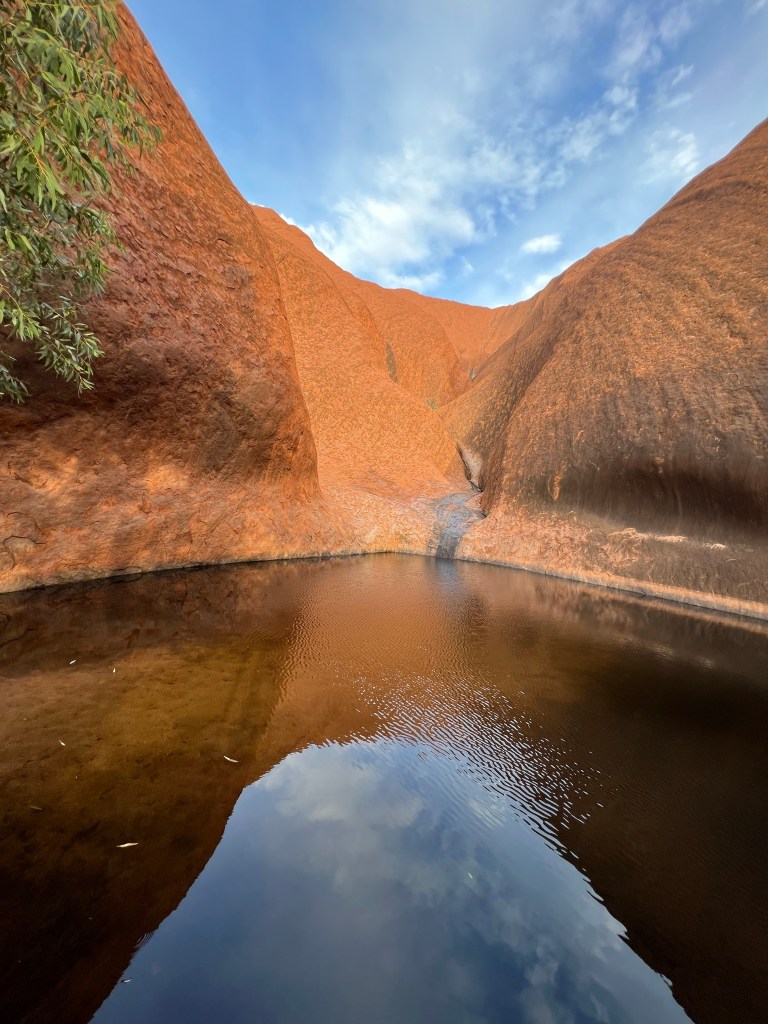
We ended up at the beautiful, sacred Mutitjulu waterhole, a huge indent within the rock and one of the few permanent water sources. This was left for the animals to come to and never drunk or swum in by the Aṉangu, as this would leave a scent and deter the animals from coming. It was so peaceful and such a surprise to find in the heart of this smooth looking mountain.
Although nomadic, the Aṉangu have been coming to Uluru for the last 35,000 years. It was only discovered by white men about 100 years ago. Ernest Giles and William Gosse were the first to see Uluru and Kata Tjuta and named them Ayers Rock and Mt Olga. In 1920 it was included in a reserve as a sanctuary for Aboriginal people. However during the 1930s the whites started grazing their sheep on the land and their valuable food sources disappeared. At the same time police patrols came in and took away a number of the Aṉangu people and their children. Many became frightened and left only returning in the 1970’s when their elders started negotiations to regain their land. Eventually in 1985 they were granted title of the park, however this was on the understanding that it is leased to Parks Australia for 99 years and jointly managed.
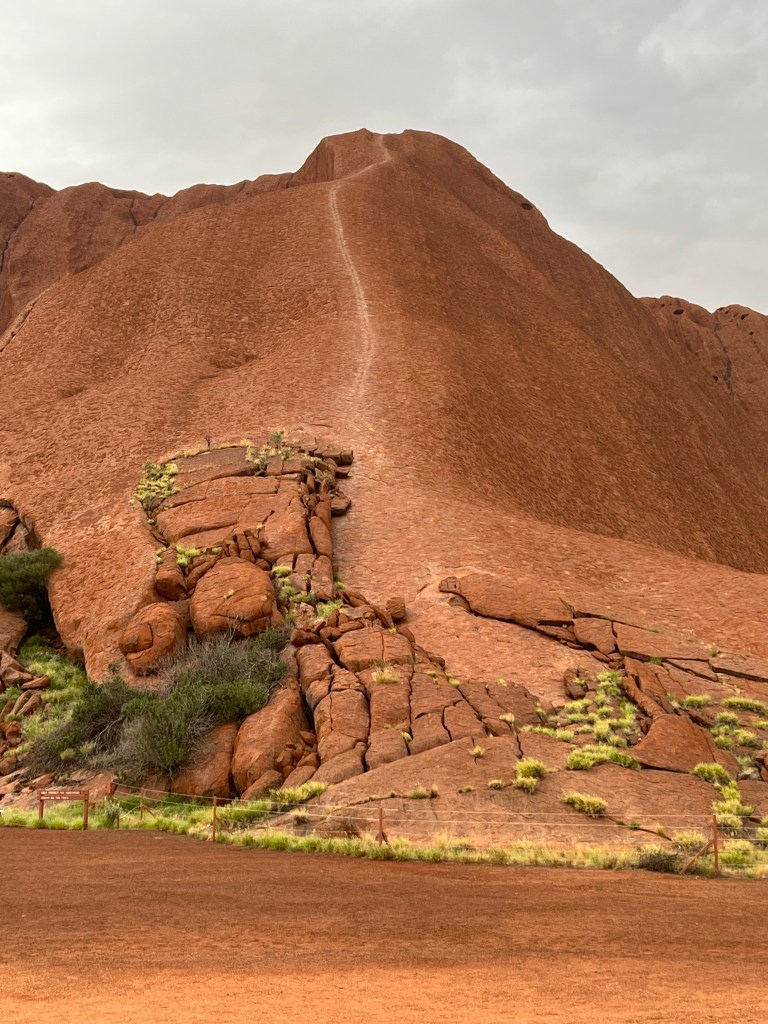
In 1948 a dirt road was made and in the 1950’s tourists started visiting and hotels were built with an airstrip alongside Uluru. Damage to the environment and the sacred sites started and eventually in 1983 the various hotels were closed with the opening of the Ayers Rock resort. This provides employment and in theory 40% of the staff in the resort are indigenous, although this is not immediately obvious. Until 2019 tourists could climb Uluru however following a number of accidents and deaths this is no longer possible. We saw the path where they used to climb, leaving a permanent scar on the side on the rock.
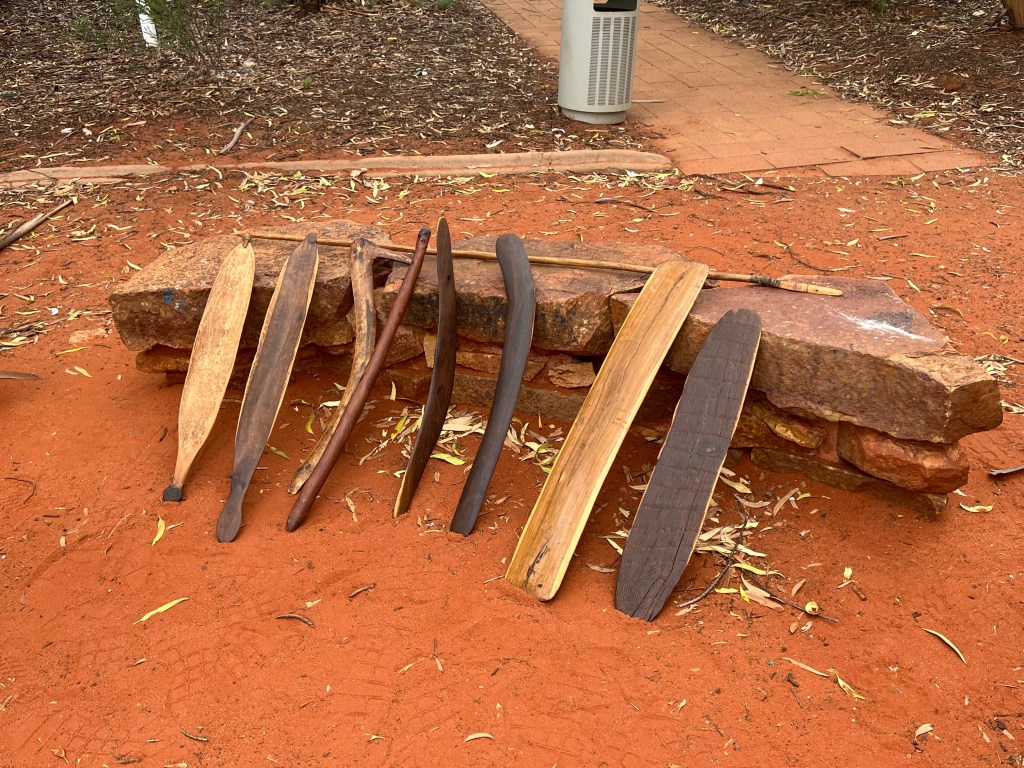
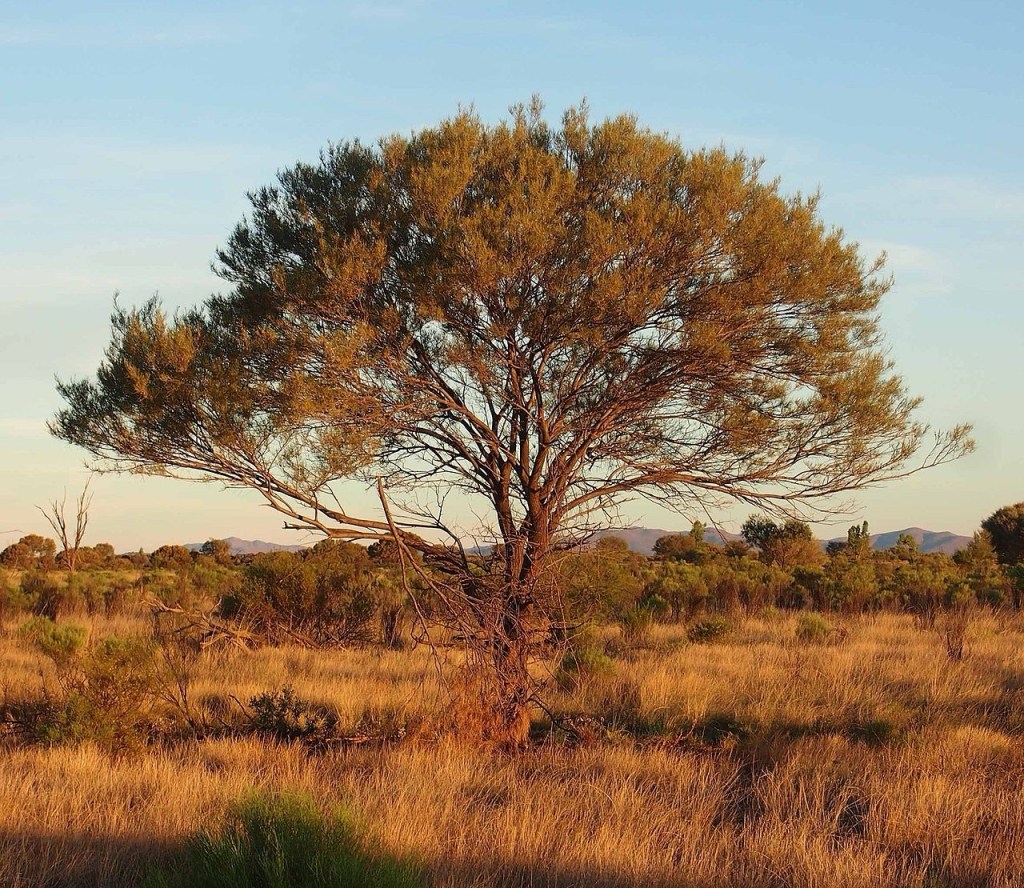
We returned to the resort and had a delicious breakfast and then headed back into the town for a series of talks. The first was entitled Bush Yarns and we were taught about the various tools the Aṉangu use to hunt, defend themselves and gather food. The majority of these are made from the very dense and hard wood of the mulga tree. This is plentiful around Uluru. Tendons of kangaroos are used to bind spears combined with resin made from spinifex grass mixed with kangaroo droppings, apparently forming the fourth strongest adhesive in the world, which is also reusable. They have a miru (also made of mulga wood), a good multipurpose tool with a hook on one end and stone knife on the other which can be used to cut animals, make string, cut wood and to make spears. A miru is primarily used as a spear thrower but can also be used as a dish and a fire lighter. Their boomerangs are made from the root and trunk of the mulga tree and again multi-purpose. These vary widely between different tribes according to what they need them to with them. The ones here, shaped like a 7, were non-returning and used to hunt and break the legs of kangaroos. The oldest boomerang has been found to be 22,000 years old.
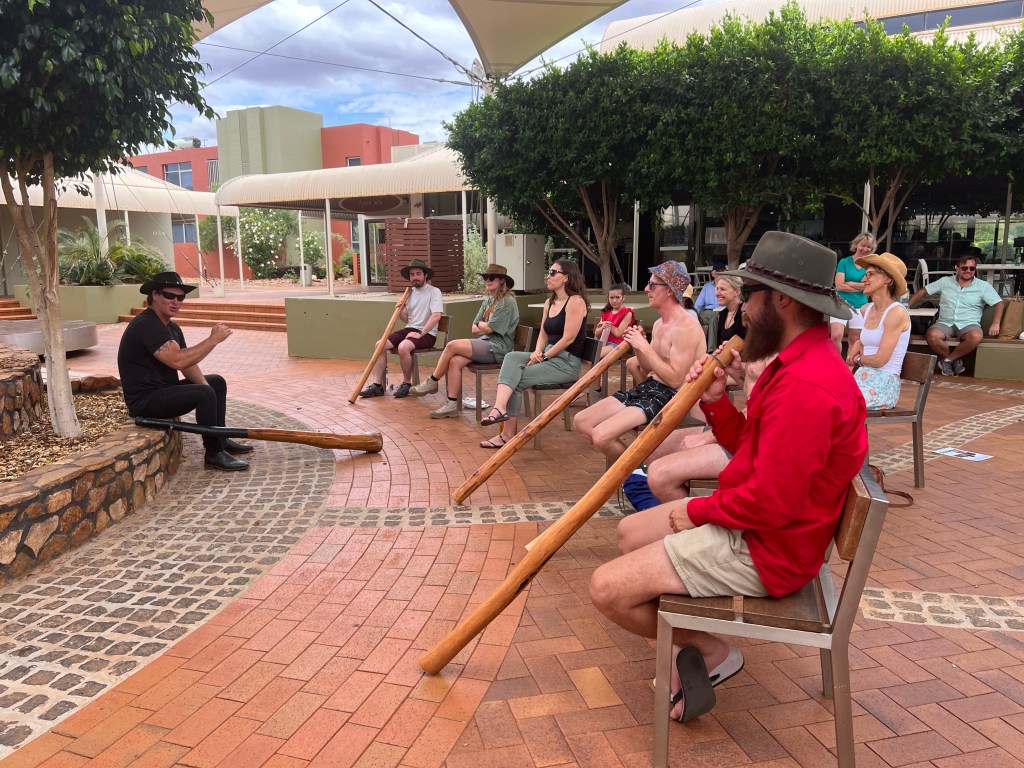
Next it was a didgeridoo workshop. Hysterical! We learnt that these were originally played by women, and then handed over to the men and women no longer play them. Only men were invited to have a lesson and it was clear that it is very much harder than it looks – they made the most hysterical sounds. Didgeridoo is in fact a rhythm of the instrument rather than the name of the instrument itself, which seems to have a number of different names. Our guy simply called it a didge! It is not played here in the Northern Territories by the Aṉangu.
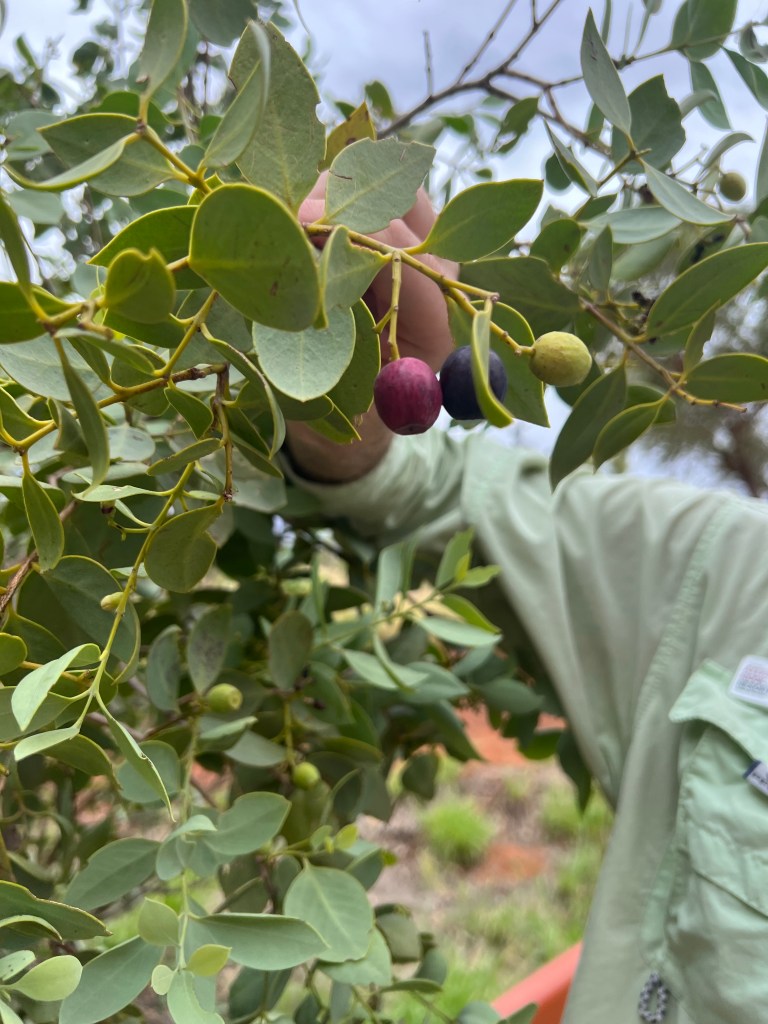
Our final lesson of the morning was about bush food and what the Aṉangu used to live on and to a certain extent still do today. Despite being in the middle of the desert, there is a considerable amount of nutritious food growing; from the native fig and plum, the latter having more anti-oxidants in one olive sized fruit, than a punnet of blueberries and more vitamin C than an orange – though it is apparently pretty disgusting. There is also a native peach (which is a member of the sandalwood family) which can be ground and used as a hair conditioner and endless different grasses and seeds which can be ground up to make pastes and seed cakes. We also heard how they dig deep into the roots of the mulga tree to extract the witchetty grubs – which they either eat raw or cooked. Apparently also pretty filthy but very nutritious!
Exhausted by our mornings education, we went back to the hotel and I confess to a little sleep! Very nice. We had a good dinner in the hotel and attempted to have a bit of an early night.
 EC-Rider Travels
Leave a comment