Today it is Tikal, a name I remember so well from Mum and Dad’s visit here so many years ago when Amanda and I thought it was so funny that it was called ‘tickle’ – nearly as funny as Lake TITicaca!
We headed off pretty early and again drove North East for about an hour. Tikal is in a national park which is heavily monitored, restricting the number of people coming in. It involves many, many people and much paperwork! Your speed is carefully watched with your time recorded as you enter the park and again when you reach your destination (all recorded on paper!) to ensure you are keeping to the speed limit and protecting the wild-life.
On our way, sharp-eyed Hans spotted a roadside-hawk sitting on the roadside! We parked by a small lagoon which had turtles and the most enchanting upright lizards, called basilisk, who scampered across the water on their hind-legs.
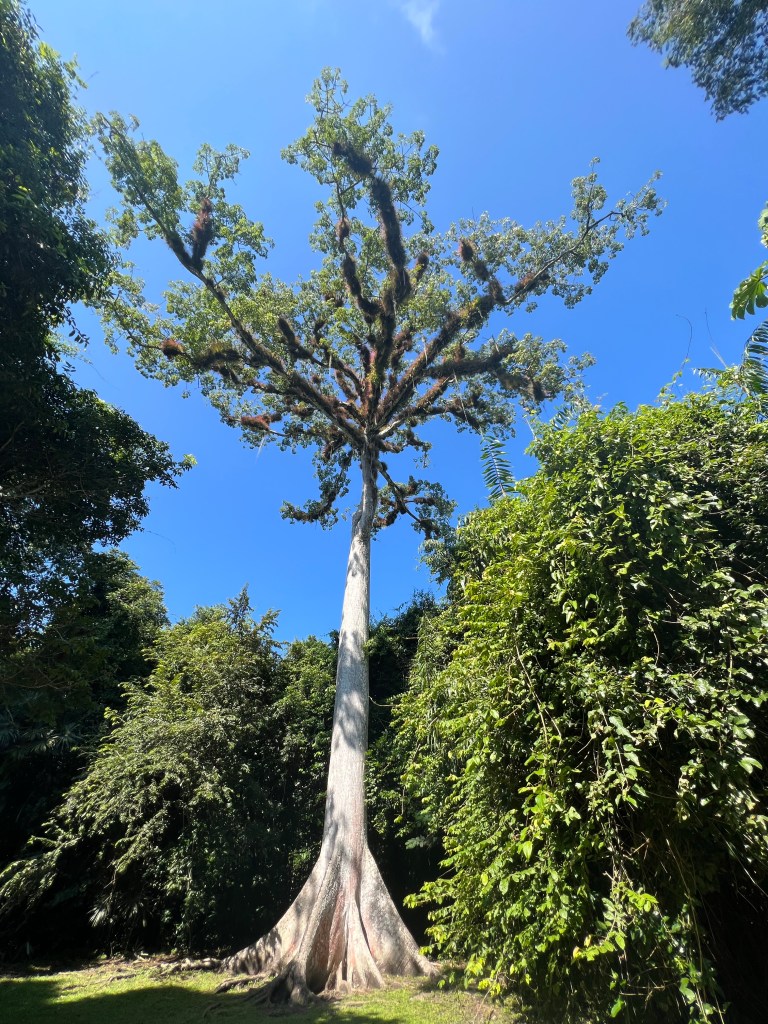
There is a policy of supporting the local community so we met our sweet local guide, who spoke limited English, and I think felt slightly intimidated by perfect English speaking, Fito. We started to walk towards the site, passing the most stunning ceiba tree, the national tree of Guatemala which is considered to be sacred: the roots representing the underworld; the branches, the living world and the canopy reaching up to the heavens. It appeared to have its own ecosystem and was covered with epiphytes – orchids, Spanish moss and bromeliads.
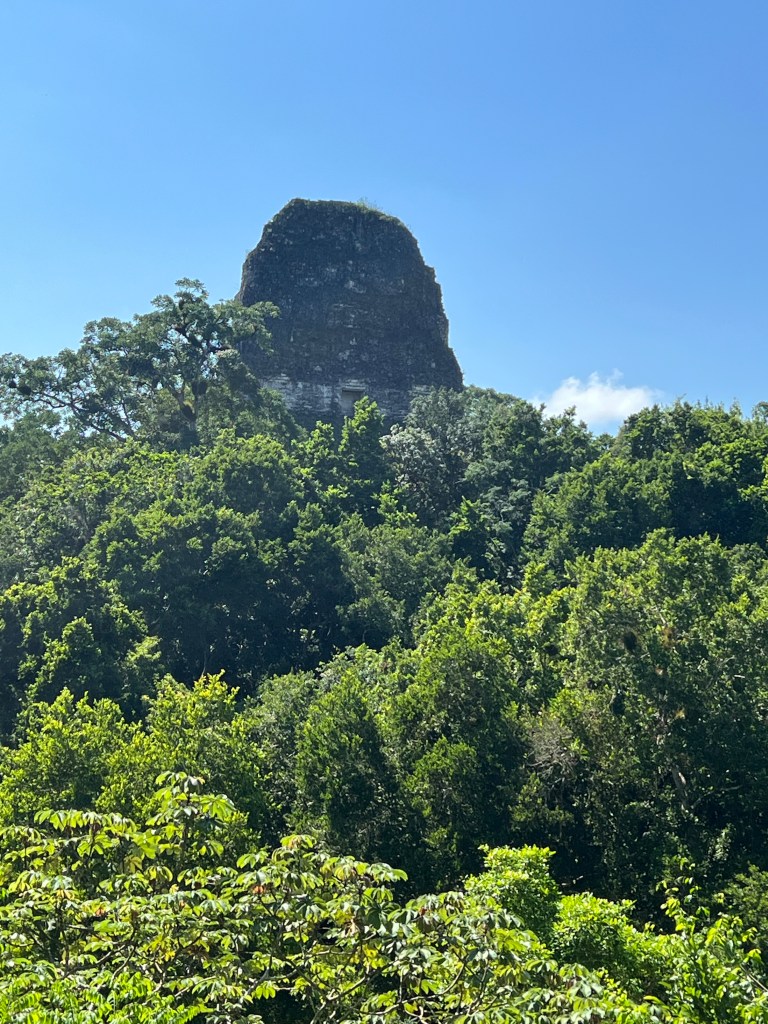
Tikal (or Yax Mutal as it was believed to have been called) is a complex of more than 3,000 Mayan buildings and lies deep in the rainforest. It stretches more than 16 Sq Km and was the capital of one of the most powerful kingdoms of the ancient empire
The first report of Tikal was in 1848 by Modesto Mendz, a Spanish Guatemalan who had been shown the site by native Ambrosio Tut. A report of his findings was eventually published in Germany in 1853. It was not until almost a quarter of a century later, in 1877, that Swiss, Gustav Bernoulli organised an expedition to Tikal to initiate excavation. He was followed by English archeologist, Alfred Maudlslay in 1881/2 but it was not until 1895, when explorer Teobert Maler was commissioned to photograph the site, that it reached world recognition.
Funded by the Carnegie family and the Peabody Museum in Cambridge, Massachusetts (now part of Harvard), Maler lived on site (now known as the Maler Palace) from 1895-1904 and although he captured the first images of the site, he unfortunately caused considerable damage by clearing the site of trees and burning them in the central plazas melting much of the plaster on the temples. The University of Pennsylvania returned in 1957 to carry out the first substantial controlled excavation, building a small village to house the archeologists. They uncovered much of what we see today but they too caused considerable damage to some of the buildings. There are definitely mixed feelings amongst the Guatemalans about the archeologists coming to their precious site.
After about half an hour, on this INESCO world heritage site, we saw Temple I. Built in approximately 732 it is known as Temple of the Jaguar because of a wooden lintel above the entrance into the shrine, depicting the king upon a jaguar throne. Temple I forms part of a complex of two pyramidal temples facing one another, East to West of the Great Plaza. It stands 55m high and rises in nine stepped levels, possibly symbolic of the nine levels of the underworld. A steep staircase rises to the summit shrine where there were four wooden lintels over the doorways. These were carved from Sapodilla wood with intricate designs. Two of the lintels are missing however British explorer, John Boddam-Whetham rescued the other two and they are now in the British Museum.
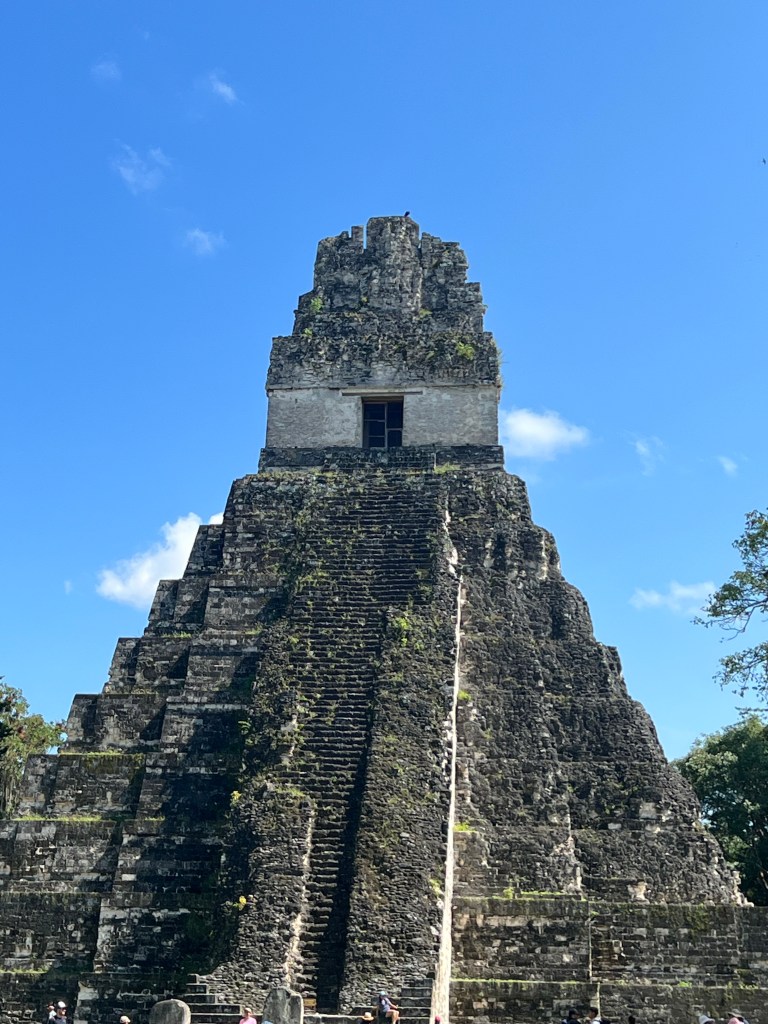
Temple I was a funerary temple for Jasaw Chan K’akill I who ruled from AD 682–734. His tomb was discovered by archaeologists in 1962 in a large vaulted chamber deep within the pyramid, below the level of the Great Plaza. The tomb would have been built first, with the temple raised over it. The king’s remains had been laid on a woven mat and the tomb contained rich offerings of jaguar skins, jadeite, rare shells, pearls and painted ceramics. The king’s body was covered with jade including an enormous necklace weighing almost 4kg.
We then visited the largest of the temples – Temple IV which was built in 741AD and at almost 65m high, is the highest of the temples. It was the funerary temple of the 27th king, Yik’in Chan K’awiil, although his tomb remains undiscovered. The summit shrine faces eastward with Temple III directly in front and Temple I & II beyond. Lottie and I climbed up to the shrine where we had the most incredible view of the city.
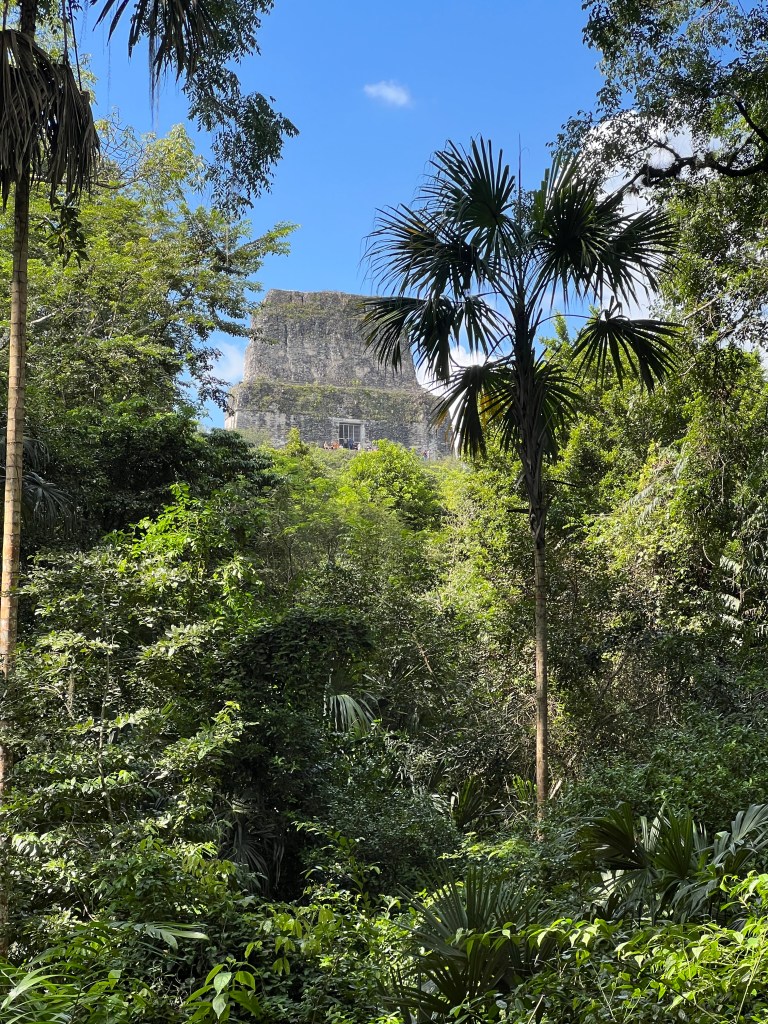
The shrine had three chambers situated one behind the other, each linked by a doorway with a lintel of sapodilla. The lintel of the exterior doorway was plain but the two interior lintels were intricately carved depicting the king seated under the arch of a celestial serpent to mark his victory over the city of El Peru. The carved lintels were removed by Gustav Bernoulli and are now in a museum in Basel, Switzerland.
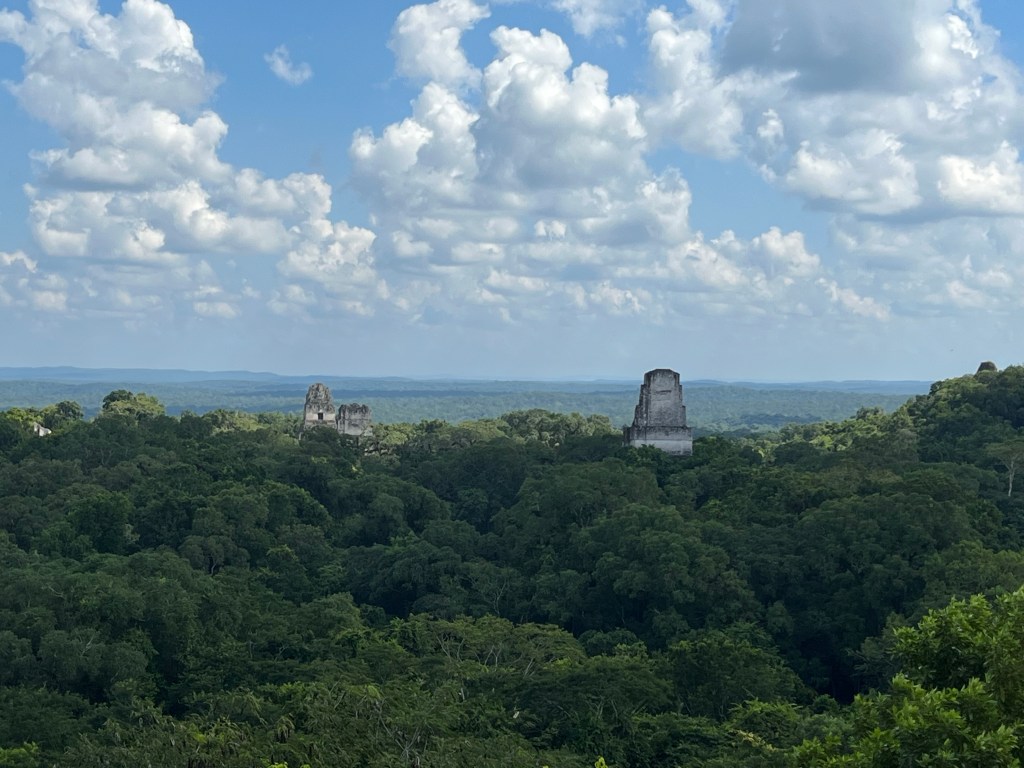
Temples and complexes were built to celebrate the reign of a king or the end of a twenty year cycle. Each temple usually being bigger than the last. As the kingdoms grew, resources and particularly water became scarce. Tikal is a long way from natural water, however they built reservoirs, lined with hydrated lime to make them waterproof, to collect the rainwater. As numbers increased however, this came in short supply together with all other resources including building materials, food etc. Discontent set in and the kingdom started to collapse at the end of the first century.
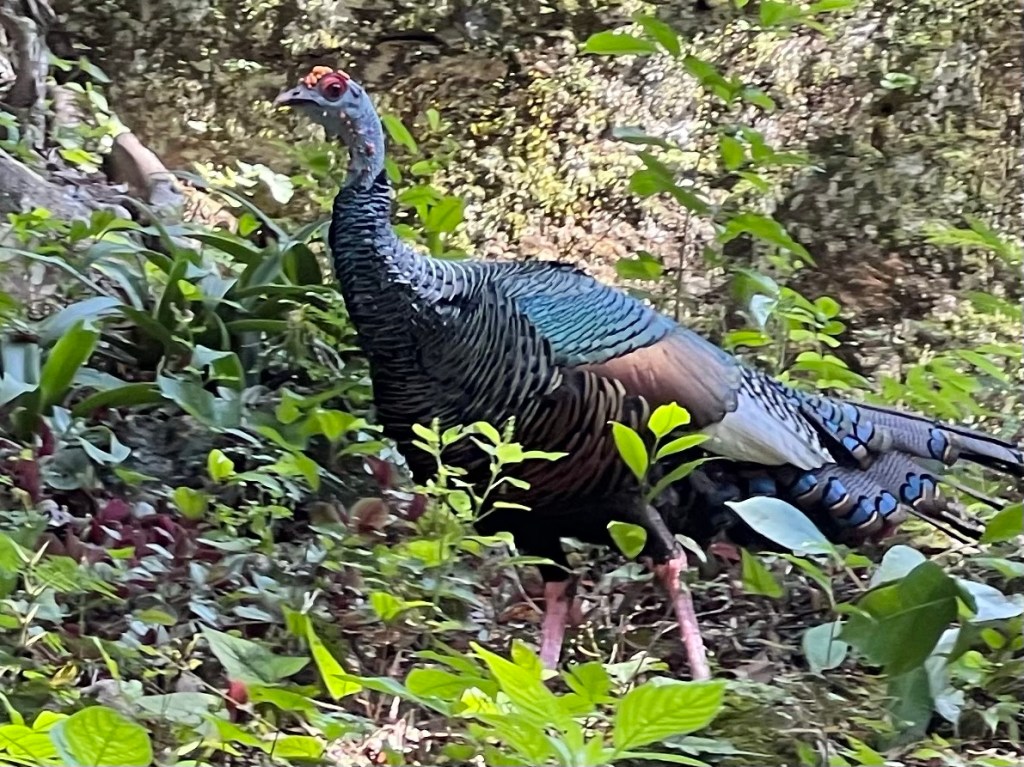
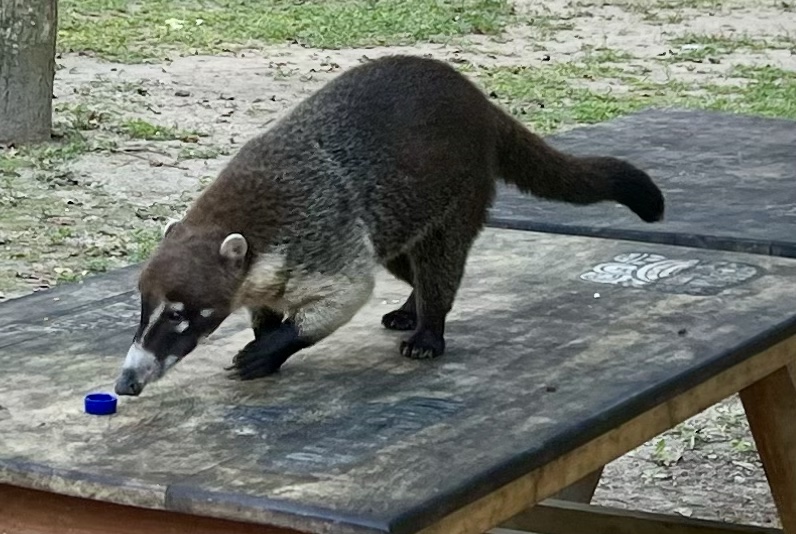
On our journey we saw some pretty special wild-life including a number of spider monkeys, heard lots of howler monkeys and spotted a rare emerald toucanet (which was quite a treat) and also a number of not so rare ocellated turkeys which are endemic to the Yukatan. My friends from yesterday, the coati, are two a penny and have become very bold scavenging around all the picnics – all the same, quite sweet. We also saw a large rodent called an agouti paca which was apparently served to HM The Queen when she visited Belize and became known as the the royal rodent!
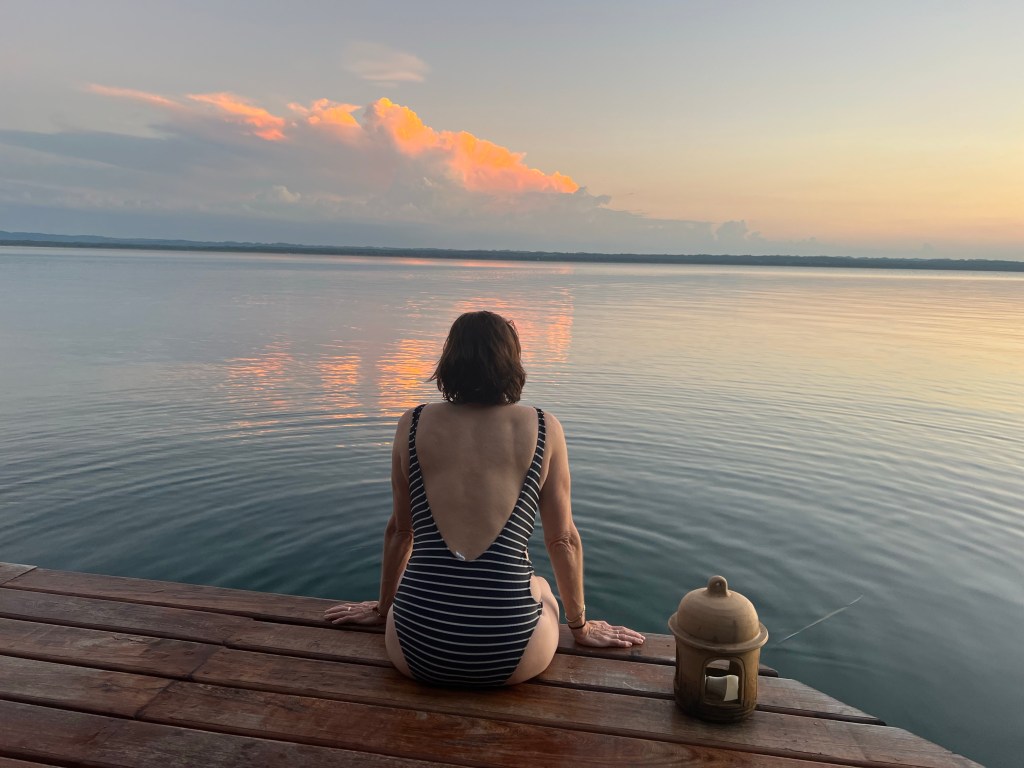
We ended our visit with a late lunch (which we ordered when we walked in!) then headed back to the hotel where we said a very sad farewell to Fito. He really has been the most exceptional guide and we feel rather bereft without him. The only solution was to go for a swim in the lake. This is some way below the hotel and you get there in a hysterical funicular which heads, very slowly, down a very steep track like a roller-coaster. But it was worth the risk …. the lake was like glass and so warm. We swam as the sun went down being watched by a pair of egrets in the tree. Lovely.
 EC-Rider Travels
Leave a comment