
Today has been a travelling day, flying to Brazil’s former capital, Salvador, via Recife, which is about two and a half hours north of Rio, though still only about a sixth of the way up – it is a HUGE country.
In Brazil, you are considered to be very old if you are over 60 (unlike in the UK of course!) and you get preferential treatment wherever you go. Cheaper tickets and special queues, including priority check in and getting on the plane first. If someone thinks you are older than them they let you go in front of them. So despite still being in denial, I graciously agreed to take advantage of this and was mortified how many seriously old people suggested we go in front of them and not one questioned our age…. 👵. The other thing which is rather extraordinary is, when you reach your destination on a Brazilian flight, no one moves from their seat, waiting patiently until instructed to do so! Funnily enough everyone gets off just as quickly.
We were met at the airport by sweet Katia and her friend Marlena (our guide and driver for the next 36 hours). Salvador is the capital city of the state of Bahai. Founded by Portuguese, Tome de Sousa, in 1549, it was the first capital city of colonial Brazil and he was the first Governor General. It is one of the oldest cities in the Americas, sitting on a peninsula separating the Bay of All Saints (the biggest bay in Brazil) and the Atlantic. It was initially a major port for the slave trade and sugar-cane industry and is still a major commercial hub.
As we drove in, it became apparent that Salvador is an even more contrasting city. The outskirts seem hugely developed with state of the art factories and endless car manufacturers and then again areas of extreme poverty. Katia explained that there are no favelas in Salvador but there are many areas of very low-level housing. She explained that the city is divided in two halves – the High City and the Low City – separated by a deep escarpment (85m) and connected by a hydraulic elevator. There is 80km of coastline in the city, with the Low City bordered by beaches of the All Saints Bay, and the High City with beaches on the Atlantic except for Porto Barra Beach on All Saints Bay (voted by the Guardian as the 3rd best in the world!). The Upper City was the administrative, religious and primary residential area while the Lower City was the commercial centre with the port and market. It does not appear much has changed.
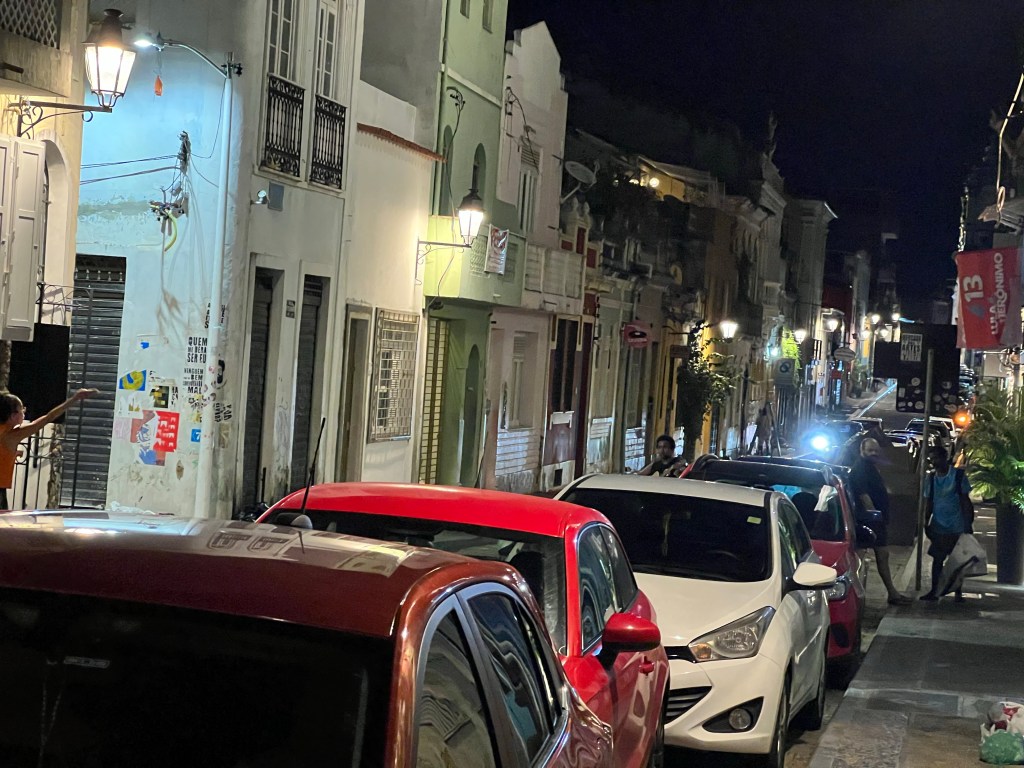
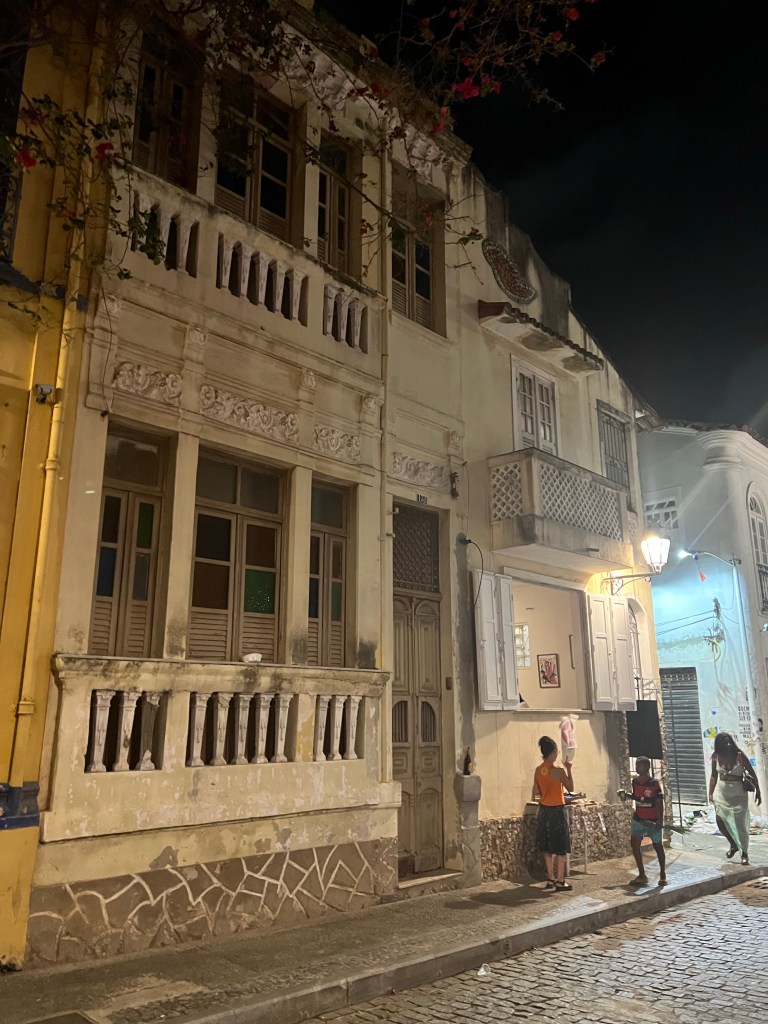
Being a Sunday, restaurants were closing early, so we headed straight to dinner. Katia is a Chef and recommended a lovely restaurant in Pelourinho, the historic centre. This again is a huge contrast, suddenly we were on steep cobbled streets with brightly painted colonial houses with balconies. In 1985 Salvador was recognised as a UNESCO World Heritage Site and in the 90s there was a major municipal project to clean up the centre and turn it into a tourist area. This involved removing thousands of working class residents to the periphery of the city, where they have experienced great hardship away from their work and amenities. Katia explained that since the pandemic a lot of the historic centre has been abandoned and fallen into a tragic state of disrepair.
Salvador hosts one of the world’s biggest carnivals involving over 100,000 people and attracting almost 4 million along 25km of streets. It has a different format to the ones in Rio and São Paulo, with no Samba Schools but huge 60ft long trucks called Trios Electricos carrying dancers and celebrities and surrounded by blocks of dancers and performers. With a heavy Afro/Brazilian culture, Salvador is also renowned for its cuisine and music and has its own style of dance called capoeira, a mix of dance and martial arts of Afro-Brazilian origin.
Although one does not feel it, Katia informed us that Salvador is one of the most crime-ridden cities in Brazil! So we have to be careful and she recommended no jewellery, watch or bag to be worn.
We are staying in a funny little boutique hotel called Zank on a steep hill in the Bohemian, Rio Vermhelho, area. It is again a story of two halves, the front is a pretty colonial house which rather surprisingly leads into a modern block behind where the bedrooms are a little tired, as indeed am I… night night!
 EC-Rider Travels
Leave a comment